


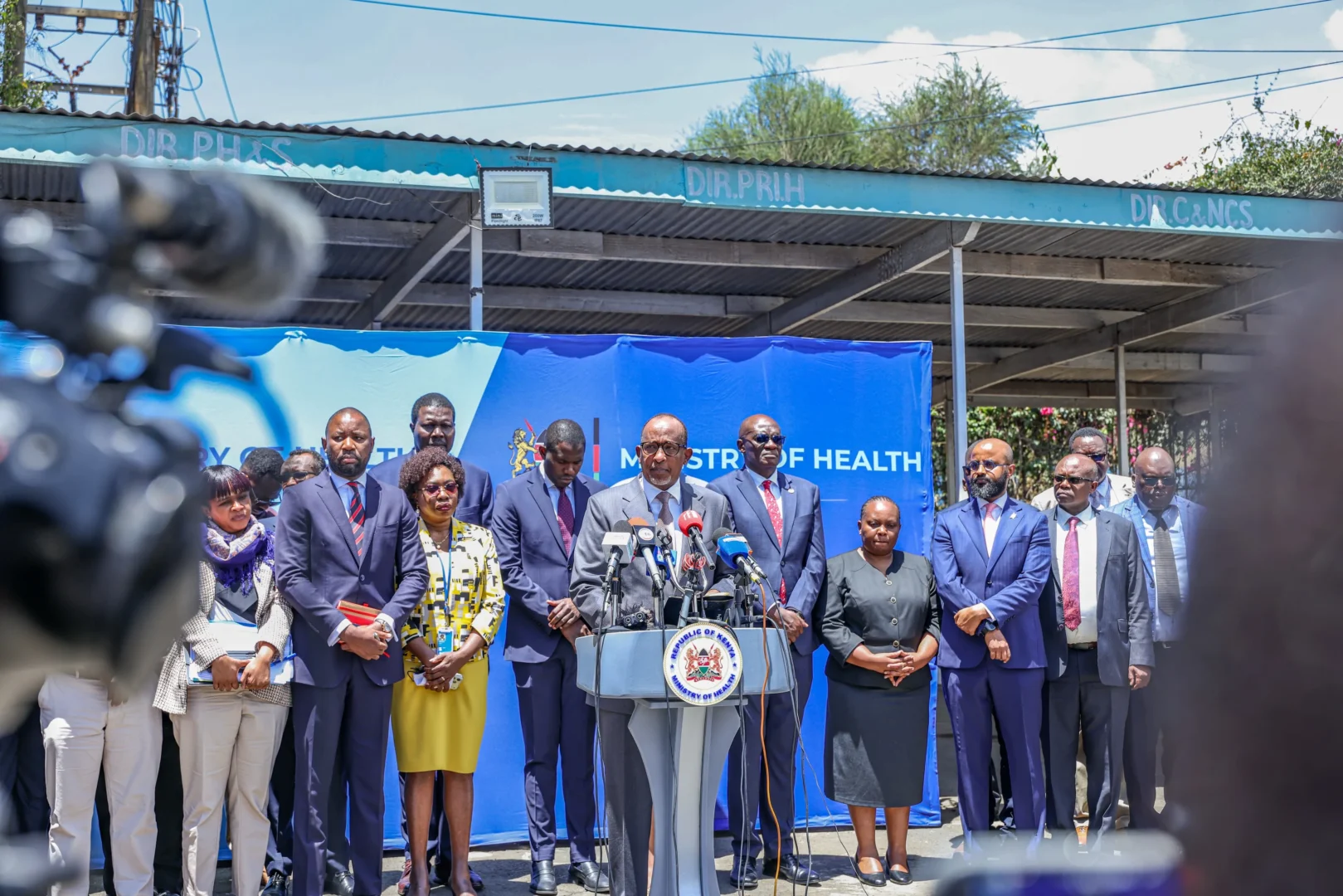
NAIROBI, Kenya — Kenya has formally declared Ebola disease caused by the Bundibugyo virus a formidable epidemic disease under the Public Health Act, introducing a legal framework for surveillance, contact tracing, isolation, quarantine and the safe handling of suspected and confirmed cases.
The declaration, issued by Health Cabinet Secretary Aden Duale through Legal Notice No. 203 in a special Kenya Gazette dated October 12, 2026, invokes Section 35 of the Public Health Act, Cap. 242.
A separate Legal Notice No. 204 sets out the Public Health (Ebola Disease) Rules, 2026, detailing how authorities should detect infections and respond to potential transmission.
“The Ebola (Bundibugyo Virus) Disease is hereby declared to be a formidable epidemic disease,” the declaration states.
The new framework comes less than a week after Kenya confirmed its first imported case of Bundibugyo Ebola in a Kenyan citizen who had been living in the Democratic Republic of Congo (DRC).
The patient travelled through Uganda to Nairobi, tested positive after being assessed at Nairobi Hospital and subsequently died. The Ministry of Health confirmed the case on October 6.
The declaration gives the government a specific legal basis for implementing Ebola control measures. However, the classification itself does not mean Kenya has declared a nationwide Ebola outbreak.
New rules govern screening, isolation and contact tracing
Under the Public Health (Ebola Disease) Rules, 2026, health authorities are required to strengthen surveillance, investigate suspected infections, identify people who may have been exposed and arrange appropriate clinical assessment and care.
The regulations cover screening at airports, seaports, inland ports and land border crossings used by people, vehicles and goods entering or leaving Kenya.
Screening may include health declarations, questions about symptoms and travel history, assessment of possible exposure, observation for signs of illness and temperature checks.
The rules also distinguish between isolation and quarantine. Isolation involves separating a suspected or confirmed case from other people to prevent transmission, while quarantine restricts the activities or movement of someone who may have been exposed.
Contacts placed under quarantine are to be monitored daily for symptoms for 21 days after their last relevant exposure. The rules also require restrictions to be reviewed and adjusted when the circumstances that justified them change.
Contact tracing covers people who may have encountered an infected or suspected case, their blood or other body fluids, or contaminated animals, objects and surfaces.
The framework provides for identifying, listing, assessing and following up with contacts to detect possible illness and interrupt transmission.
The regulations also establish procedures for reporting suspected cases and deaths, investigating possible infections, referring patients for medical care and decontaminating affected premises, equipment and conveyances.
Health workers and the public required to report suspected cases
The rules require suspected or confirmed Ebola cases to be reported promptly to the relevant medical officers of health. Healthcare professionals, health facilities and laboratories also have reporting obligations under the new framework.
Members of the public who know or have reasonable grounds to suspect that someone has Ebola, or has died from the disease, are required to notify the relevant authorities through available reporting channels.
Medical officers of health may investigate suspected cases, arrange assessments of potentially exposed people and order isolation or quarantine where legally justified. The regulations also permit them to seek assistance from the National Police Service to enforce lawful orders.
Failure without reasonable excuse to comply with lawful requirements on screening, reporting, contact tracing, isolation, quarantine, decontamination or safe burial constitutes an offence under the rules, with penalties prescribed under Section 164 of the Public Health Act.
The regulations also restrict Ebola testing to the national reference laboratory or other facilities designated by the Health Cabinet Secretary. Laboratories not authorised to conduct the tests must refer specimens to an approved facility.
The rules provide safeguards for people subjected to compulsory restrictions, including access to appropriate medical care, food, water and essential assistance.
They also state that a person should not face restrictions solely because they have arrived from an Ebola-affected country without an assessment of possible exposure.
New safeguards for handling Ebola deaths
The regulations establish procedures for the safe and dignified handling, transportation and disposal of bodies of people who die from suspected or confirmed Ebola.
Only trained personnel wearing appropriate protective equipment may handle the bodies under the prescribed precautions.
The rules prohibit washing, embalming and dressing bodies for funerals where these practices would breach the Ebola-specific safeguards.
Families must be consulted and allowed to observe religious and cultural practices where these do not conflict with infection-prevention requirements. The rules also prohibit transferring or repatriating Ebola victims’ bodies outside Kenya.
The framework defines a confirmed case as a living or deceased person whose infection has been established through a designated laboratory diagnostic test.
A suspected case is someone whom a medical officer of health or medical practitioner has reasonable grounds to suspect has Ebola, based on clinical signs, circumstances of death or epidemiological information.
The regulations cover diseases caused by viruses in the genus Orthoebolavirus, including Ebola virus, Sudan virus, Bundibugyo virus and Taï Forest virus.
Declaration follows Kenya’s first imported case
Kenya’s first confirmed Bundibugyo Ebola case triggered intensified surveillance and contact tracing after the patient travelled from the DRC through Uganda and arrived in Nairobi on October 3, 2026.
The Health Ministry said the patient had developed symptoms while in the DRC, received treatment at several facilities there and was later taken to Nairobi Hospital, where he was isolated and assessed.
Samples were independently confirmed by the National Virology Reference Laboratory and the Kenya Medical Research Institute.
Also Read: Kenya accounts for All 122 Ebola contacts as 108 remain in quarantine
In an update on October 11, Duale said all 122 contacts linked to the case had been identified and verified, with 108, or 88.5 per cent, in quarantine and undergoing daily monitoring. None had developed symptoms at the time of the update.
The regulations designate the Kenya National Public Health Institute as the lead national technical institution responsible for coordinating prevention, preparedness, response and recovery activities relating to Ebola.
The rules are subject to review at intervals not exceeding three months and are due to expire 12 months after commencement unless revoked earlier
The new legal framework strengthens the powers and obligations of public health authorities as Kenya seeks to contain the risk of further transmission following the imported case.
