


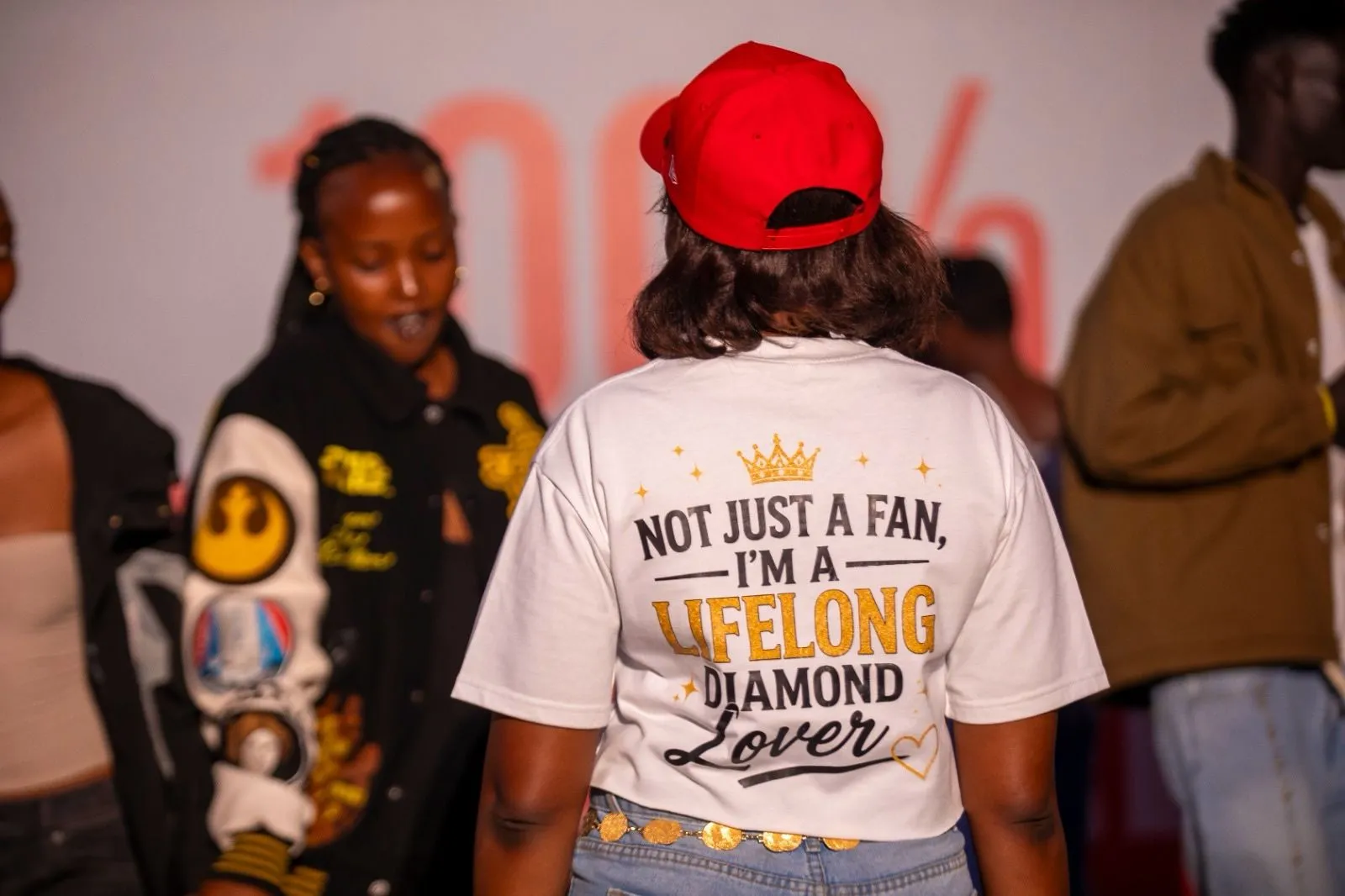
KIGALI, Rwanda — Rwanda’s increasingly strict campaign on public decency has ignited a debate over personal freedom, cultural values and the limits of police authority after women were reportedly stopped from entering a Diamond Platnumz concert in Kigali because of their clothing.
The controversy emerged during the Diamond Platnumz Experience at the BK Arena parking lot on Saturday, August 29, where thousands of fans gathered to watch the Tanzanian Bongo Flava star perform alongside Rwandan artistes including Bruce Melodie, Ish Kevin and Nel Ngabo.
Reports from the event indicated that security personnel were checking the clothing of people arriving at the venue, with some women reportedly turned away because their outfits were considered too revealing.
Rwandan outlet Rebero reported that women wearing very short clothes were denied entry and that security personnel at the gates were checking attendees for compliance with the dress requirements imposed for the event.
The incident has since prompted a broader argument over whether Rwanda’s public-decency regulations are being applied clearly and proportionately — and whether enforcement should extend to regulating how adults dress at entertainment events.
Questions over police powers
One concertgoer alleged that police officers threatened to detain her and physically assault her after confronting her about her clothing.
She further alleged that officers criticised her limited command of Kinyarwanda and that a male friend who attempted to intervene was beaten.
The allegations could not be independently verified, and no public response from the Rwanda National Police specifically addressing the account had been identified by the time of publication.
The distinction is important because being refused entry to an event under a venue’s dress policy is different from being subjected to unlawful arrest, assault or degrading treatment.
The controversy has nevertheless raised questions about whether attendees were adequately informed of the dress requirements before arriving and who ultimately had the authority to determine what constituted unacceptable clothing.
Rwandan commentator Nadia Mugunga questioned the basis for such enforcement, asking whether policing personal appearance amounted to intimidation.
Another commentator, Pamela Uwicyeza, criticised what she described as the treatment of women over their clothing, arguing that personal modesty should not become a justification for humiliation or violence.
A wider debate about culture and modernity
The dispute has unfolded against a much wider national conversation about changing social norms, particularly among Rwanda’s younger population.
Minister of State for Youth and Arts Sandrine Umutoni has argued that the debate should go beyond the question of whether women are wearing too little.
Umutoni has challenged young Rwandans to examine the commercial and cultural forces shaping fashion, advertising, music and social media, particularly the way femininity can be linked to displaying the body.
She has also cautioned against turning the debate into an argument that women’s bodies are inherently provocative.
At the same time, Umutoni has argued that Rwanda can embrace modern fashion without abandoning its cultural identity.
She has encouraged the country’s fashion industry to draw inspiration from local fabrics, craftsmanship and aesthetics while remaining open to international influences.
Her position reflects a broader tension confronting Rwanda: how to preserve cultural values while a younger, increasingly connected population absorbs influences from across Africa and the wider world.
Rwanda already criminalises public indecency
The controversy also raises questions about the country’s legal framework.
Rwanda National Police has previously warned the public against nudity and public indecency, saying such conduct can result in arrest and prosecution. In a 2022 advisory, the police cited the country’s law determining offences and penalties and warned that people engaging in public indecency could face legal consequences.
The legal framework, however, does not amount to a simple statutory list of prohibited clothing.
That leaves an important distinction between an offence defined by law and an event organiser’s own dress requirements.
For the Diamond concert, reports indicate that security personnel were enforcing clothing requirements at the entrance. That does not, by itself, establish that every person turned away had committed a criminal offence.
Nor does the existence of public-decency laws automatically authorise officers to use arbitrary force against people whose clothing they consider inappropriate.
Any allegation of assault or unlawful detention would therefore require a separate investigation.
The government’s wider campaign
The dress-code controversy comes as President Paul Kagame’s government intensifies its campaign against what it considers harmful social behaviour, particularly excessive alcohol consumption.
Kagame has repeatedly warned young Rwandans about the dangers of alcohol abuse.
Addressing participants in the Indangamirwa civic education programme in July, the President described excessive drinking as a growing problem and referred to what he called a “religion of alcohol”.
He warned that alcohol consumption could undermine young people’s health, ambitions and ability to contribute to Rwanda’s development.
The campaign has coincided with increased scrutiny of entertainment venues and alcohol-related businesses.
Rwanda’s police leadership has also warned that authorities would monitor conduct at entertainment venues, private parties and on social-media platforms.
The approach has attracted support from people who believe stronger enforcement is necessary to protect young people and maintain Rwanda’s social values.
But critics argue that regulations must be clearly defined and consistently applied, particularly where enforcement involves police powers.
The concert itself
The controversy unfolded during one of Kigali’s biggest entertainment events of the year.
Diamond returned to Kigali for the first major show there in almost three years, performing at the BK Arena parking lot as part of his ongoing tour.
The event featured a regional line-up including Bruce Melodie, Ish Kevin, Nel Ngabo, Uganda’s Etania and DJ Marnaud. Thousands of people attended.
Also Read: Ugandan MPs push for stricter dress code in parliament
The concert was also subject to Rwanda’s regulations governing entertainment venues. The performance was eventually cut short shortly after 2am when authorities enforced the country’s closing-time rules for entertainment establishments.
That provided another illustration of Rwanda’s tightly regulated entertainment sector, where organisers and venue operators are expected to comply with rules governing public conduct and operating hours.
Where does the line fall?
The debate over what happened at the Diamond concert is unlikely to end with the event.
At its centre is a difficult question: where should the line be drawn between enforcing public standards and controlling private behaviour?
Supporters of stricter rules argue that public spaces and entertainment venues should reflect Rwanda’s cultural values and that organisers and authorities have a responsibility to protect young people from behaviour considered harmful or inappropriate.
Critics counter that adults should have significant freedom over their appearance and that any restriction must be based on clear rules rather than subjective judgments by individual officers.
There is also a separate question of accountability.
Even where authorities have legitimate grounds to enforce a law or venue rule, enforcement must remain lawful and proportionate. Allegations of physical assault, threats or discriminatory treatment cannot simply be justified by invoking public decency.
For Rwanda, the challenge will be to maintain its emphasis on social order and cultural identity while ensuring that enforcement is transparent, predictable and respectful of individual rights.
The Diamond Platnumz concert has therefore become more than a dispute about what people wore to a music show.
It has opened a wider conversation about how far the state should go in regulating personal behaviour — and who gets to decide where cultural values end and individual freedom begins.
