


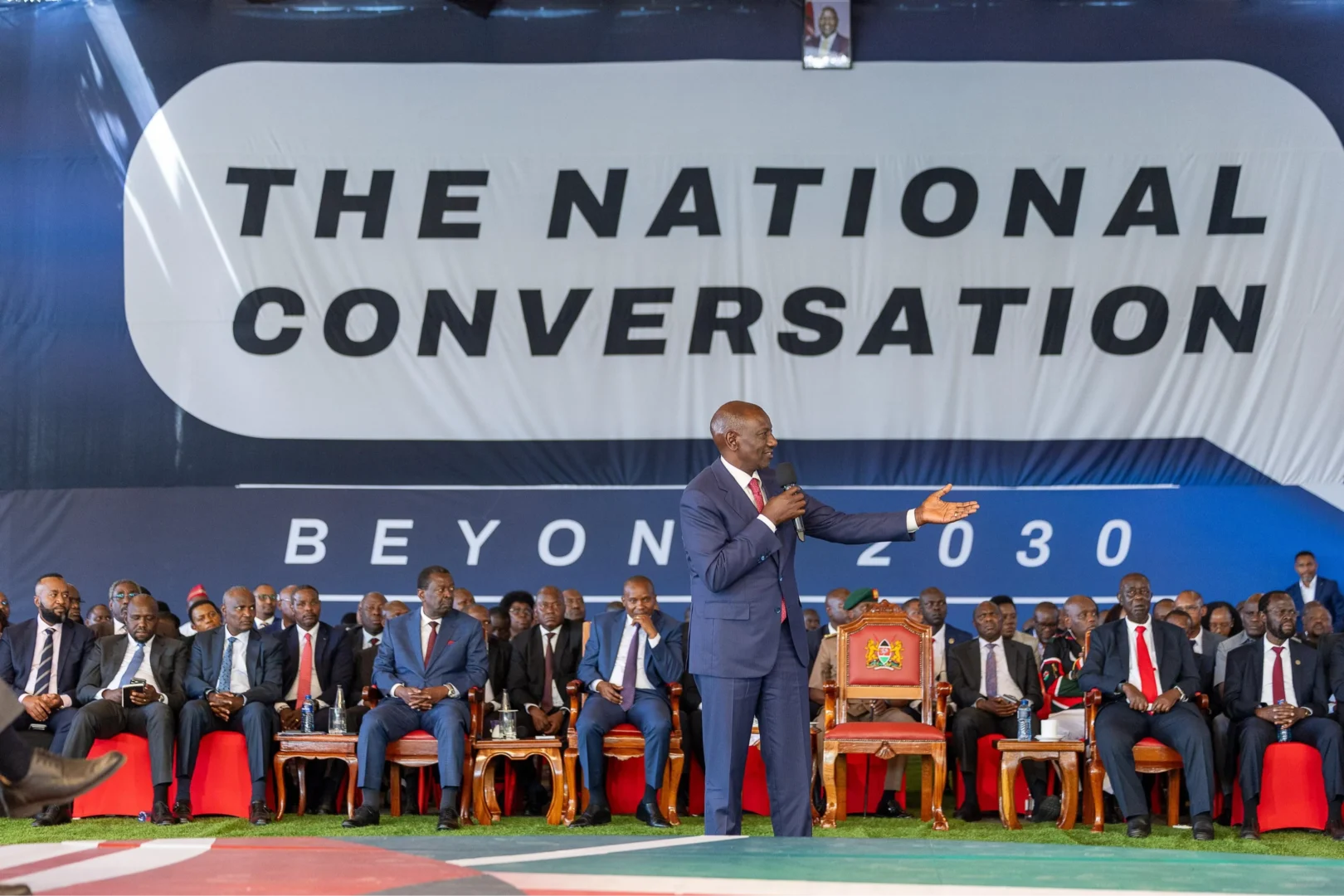
NAIROBI, Kenya — President William Ruto has launched a nationwide conversation on Kenya’s development beyond Vision 2030, urging citizens to help shape a long-term economic blueprint that he says should transform the country into a wealthy, industrialised and globally competitive economy by 2060.
The conversation formally opened on Wednesday, August 12, 2026, at the Kenyatta International Convention Centre (KICC) in Nairobi, bringing together more than 5,000 delegates drawn from all 47 counties as the government began gathering views on what should replace Vision 2030.
The event was framed not as the unveiling of a finished policy document, but as the beginning of a nationwide consultation intended to determine Kenya’s priorities beyond 2030.
Ruto said the process must be owned by Kenyans rather than successive governments or bureaucrats, arguing that the country’s next development blueprint should survive political transitions and election cycles.
“Beyond 2030 is our collective responsibility.”
The President said Kenya could no longer plan for the future using assumptions developed for a different era, pointing to rapid advances in technology and artificial intelligence, climate change and changing global economic conditions.
Why Kenya is looking beyond Vision 2030
Vision 2030 was launched in 2008 by the late President Mwai Kibaki with the ambition of transforming Kenya into a newly industrialising, middle-income country offering citizens a high quality of life in a clean and secure environment.
Its final five-year implementation phase is now approaching its conclusion. The government says the country therefore needs a new framework capable of guiding development over a much longer period.
Ruto argued that the circumstances under which Vision 2030 was developed have changed fundamentally.
He pointed to the emergence of artificial intelligence, rapid technological change and climate-related disruptions as among the forces reshaping the global economy.
He also argued that the 2010 Constitution created a stronger framework for public participation than existed when Vision 2030 was formulated.
According to the President, inadequate public participation partly explains why some Kenyans have struggled to identify with Vision 2030.
This time, he said, citizens must be involved from the beginning.
“We have an opportunity … to formulate a long-term plan, one that is done by the people, not by government, not by bureaucrats, by the people themselves.”
Ruto’s election warning
One of the strongest political messages from the KICC forum was Ruto’s call for Kenya to stop allowing election cycles to dictate national development planning.
The President argued that governments frequently postpone difficult decisions because of concerns about how they might affect the next election.
“Kenya is bigger than any election,” Ruto said, warning against treating elections as matters of life and death.
He said the country had too often planned around the next electoral contest instead of the next generation.
The argument is central to the government’s case for Vision 2060: infrastructure, education, industrialisation, climate resilience and economic transformation require policies that remain in place long after individual political administrations leave office.
But it also gives the initiative a distinctly political dimension, coming less than a year before the 2027 General Election.
The government insists the proposed vision is not intended to serve one administration.
Treasury Cabinet Secretary John Mbadi made the same point before the KICC meeting, saying Ruto could only remain in office for a limited period while the proposed vision would run until 2060.
The ambition: A first-world Kenya
The economic ambition discussed at KICC is substantial.
Government officials and advisers have presented Vision 2060 as a framework for moving Kenya towards high-income, industrialised and globally competitive status.
The vision’s intellectual foundation includes work by Kisumu Governor Prof Peter Anyang’ Nyong’o and economist Prof Hiroyuki Hino, whose work has informed the emerging post-2030 development debate.
Hino has drawn comparisons between Kenya and countries such as Singapore, arguing that Kenya’s human capital could become a much stronger engine of economic transformation if properly harnessed.
The Singapore comparison became one of the recurring themes of the day’s discussions.
ODM leader Oburu Oginga said Kenya could achieve a similar transformation if it seriously confronted corruption, waste and weak institutions.
The comparison, however, also highlights the scale of the challenge. Singapore’s transformation was built over decades around strong institutions, human-capital development, infrastructure, technology and a business environment capable of attracting investment.
Agriculture, manufacturing and technology at the centre
The emerging economic conversation places considerable emphasis on sectors capable of generating jobs and raising productivity.
Agriculture remains central because of its importance to household incomes, food security and exports.
Deputy President Kithure Kindiki pointed to agricultural value chains, farmer registration and reforms in sectors including coffee and maize as areas that could support the country’s longer-term economic transformation.
Manufacturing and technology and innovation are also expected to form major components of the post-2030 agenda.
The challenge is to move beyond simply producing more raw materials and instead build industries capable of processing agricultural products, creating skilled employment and competing in international markets.
That ambition is consistent with the broader logic of Kenya’s existing development strategy, which has placed value addition, exports, manufacturing and productivity at the centre of economic transformation.
Human capital emerges as another priority
The discussions also placed education, skills and healthcare at the centre of Kenya’s long-term ambitions.
Kindiki cited increases in education funding, university financing, scholarships, teacher recruitment and classroom construction as evidence of progress that the government wants incorporated into the country’s longer-term development trajectory.
He said education funding had risen from KSh500 billion to KSh784 billion, while university funding increased from KSh42 billion to KSh82 billion.
He also cited the recruitment of 100,000 teachers and construction of 23,000 classrooms.
Healthcare was similarly highlighted, with Kindiki saying medical insurance coverage had expanded from about eight million people under NHIF to 32.2 million.
The figures form part of the government’s case that Vision 2060 should build on existing interventions rather than discard them with every change of administration.
Population could become an economic asset — or burden
National Assembly Majority Leader Kimani Ichung’wah introduced another long-term issue into the conversation: Kenya’s population.
He warned that population growth could either become a major economic asset or place increasing pressure on national resources, depending on whether economic growth keeps pace.
“Population is both a resource but can also be a burden to our nation’s economy.”
He argued that Kenya must balance population growth with economic expansion, employment creation, infrastructure and public services.
That question becomes increasingly important over a 34-year horizon, particularly as Kenya’s population ages and demand for education, housing, healthcare, transport and employment changes.
Parliament, Ichung’wah said, should support wider consultations, including through specialised committees that could travel across the country to gather views.
A seven-year-old offered a glimpse of 2060
Perhaps the most striking moment of the day came not from a senior politician or economist but from a seven-year-old.
Adrian Gweth Ombuni captured attention at KICC when he spoke about the Kenya he wants to see in 2060 — a country with good schools, clean water and jobs for young people.
His appearance gave a human dimension to an otherwise highly technical debate.
For the generation represented by Adrian, 2060 is not an abstract political horizon. It is much of their adult lifetime.
That is also the central argument behind the government’s insistence that the debate should look beyond the 2027 election.
The unresolved question: What happened to Vision 2030?
The launch also raises a difficult question that the new vision will have to confront: Why did Kenya not achieve all the objectives of Vision 2030?
The existing blueprint targeted a newly industrialising middle-income economy, but many of its ambitions remain incomplete.
The government’s own development framework acknowledges unfinished objectives, while the Fourth Medium Term Plan describes the 2023-2027 period as the final medium-term phase before transition to the next long-term development plan.
That means Vision 2060 cannot simply become another list of ambitious targets.
Its credibility will depend on whether it establishes measurable targets, clear implementation responsibilities, reliable financing and mechanisms for holding successive governments accountable.
That question was implicit throughout Wednesday’s discussions.
From KICC to all 47 counties
The KICC meeting is only the beginning.
The government says the conversation will now move across Kenya’s 47 counties, where citizens, businesses, professional organisations, religious groups, young people, civil society, academia and other stakeholders will submit their proposals.
The views will be consolidated into the proposed Vision 2060 framework before it proceeds through the required approval process.
The government has also indicated that the eventual development charter is expected to be anchored in law, giving future administrations a formal framework to follow.
Ruto pledged that government resources would be made available to ensure the process remains citizen-driven.
The political test begins now
The biggest challenge facing Vision 2060 may not be writing the document.
It will be building public confidence that the document can outlive politics.
The initiative has already attracted criticism from opposition figures who question the timing of a 30-plus-year development conversation while Kenya continues to face immediate concerns around the cost of living, unemployment, public debt, governance and security. Citizen Digital reported that critics have questioned the early launch and its relevance against current economic pressures.
Also Read: Ruto to lead national dialogue on Kenya’s proposed Vision 2060 plan
The government, meanwhile, argues that precisely these long-running problems demonstrate why Kenya needs a framework extending beyond individual political terms.
That tension is likely to follow the conversation as it moves from KICC to the counties.
What Wednesday’s KICC meeting really achieved
Wednesday’s meeting did not complete Vision 2060. It opened the national process for deciding what Kenya’s post-2030 development agenda should look like.
The emerging consensus is broad: Kenya wants stronger institutions, better human capital, higher productivity, industrialisation, technological competitiveness, agricultural transformation and an economy capable of creating opportunities for a growing population.
But the harder questions are still ahead.
How will Kenya finance the transformation? Who will be held accountable when targets are missed? How will the country protect the plan from political interference? And what lessons from Vision 2030 will actually be carried forward?
Those questions will matter more than the speeches at KICC.
If the process succeeds, Vision 2060 could become a development framework capable of surviving several presidential administrations.
If it does not, it risks becoming another ambitious national blueprint whose targets sound impressive when launched but become increasingly distant from the daily realities of Kenyans.
For now, the conversation has begun.
And the next stage — taking that conversation from Nairobi to the rest of the country — will determine whether Vision 2060 becomes a government plan or genuinely Kenya’s long-term national project.
