


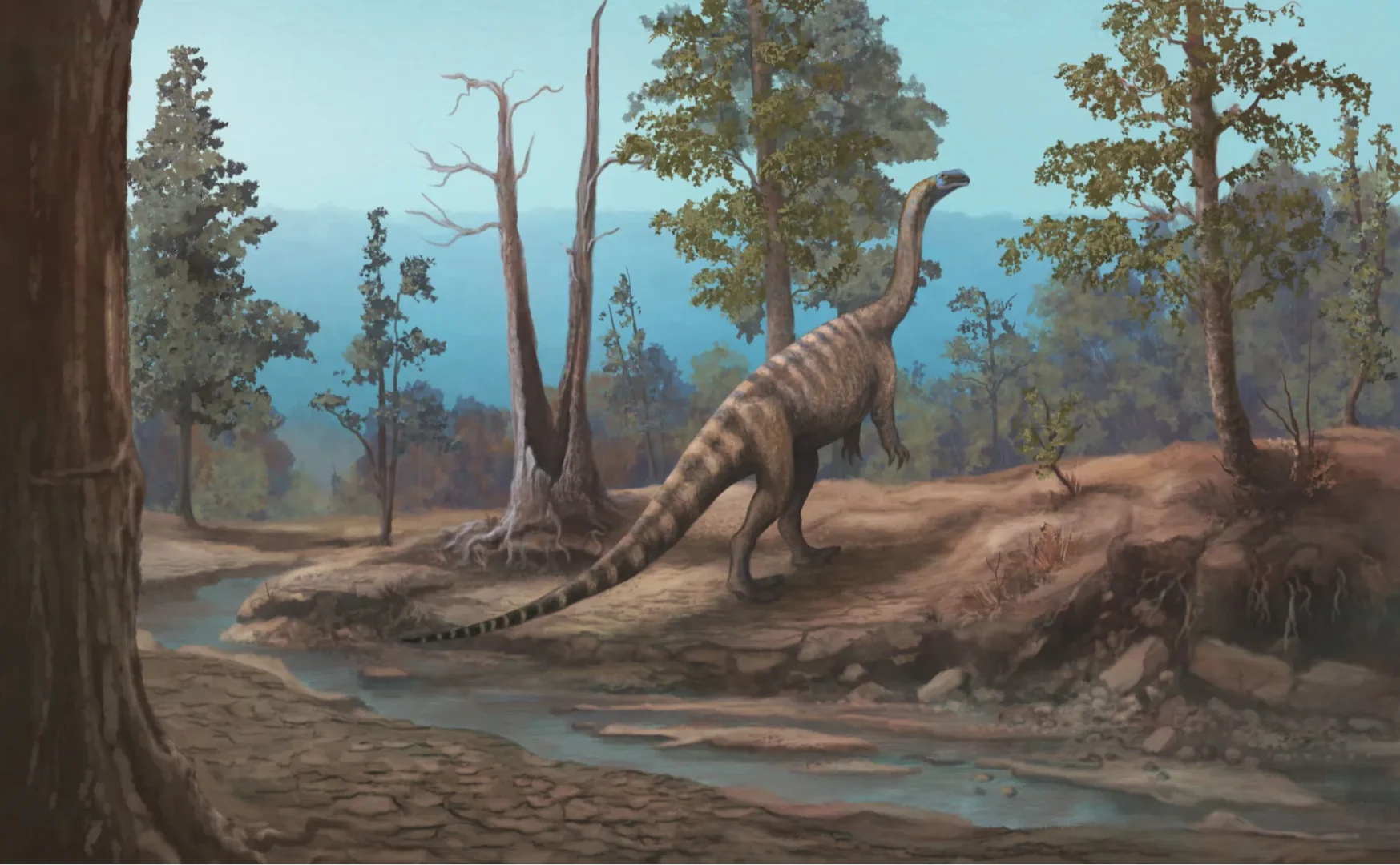
HARARE, Zimbabwe — A newly identified dinosaur species discovered in Zimbabwe is offering scientists fresh insight into the remarkable diversity of prehistoric life that once thrived across southern Africa more than 200 million years ago.
The dinosaur, named Musango matusadonaensis, is the fifth dinosaur species ever formally named from Zimbabwe and lived approximately 210 million years ago during the Late Triassic Period, a crucial chapter in Earth’s history when dinosaurs were beginning to spread across the planet.
The fossil was unearthed along the shores of Lake Kariba in northern Zimbabwe through an international collaboration involving researchers from Zimbabwe, South Africa and the United Kingdom.
The findings, published in the Journal of Systematic Palaeontology, challenge long-held assumptions that dinosaur populations across southern Africa were largely uniform.
Instead, researchers now believe the region contained several distinct prehistoric ecosystems, each supporting different dinosaur communities.
During the Late Triassic, Zimbabwe formed part of the ancient supercontinent Gondwana, which also included present-day South America, Australia, Antarctica, India and Africa.
Although Europe and North America have yielded thousands of dinosaur fossils over the decades, much of Africa’s prehistoric record remains comparatively underexplored.
Scientists say discoveries such as Musango matusadonaensis are helping fill critical gaps in understanding how dinosaurs evolved across the southern hemisphere.
Musango belonged to a group known as sauropodomorphs—early ancestors of the giant, long-necked dinosaurs such as Diplodocus that later dominated the Jurassic Period.
Unlike their enormous descendants, however, Musango moved primarily on two legs.
Researchers recovered several important fossilised bones, including parts of the spine, arms and feet, allowing them to reconstruct much of the animal’s anatomy.
Analysis suggests the dinosaur measured about 4.5 metres in length—roughly the size of a medium-sized family car—and was nearly fully grown when it died.
Scientists estimate it was around eight years old.
Researchers believe Musango was an omnivore, feeding on both plants and animals.
Its diet may have included crocodile-like phytosaurs, lungfish and smaller dinosaurs that shared its environment alongside vegetation.
The discovery provides scientists with valuable information about food chains and ecological relationships that existed during one of the most transformative periods in dinosaur evolution.
Professor Paul Barrett, a palaeontologist at the Natural History Museum in London and lead author of the study, said the discovery changes how scientists view prehistoric southern Africa.
Also Read: Over 120 endangered vultures killed in South Africa poisoning incident
“Until recently, it was assumed that the dinosaurs living across southern Africa were largely the same,” Barrett explained.
“However, these discoveries are showing that this part of the ancient supercontinent Gondwana was actually made of a series of smaller ecosystems – each with a different cast of characters.”
Researchers say the discovery reinforces the growing importance of African fossil sites in understanding the early evolution of dinosaurs and highlights the need for continued palaeontological exploration across the continent.
As more fossils emerge from previously understudied regions, scientists expect Africa to play an increasingly significant role in reconstructing the origins and diversification of the dinosaurs that would later dominate Earth for more than 160 million years.
