


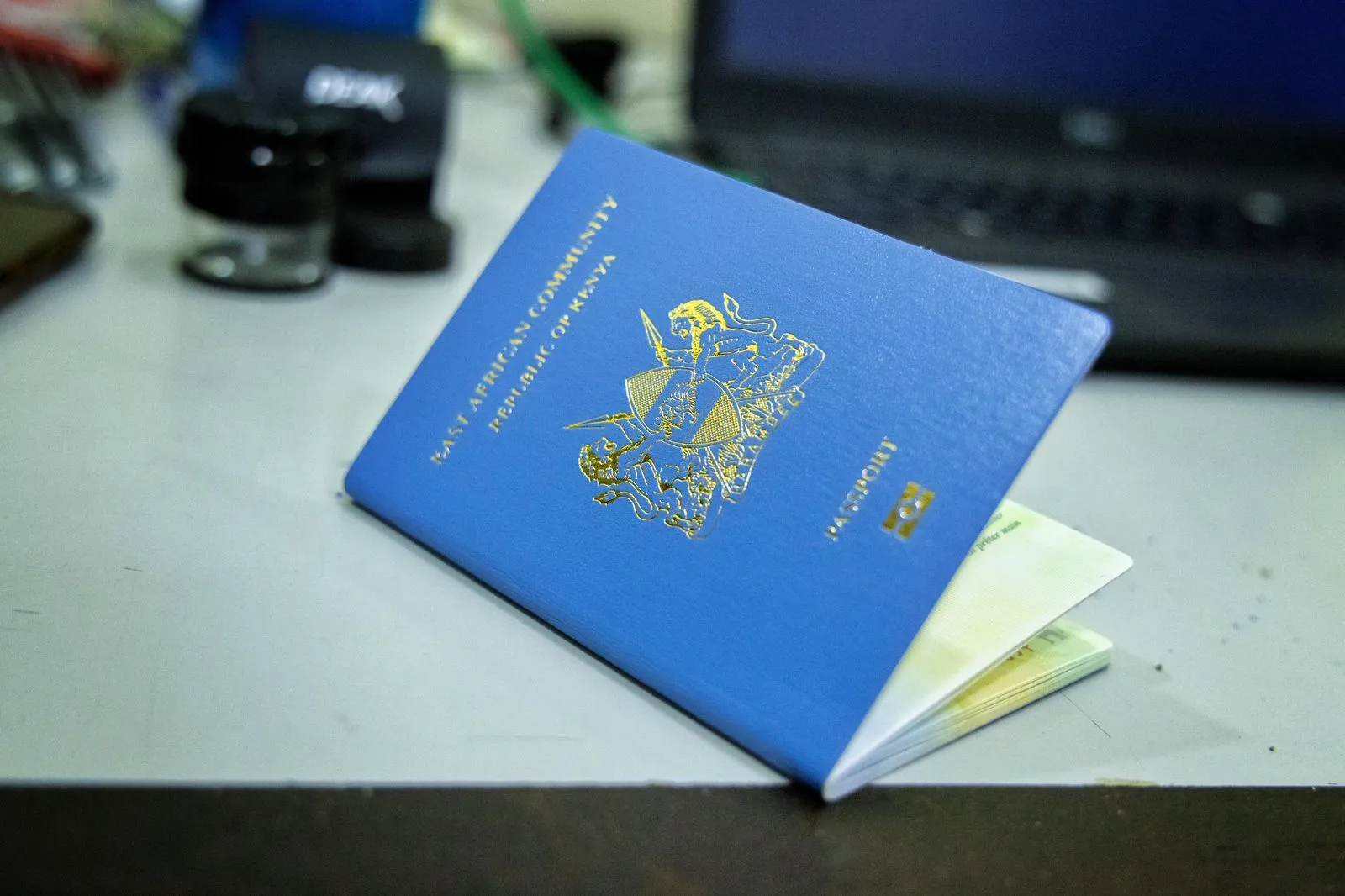
NAIROBI, Kenya — For years, obtaining a Kenyan passport often depended on finding someone willing to vouch for you.
Not a government database.
Not a fingerprint scan.
Not even the national identity card already sitting in your wallet.
Instead, thousands of applicants found themselves searching for a doctor, lawyer, civil servant, banker, clergy member or another recognised professional willing to sign a passport form and certify that they were who they claimed to be.
For many Kenyans, that seemingly simple requirement became one of the most frustrating parts of the application process.
Some spent days looking for a qualified recommender. Others turned to friends of friends. Some relied on strangers. In certain cases, applicants even paid for signatures to avoid delays.
Now, that requirement is quietly fading into history.
The Department of Immigration Services (DIS) has confirmed that the “Recommending Officer” section on Kenya’s passport application form is now optional and no longer a mandatory condition for approval.
While the adjustment may appear minor, it signals something much larger: a fundamental shift in how the government verifies identity in the digital age.
From human trust to digital verification
The recommending officer requirement originated in an era when government systems depended heavily on personal verification.
A trusted member of society effectively acted as a human guarantor.
Their signature was meant to reassure authorities that the applicant was genuine and that the photographs submitted represented the person named in the application.
In theory, it added an additional layer of security.
In practice, immigration officials say the system often created complications.
The Department of Immigration Services told Vivid Voice News that many applicants relied on recommenders whose identities could not always be independently verified.
In some instances, officials encountered signatures from people who were difficult to trace or whose qualifications could not be confirmed.
As passport applications increasingly moved online, that model began to look outdated.
The rise of biometric technology offered a different solution.
Rather than asking another person to confirm an applicant’s identity, immigration authorities can now compare fingerprints, national identification records and passport photographs against existing government databases.
The verification process has effectively moved from human endorsement to data matching.
Why the change matters
The removal of the requirement reflects a broader trend occurring across government services worldwide.
Countries are increasingly replacing paper-based trust systems with digital identity verification mechanisms that rely on biometrics and interconnected databases.
Security experts argue that such systems can be more reliable because they reduce dependence on subjective judgments and personal relationships.
A recommending officer may know an applicant personally—or may not.
A fingerprint, by contrast, provides a direct and verifiable identifier.
The Department of Immigration Services (DIS) says the biometric stage now offers sufficient safeguards to confirm identity without requiring a third party’s endorsement.
Also Read: Kenya’s 34-page passport is back — and exposing a bigger immigration challenge
That evolution also reflects changing public expectations.
Many Kenyans already use biometric verification when registering SIM cards, accessing financial services and obtaining government documents.
Against that backdrop, requiring a professional acquaintance to sign a passport application increasingly appeared inconsistent with the government’s digital transformation agenda.
The hidden cost of a signature
Beyond the administrative inconvenience, the recommending officer requirement created opportunities for abuse.
Applicants frequently reported difficulties finding qualified individuals willing to endorse their forms.
Others described situations where signatures became informal commodities.
What was intended as a security measure sometimes became an additional bureaucratic hurdle.
Immigration officials acknowledge that forged endorsements and questionable recommendations occasionally undermined confidence in the process.
The department says eliminating the requirement is partly aimed at closing those loopholes.
By relying on birth certificates, national identity cards and biometric records already held by the government, authorities believe they can achieve stronger verification while reducing opportunities for fraud.
In effect, the government is replacing a system based on personal credibility with one based on verifiable data.
A sign of Kenya’s digital future
The change comes as Kenya continues expanding digital public services through platforms such as eCitizen.
Over the past decade, government agencies have increasingly sought to reduce paperwork, automate processes and integrate databases to improve service delivery.
Passport applications have been among the most visible examples of that transition.
While applicants will still undergo biometric capture and identity verification, the need to persuade another person to formally endorse their application is no longer central to the process.
For many Kenyans, that may remove one of the most confusing and time-consuming steps in obtaining a passport.
The Department of Immigration Services (DIS) insists the recommending officer section should never be treated as a barrier to securing travel documents.
Instead, officials say identity verification now rests on evidence that can be independently checked: fingerprints, photographs, birth records and national identification data.
It is a small adjustment on a form.
But it reflects a much bigger shift in how governments determine who we are.
In Kenya’s passport system, trust is increasingly being transferred from signatures to systems—and from personal endorsements to biometric proof.
