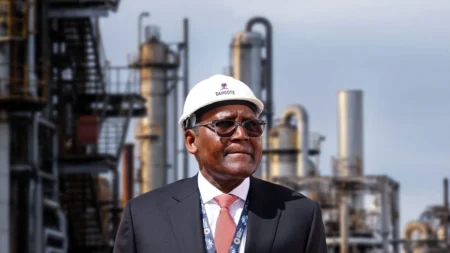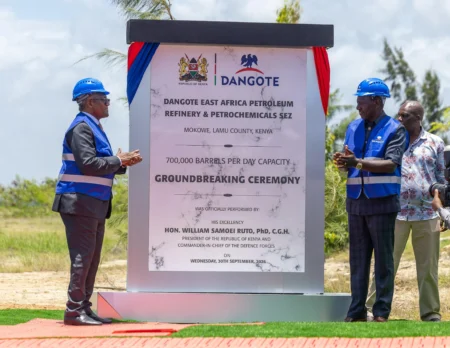




LAMU, Kenya — Nigerian billionaire Aliko Dangote has confirmed that Lamu County will host his long-awaited East African oil refinery, ending months of speculation over the project’s location and positioning Kenya to become a major regional petroleum refining hub.
The proposed refinery, expected to process 700,000 barrels of crude oil per day, represents Dangote Group’s largest investment outside Nigeria and is projected to cost about $20 billion (approximately KSh2.59 trillion).
Construction is expected to take between 30 months and three years once final engineering and financing arrangements are completed.
The announcement follows extensive feasibility studies and negotiations, with the company confirming that Lamu was selected over alternative locations, including Tanzania’s port city of Tanga, after evaluating commercial, logistical and infrastructure considerations.
Kenya chosen after regional assessment
Dangote Industries Vice President for Oil and Gas Edwin Devakumar said the company has already identified the site in Lamu, while soil investigations, engineering designs and technical preparations are underway.
“The site has been selected, soil tests are under way, and design and engineering work has commenced. Kenya was the choice from the beginning,” Devakumar told Vivid Voice News.
The refinery is expected to become East Africa’s largest petroleum processing facility, significantly reducing the region’s dependence on imported refined fuel products while strengthening Kenya’s position as an energy and logistics hub.
Financing model
Dangote said the refinery will be financed through a combination of:
- Internal company cash flows
- Corporate bonds
- A planned Initial Public Offering (IPO)
The company did not disclose the final investment figure but indicated that it would be comparable to the cost of the Dangote Refinery in Lagos, which eventually exceeded $20 billion after inflation, engineering changes and construction delays.
Regional energy ambitions
The refinery is intended to supply petroleum products to Kenya and neighbouring countries, helping reduce East Africa’s heavy reliance on imported fuels.
The project also aligns with Dangote Group’s broader strategy of expanding refining capacity across Africa following the successful commissioning of its 650,000-barrel-per-day Lagos refinery in 2024, now regarded as one of the world’s largest single-train refineries.
Analysts say the Kenyan refinery could strengthen fuel security across the East African Community by lowering transport costs and reducing exposure to global supply disruptions.
Link to LAPSSET
The refinery is expected to complement the Lamu Port-South Sudan-Ethiopia Transport (LAPSSET) Corridor, Kenya’s flagship infrastructure project designed to transform Lamu into a regional gateway for trade, logistics and energy investments.
For years, Lamu has featured in Kenya’s long-term plans for an oil refinery, although previous proposals failed to materialise because of financing and commercial viability concerns.
The Dangote investment now gives fresh momentum to those ambitions.
Government oversight
Kenya’s government has moved to coordinate implementation of the multibillion-shilling investment by establishing a high-level committee chaired by Deputy President Kithure Kindiki, which will oversee intergovernmental coordination, approvals and strategic planning for the project.
Also Read: Ruto bans raw mineral exports as Kenya pivots to local processing and industrialisation
The committee is expected to coordinate national and county government agencies on land, environmental approvals, infrastructure connectivity and investor facilitation.
Strategic implications
If completed, the refinery would reshape East Africa’s petroleum industry by:
- Increasing regional refining capacity
- Reducing dependence on imported refined fuel
- Supporting industrialisation and manufacturing
- Creating thousands of direct and indirect jobs
- Strengthening Kenya’s role as an energy hub for the wider region
Questions remain, however, over long-term crude oil supply, particularly as Kenya’s commercial oil production has yet to commence and regional pipeline infrastructure remains under development.
Industry observers say future feedstock could come from Kenya, Uganda, South Sudan and other regional producers as production expands.