


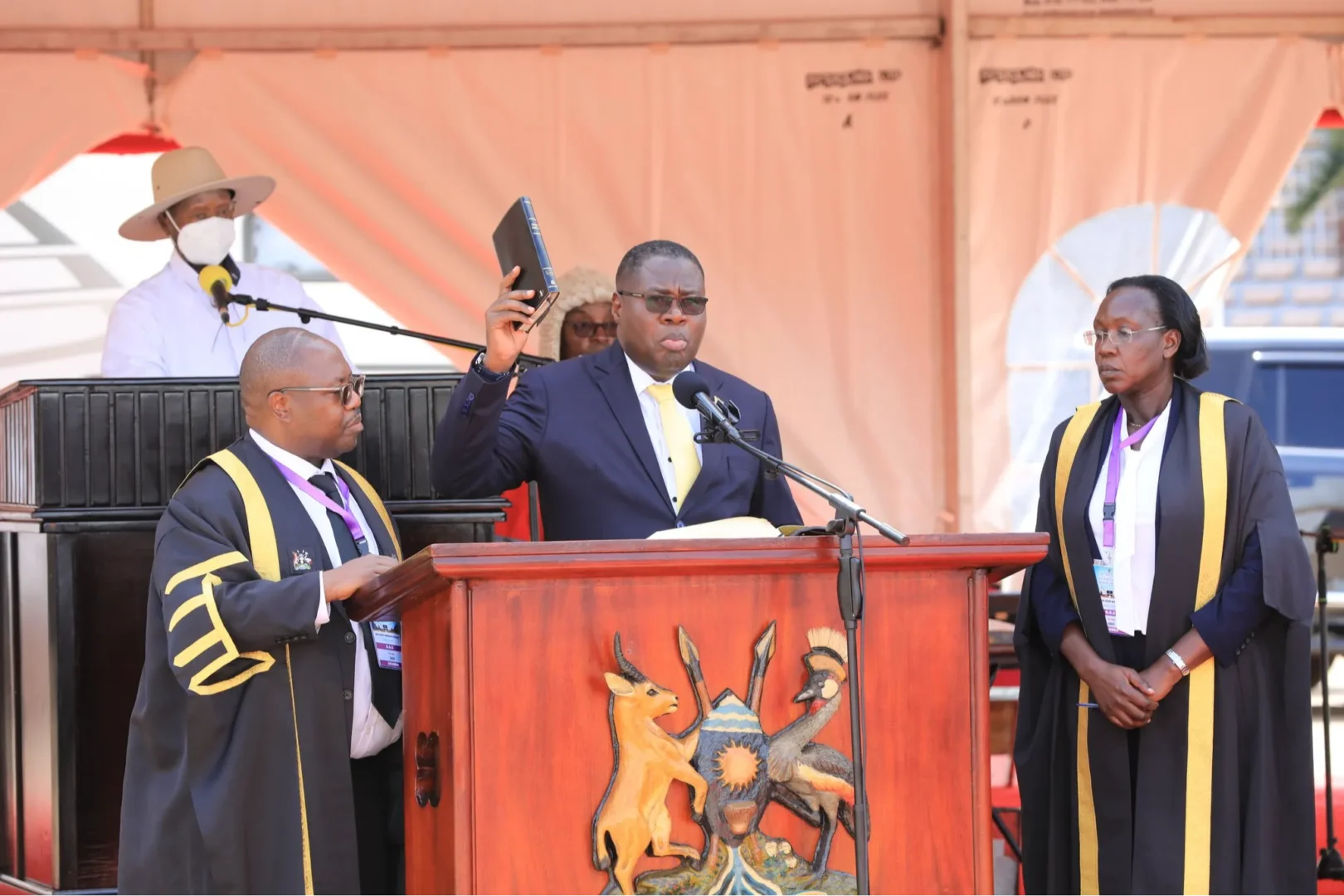
KAMPALA, Uganda — Jacob Marksons Oboth-Oboth has been overwhelmingly elected Speaker of Uganda’s 12th Parliament after securing more than 400 votes in a special sitting held at Kololo Ceremonial Grounds.
Three candidates contested the position: Oboth-Oboth, the National Resistance Movement (NRM) flag bearer who emerged victorious; Paul Mwiru of the National Unity Platform (NUP), who stood as the joint opposition candidate and garnered 60 votes; and Democratic Party (DP) President General Norbert Mao, who received 15 votes.
The election was conducted by secret ballot, with Members of Parliament required to write the name of their preferred candidate on blank ballot papers before casting them into the ballot box. Three ballots were declared spoilt after MPs wrote names of individuals not in the race or selected multiple candidates.
Oboth-Oboth was nominated by Vice President Jessica Alupo, who told the House that his extensive experience in Parliament, government, and public service had prepared him to effectively lead the legislature. She also cited his endorsement by the ruling NRM and President Yoweri Museveni as a demonstration of confidence in his leadership.
The election was presided over by Chief Justice Flavian Zeija.
Brief profile: Jacob Marksons Oboth-Oboth
Jacob Marksons Oboth-Oboth, commonly known as Jacob Oboth-Oboth, was born on April 13, 1971, in Tororo, Uganda.
He holds a Bachelor of Laws degree from Makerere University, a Diploma in Legal Practice from the Law Development Centre, and a Master of Laws from the University of Minnesota.
He is the Member of Parliament for West Budama County South under the NRM ticket and has been serving as State Minister for Defence (General Duties).
Also Read: Norbert Mao secures 15 votes in Speaker election at Kololo
Over the years, he has chaired the Legal and Parliamentary Affairs Committee and previously led the Rules, Discipline and Privileges Committee. He has also served on the Parliamentary Business Committee.
Historical pattern: Speakers and their political alignment
A review of Uganda’s parliamentary leadership over the past three decades reveals a striking consistency—not just in personnel, but in political alignment.
Speakers of Parliament (Since 1996 Constitution)
- Anita Annet Among (2022–present)
Party: National Resistance Movement (NRM)
Rose from Deputy Speaker following the death of Jacob Oulanyah. Her tenure has faced scrutiny over governance, spending controversies, and perceived proximity to executive power. - Jacob Oulanyah (2021–2022)
Party: National Resistance Movement (NRM)
A seasoned legislator and lawyer whose short tenure was cut by his death in office. - Rebecca Kadaga (2011–2021)
Party: National Resistance Movement (NRM)
One of Uganda’s longest-serving Speakers. Occasionally projected institutional independence but ultimately remained within ruling party structures. - Edward Ssekandi (2001–2011)
Party: National Resistance Movement (NRM)
Later became Vice President, reinforcing the close link between parliamentary leadership and executive hierarchy. - Francis Ayume (1998–2001)
Affiliation: Movement system (precursor to NRM dominance under no-party framework)
Served during Uganda’s transition from no-party to multiparty politics. - James Wapakhabulo (1996–1998)
Affiliation: Movement system
Oversaw early implementation of the 1995 Constitution.
Deputy Speakers of Parliament (Key Figures)
- Thomas Tayebwa (2022–present)
Party: National Resistance Movement (NRM) - Anita Annet Among (2021–2022)
Party: National Resistance Movement (NRM) - Jacob Oulanyah (2011–2021)
Party: National Resistance Movement (NRM) - Rebecca Kadaga (2001–2011)
Party: National Resistance Movement (NRM) - Edward Ssekandi (1998–2001)
Affiliation: Movement system
