


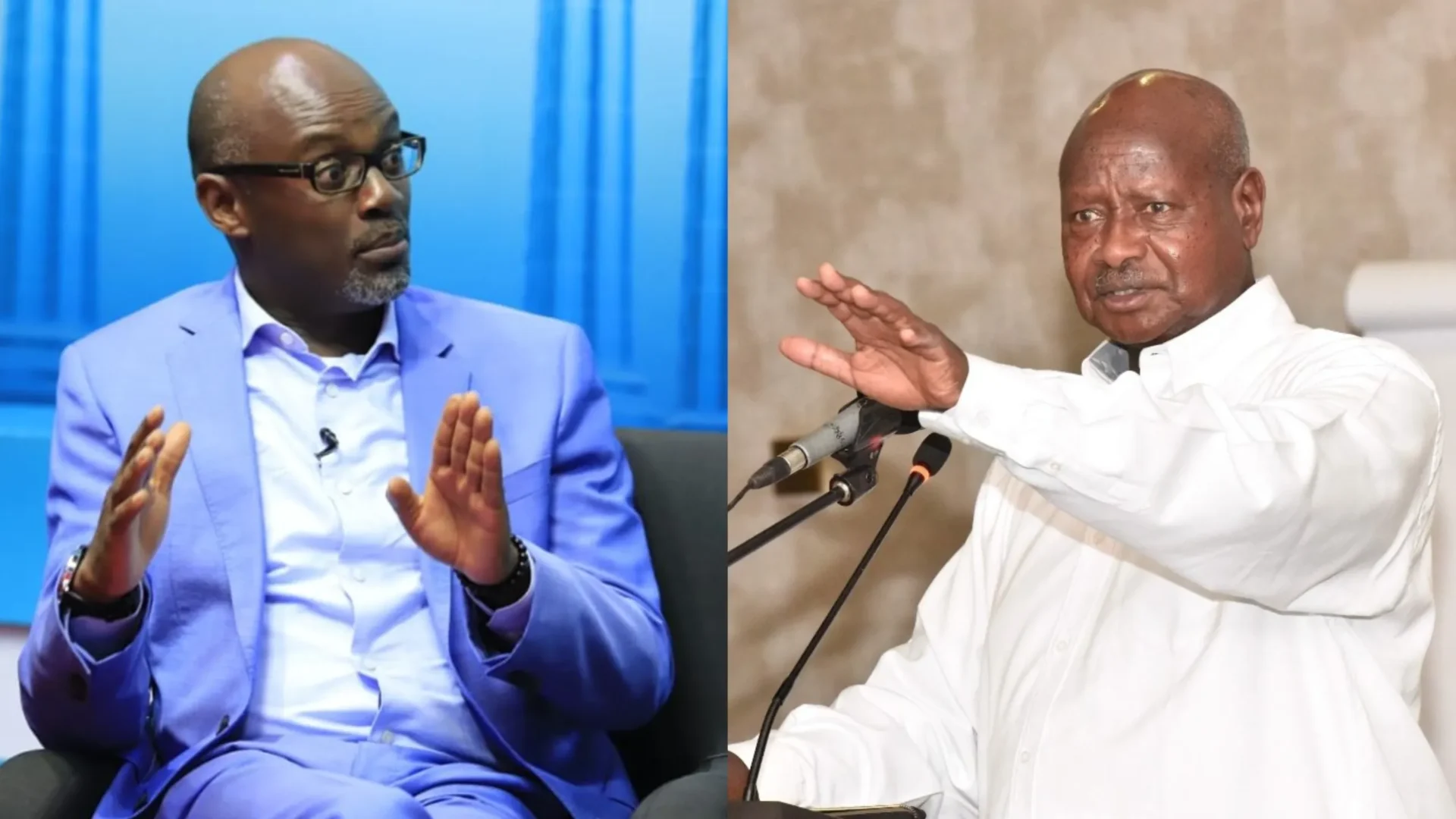
KAMPALA, Uganda — A bitter and unusually public fallout between Ugandan President Yoweri Museveni and veteran journalist Andrew Mwenda has escalated into one of the most explosive ideological confrontations within Uganda’s political establishment in recent years, exposing growing tensions over corruption, state-backed mega projects, industrialisation and the future direction of Uganda’s economy.
The clash, which has dominated political and media discourse across Uganda, was triggered by a sharply critical opinion article authored by Andrew Mwenda in which he accused Museveni of increasingly backing questionable multi-billion-shilling projects promoted by politically connected businessmen.
Mwenda further suggested the veteran leader’s advanced age had weakened his ability to critically assess investment proposals being pushed through government channels.
The dispute quickly evolved from a policy disagreement into a deeply personal confrontation after Museveni responded with a fiery rebuttal defending both his leadership and Uganda’s industrialisation agenda.
“Mr Mwenda, thank you for declaring me senile and incapable of judging right,” Museveni wrote in a widely circulated statement.
“You will, however, discover that at 82, I am still able to defend Uganda and myself with the Bible, the AK-47 and the pen.”
From internal criticism to public political war
Mwenda’s article questioned the viability of several heavily funded government-supported ventures, including projects linked to businessman David Ssenfuka, Dei Biopharma founder Dr Matthias Magoola, the Lubowa specialised hospital project, Atiak Sugar Factory, Kiira Motors and coffee processing investments in western Uganda.
He argued that Uganda’s financially strained economy was increasingly concentrating massive amounts of public money into politically favoured “white elephant” projects while exposing taxpayers to enormous financial risk.
Mwenda claimed some businessmen had learnt how to exploit Museveni’s long-standing belief in state-led industrialisation by pitching ambitious projects promising to transform Uganda’s economy.
Among the most controversial allegations was his assertion that Museveni had become vulnerable to manipulation by individuals surrounding him politically and economically.
“This brings me to the choice of the title of this article. Museveni has grown old,” Mwenda wrote in the opinion piece that triggered the fallout.
“He has become less able to rigorously assess the economic and business viability of the ideas and projects sold to him.”
The remarks marked one of the strongest public criticisms ever directed at Museveni by a commentator long viewed as ideologically aligned with sections of the ruling establishment.
Museveni defends State-led industrialisation
Museveni, however, framed the criticism as part of what he described as a broader “neo-colonial” campaign against Uganda’s industrial transformation efforts.
In his response, the President accused Mwenda of undermining local manufacturing, value addition and strategic economic independence.
“You are ashamed and you dare not talk about Kiira Motors because that is a shamer of the neo-colonial agents like Mwenda,” Museveni said.
“The do-nothingers like Andrew Mwenda always run around noisily telling lies while defending the neo-colonial status quo.”
Museveni argued that Uganda’s long-term economic survival depends on industrialisation and local processing of raw materials instead of exporting unprocessed commodities.
He cited government interventions in gold refining, coffee production, dairy farming and agro-processing as evidence that state-backed industrial policies were already yielding results.
According to Museveni, Uganda’s gold exports have risen sharply following restrictions on the export of unprocessed minerals, while coffee earnings and milk production have also expanded significantly.
The President further defended wealth creation programmes such as the Parish Development Model (PDM), saying critics ignored visible economic gains in rural areas.
The bigger political meaning behind the clash
Beyond the personal attacks, analysts say the confrontation reflects a deeper ideological struggle within Uganda’s ruling elite over how the country should pursue economic transformation.
One side argues Uganda requires aggressive state intervention and large-scale industrial financing to break out of dependency on raw-material exports.
The opposing view warns that politically connected mega projects lacking transparency and proper oversight risk becoming expensive patronage networks that drain public resources without delivering meaningful economic returns.
The dispute also reveals growing unease within sections of Uganda’s political and intellectual class over accountability, governance and concentration of economic decision-making around the presidency.
Notably, Museveni’s response accused Mwenda of leaking internal discussions and attempting to sabotage investor confidence by publicising Cabinet-related debates.
“What could be the real motive of Andrew Mwenda externalising our internal discussions, including Cabinet?” Museveni asked.
“It is to scare away our partners.”
Symbolism of the “Bible, AK-47 and Pen”
Museveni’s reference to the “Bible, AK-47 and pen” has since become one of the most discussed political phrases in Uganda this year, symbolising his attempt to project continued political authority, ideological conviction and revolutionary legitimacy despite growing scrutiny over his decades-long rule.
Supporters of the President have praised the statement as a powerful defence of Uganda’s industrial ambitions and economic sovereignty.
Also Read: Uganda succession debate: What happens after Museveni?
Critics, however, argue the unusually emotional response reflects increasing sensitivity within the ruling establishment to criticism surrounding governance, corruption and public spending.
The clash has also reignited broader debate about succession politics, generational transition and the future of Uganda’s economic model as Museveni approaches more than four decades in power.
A rare public rupture
Public disagreements between Museveni and influential commentators close to the establishment are relatively uncommon, making the fallout politically significant.
Mwenda has for years been regarded as one of the most influential political commentators in Uganda, often defending aspects of Museveni’s governance while maintaining access to senior power circles.
The sharp deterioration in relations therefore signals what observers describe as a rare fracture within Uganda’s broader pro-establishment intellectual ecosystem.
Whether the confrontation remains an isolated ideological dispute or evolves into a wider political realignment within sections of Uganda’s elite remains unclear.
But the exchange has already exposed growing tensions over corruption, state spending, industrialisation and political accountability at the highest levels of power in Uganda.
