


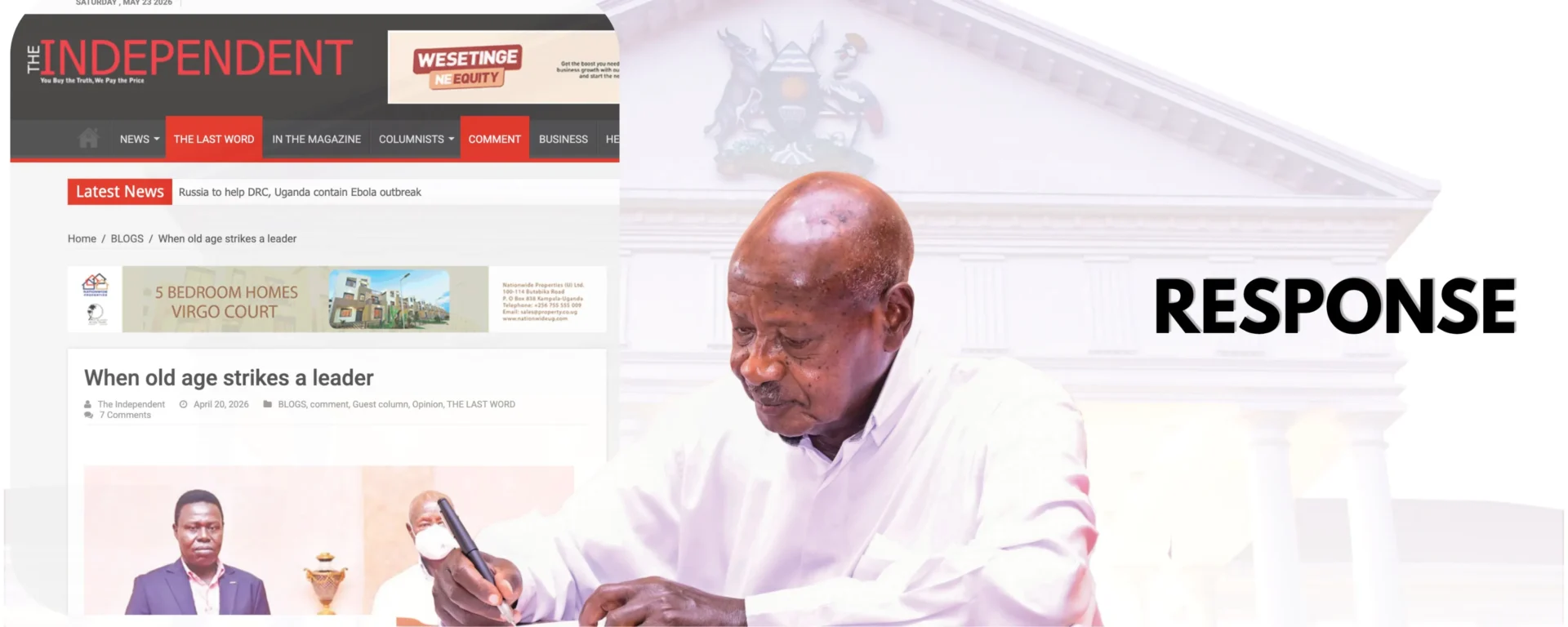
KAMPALA, Uganda — President Yoweri Museveni has issued a strongly worded response to journalist Andrew Mwenda, rejecting claims questioning his judgment and defending the government’s strategy of backing large-scale industrial and investment projects.
In a direct rebuttal, Museveni dismissed Mwenda’s critique, particularly suggestions that age may have affected his decision-making, stating that he remains fully capable of leading and defending Uganda’s interests.
“At 82, I am still able to defend Uganda and myself with the Bible, the AK-47 and the pen,” Museveni said.
The president challenged Mr. Mwenda to conduct on-the-ground reporting by engaging individuals and projects he had criticised, including pharmaceutical and manufacturing ventures cited in his commentary.
Museveni framed his defence within a broader ideological stance, arguing that Uganda’s economic strategy is anchored on industrialisation, value addition and reducing dependence on raw material exports.
He criticised what he described as “neo-colonial” economic thinking that confines African economies to exporting unprocessed commodities.
To illustrate his point, Museveni cited disparities in global value chains:
- Raw gold exports versus refined gold pricing
- Unprocessed coffee compared to branded, processed exports
He argued that Uganda’s push to establish local processing capacity, including gold refineries and manufacturing plants, has already yielded measurable economic gains.
The president pointed to several government-backed initiatives and sectors as evidence of progress, including:
- Growth in coffee production and export earnings
- Expansion of dairy, fruit and palm oil industries
- Increased gold export revenues
- Implementation of programmes such as the Parish Development Model (PDM)
Museveni maintained that these interventions are central to Uganda’s socio-economic transformation and long-term resilience.
Responding to criticism of large public investments in selected projects, Museveni argued that strategic state intervention is necessary to catalyse industrial growth, even where risks exist.
He emphasised that economic transformation often involves trial, error and persistence, invoking historical examples from Uganda’s liberation struggle to argue that setbacks are part of progress.
The president also accused critics, including Mwenda, of undermining Uganda’s development agenda by publicly criticising internal policy discussions.
He suggested such commentary could discourage investors and partners, framing it as counterproductive to national interests.
Also Read: Uganda succession debate: What happens after Museveni?
Museveni further referenced past disagreements over infrastructure projects, including the Bujagali power project, to argue that criticism has historically delayed or complicated development efforts.
The exchange between Museveni and Mwenda highlights a growing public debate in Uganda over:
- The role of the state in driving economic development
- Oversight and accountability in public spending
- The balance between ambition and fiscal prudence
While critics warn of risks associated with concentrated, high-value investments, the government continues to position such projects as essential to breaking structural economic constraints.
At its core, the dispute reflects two competing visions:
- A state-driven industrial policy focused on large-scale transformation
- A more cautious approach emphasising diversified investment and risk management
As Uganda advances its economic agenda, the tension between these perspectives is likely to shape policy discourse, and public accountability, well beyond the current political moment.
