


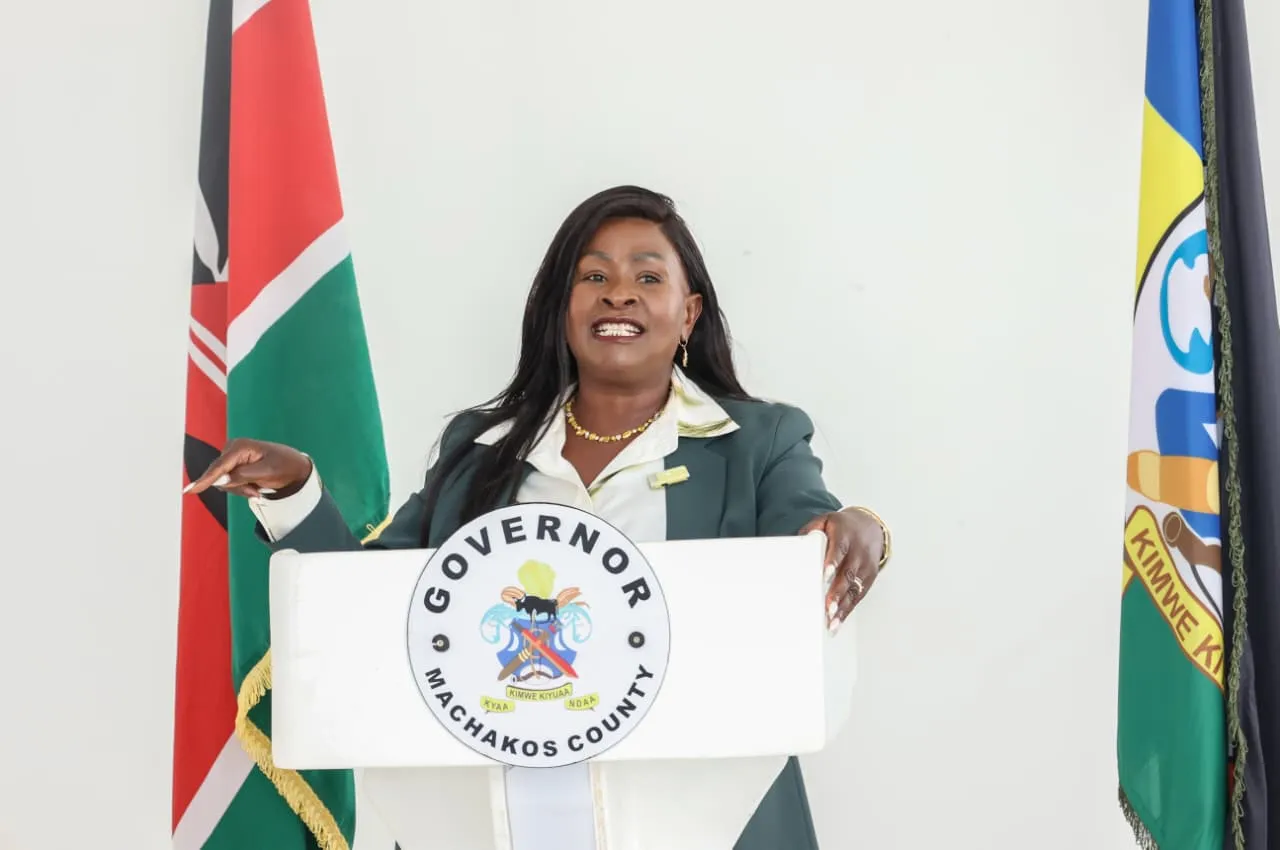
MACHAKOS, Kenya — Machakos Governor Wavinya Ndeti has defended her academic credentials, asserting that her educational background and early research experience set her apart from her political rivals.
Speaking during a public engagement, the governor said she has invested significantly in education over the years, holding multiple academic qualifications which she believes demonstrate her suitability for leadership.
“I hear others saying they are professionals. Mimi Nimesoma,” Wavinya said.
She further stated that she holds three diplomas and three degrees, dismissing suggestions that some of her competitors are better qualified for public office.
“I have got three diplomas and three degrees. The others have one degree, and they are calling themselves professionals,” she said.
The governor also pointed to her academic research history, saying she worked on Artificial Intelligence (AI) as early as 1992, long before the field gained mainstream global attention.
“I was just laughing with somebody when I told them I did my thesis in artificial intelligence in 1992,” she said.
Her remarks come amid heightened political positioning ahead of the 2027 election cycle, where competition for governorships and other key offices is expected to intensify.
Although she did not name specific individuals, the comments were widely interpreted as directed at potential political opponents.
Wavinya emphasised that academic achievement and professional training remain critical in public leadership, arguing that they equip leaders with the capacity to manage resources and deliver development outcomes.
Her remarks reflect a broader trend in Kenyan politics where education credentials are increasingly being used as both a badge of legitimacy and a point of public debate.
Also Read: Machakos Governor Wavinya Ndeti blasts Ruto over Kalonzo ‘insults’ in Ukambani
Similar sentiments have previously been echoed by President William Ruto, who has often highlighted his academic qualifications in response to critics.
“Na mkiona wale wanalalamika ni watu sijui wamesomea wapi. Si mimi niko na PhD… si mimi naelewa nini inaendelea Kenya? Sasa mimi napata watu wako na elimu kidogo kidogo hapa wanajaribu kunifundisha, mnanifundisha kazi gani?” he previously said.
(And when you see those complaining, you wonder where they even studied. I am the one with a PhD… I am the one who understands what is happening in Kenya. Now I find people with little education here trying to teach me, what exactly are you trying to teach me?)
The exchange highlights a growing trend in Kenyan political discourse where leaders increasingly foreground academic qualifications in shaping public perception, particularly as early campaigning narratives begin to take shape ahead of the 2027 polls.
