


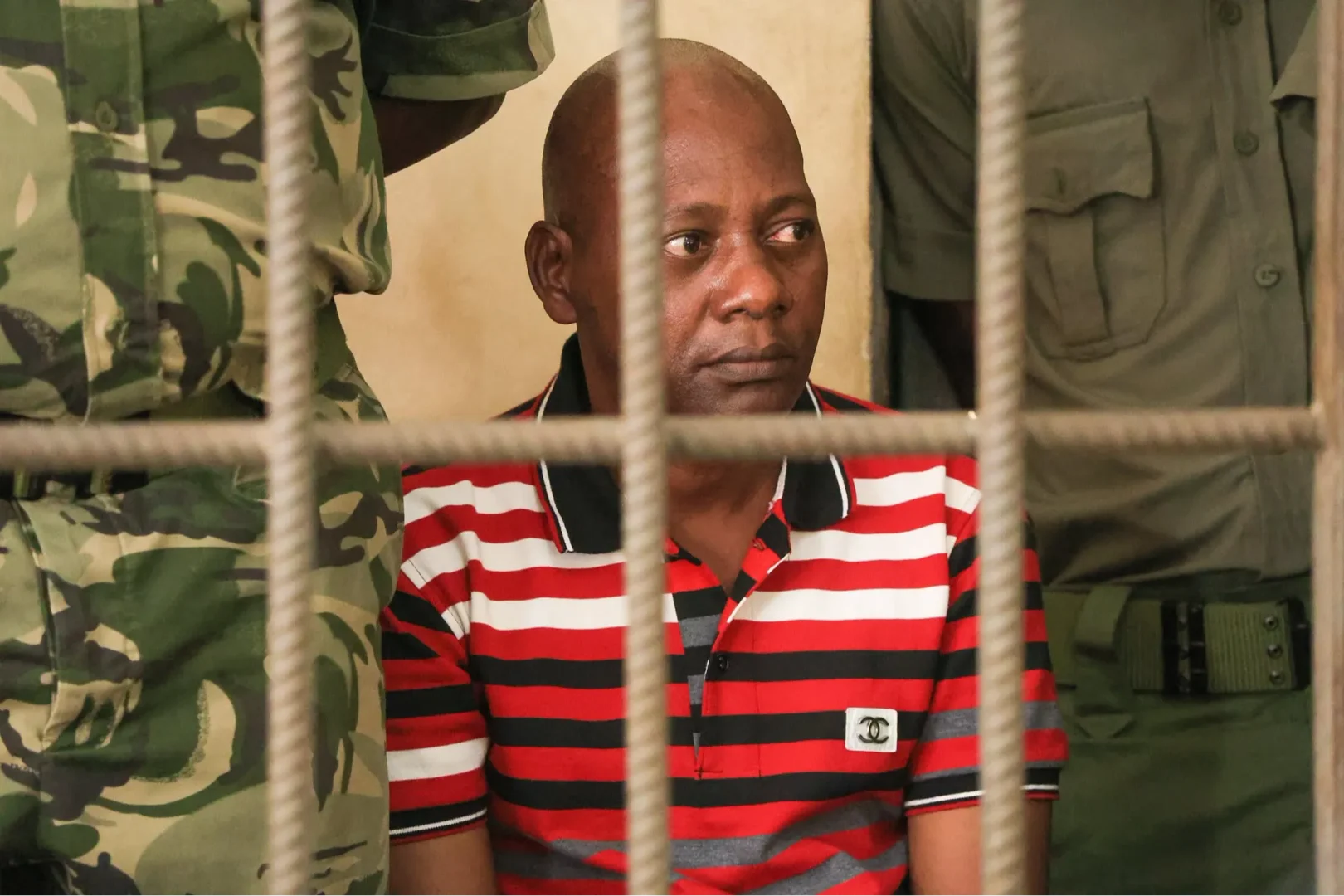
MOMBASA, Kenya — Controversial preacher and Good News International Church founder Paul Nthenge Mackenzie has been sentenced to 200 years in prison for the murder of 191 followers, including 190 children, in the Shakahola massacre.
The High Court in Mombasa handed down the sentence on Friday, November 6, 2026, with Justice Diana Kavedza finding Mackenzie primarily responsible for relocating his followers to a remote settlement and directing them to fast to death in the belief that they would meet Jesus.
The sentence follows Mackenzie’s conviction on October 19, alongside 28 co-accused, on 191 counts of murder arising from the deaths at Shakahola Forest in Kilifi County.
The prosecution had sought the death penalty for Mackenzie, arguing that the scale and brutality of the killings warranted the harshest punishment available under the law. It also cited what it described as his lack of remorse.
For the other 27 co-accused, the State had sought life imprisonment, while proposing a separate plea-bargaining arrangement for Enos Amanya Ngala, who admitted all 191 murder counts.
Mackenzie and his co-accused had asked the court for leniency during mitigation, with their lawyers urging the judge to consider their personal circumstances and time spent in custody.
Court finds organised system behind Shakahola killings
In its October 19 judgment, the court found that the deaths resulted from an organised system of religious radicalisation and enforced fasting, with children targeted first.
Mackenzie was found to have directed followers to abandon conventional lifestyles and relocate to Shakahola, where they were instructed to fast until death in anticipation of meeting Jesus.
The court heard that his followers regarded him as the mouthpiece of Jesus and followed his teachings, which included rejecting formal education and modern healthcare.
Justice Kavedza found that the fasting regime was enforced through a structured hierarchy, with guards and other followers helping to ensure compliance.
Those who resisted the directives were subjected to violence, including beatings, confinement and restraint. Children were denied food and water, while some adults who attempted to oppose the practices were also attacked.
One of the co-accused reportedly told the court that Mackenzie had instructed followers who resisted fasting to be forced to go to heaven through “kicks and blows.”
The judge also described how burials in the forest were referred to as “weddings”, with those who died celebrated as having been united with Jesus.
Medical and post-mortem evidence presented during the trial established starvation as a cause of death in many cases.
Other victims died from suffocation, strangulation and head injuries, while decomposition prevented pathologists from determining the precise cause of death in some cases.
The court rejected the defence argument that the victims had voluntarily chosen to starve, finding that the prosecution had established the accused persons’ individual criminal responsibility beyond reasonable doubt.
More than 400 bodies recovered from Shakahola
The Shakahola tragedy came to national attention in April 2023 after authorities began uncovering mass graves containing the remains of people linked to Mackenzie’s religious movement.
The subsequent search and exhumation operations recovered more than 400 bodies from shallow graves in Shakahola Forest, part of Chakama Ranch in Kilifi County.
The Kenya National Commission on Human Rights documented the recovery of 429 bodies during the 2023 operation, alongside the rescue of 92 people, including 67 adults and 25 children.
The 191 murder convictions, however, cover only 190 children and one adult. They should not be confused with the total number of bodies recovered from the wider forest investigation.
The difference means the conclusion of this particular murder trial does not account for every death associated with the Shakahola tragedy.
Families recount loss as court delivers sentence
The sentencing has been closely followed by families whose relatives died after joining Mackenzie’s movement.
Before the hearing, Francis Wanje, who lost eight relatives in Shakahola, including two grandchildren, told the BBC’s Newsday programme that he hoped the court would impose a punishment matching the scale of the suffering.
“I was hoping for… a sentence which will match his [Mackenzie’s] deeds in the forest,” Wanje said.
Wanje had previously reported concerns about children taken into the forest, but questions have since emerged over the response by authorities to warnings about the activities of the group.
He told the BBC that a relative working in the police service and a former cult participant helped rescue his grandson. The child reportedly gave investigators information about what had happened and showed them where his siblings had been buried.
The Kenya National Commission on Human Rights subsequently criticised security and administrative officials for failing to act on credible reports about Mackenzie’s activities before the deaths were discovered.
In a separate investigation, the Commission on Administrative Justice, also known as the Office of the Ombudsman, found that police and national government administration officers had received reports about the preacher’s activities but failed to take adequate action between 2021 and 2023.
Mackenzie’s history and earlier encounters with the law
Mackenzie established Good News International Ministries in 2003, attracting followers through church services, television broadcasts and online religious teachings.
His sermons increasingly focused on apocalyptic messages and warnings about the end of the world. He reportedly described formal education as evil, modern healthcare as contrary to religious doctrine and digital identification systems as the mark of the devil.
His church operated Times TV, which broadcast his sermons, before the ministry and television station were shut down in 2019.
Mackenzie subsequently relocated to Shakahola Forest, encouraging followers to join him in what was presented as a religious settlement away from conventional society.
However, his activities had attracted the attention of authorities years before the mass deaths were uncovered.
Also Read: Kenya uncovers suspected Kilifi cult: Two skulls and a body found, stirring Shakahola memories
According to the Kenya National Commission on Human Rights, Mackenzie and some of his associates had been arrested on several occasions between 2017 and 2023 over allegations involving radicalisation, children’s education and other offences.
The commission criticised failures in the earlier investigations, arguing that timely action could have prevented further deaths.
President William Ruto also established a commission of inquiry following the discovery of the mass graves. However, the High Court declared its establishment unconstitutional in July 2024, finding that it undermined the mandates of independent constitutional institutions.
Other cases against Mackenzie remain pending
Although the 200-year sentence marks a major development in the Shakahola murder proceedings, it does not bring all legal cases linked to Mackenzie and his associates to an end.
The preacher and other members of the religious movement face separate proceedings involving allegations of terrorism, radicalisation and offences relating to children’s education.
Mackenzie has also faced separate charges connected to other deaths allegedly linked to his activities.
The Shakahola convictions have intensified scrutiny of religious extremism, the regulation of religious organisations and the protection of vulnerable people, particularly children.
For families who lost relatives in the forest, the sentence represents a significant development in the pursuit of justice. However, with hundreds of bodies recovered and other investigations continuing, the wider legal and accountability questions surrounding the tragedy remain unresolved.
