


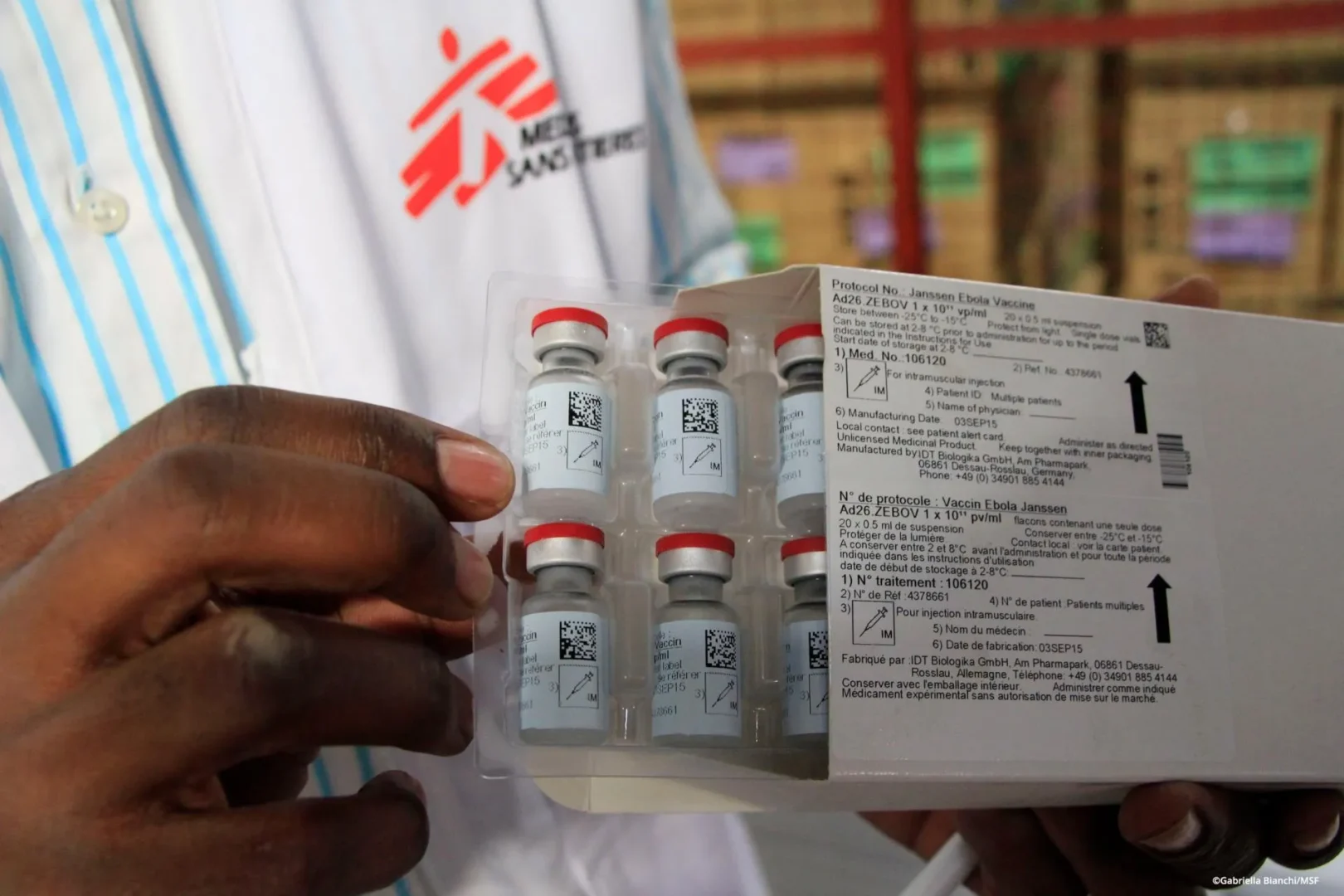
NAIROBI, Kenya — Kenya has requested 10,000 doses of an Ebola vaccine, with health workers set to receive priority if the doses are secured, Director-General for Health Dr Patrick Amoth has said.
Amoth said the government had asked the World Health Organization (WHO) and the Africa Centres for Disease Control and Prevention (Africa CDC) to help obtain the vaccines as Kenya responds to an outbreak of Bundibugyo Ebola.
The outbreak has killed one person and infected eight others, all of whom are receiving treatment at Kenyatta National Hospital (KNH) and Nairobi Hospital, according to Amoth.
He said the eight patients were stable and responding well to treatment.
The vaccine under consideration is likely to be Ervebo, which is licensed against the Zaire Ebola virus but has not been approved specifically for the Bundibugyo strain.
WHO says there is insufficient evidence to determine whether Ervebo protects people against Bundibugyo Ebola. It recommends that the vaccine be used against this strain only within a research protocol designed to assess its effectiveness.
Kenya steps up Ebola response
Speaking during a WHO Africa Region briefing on Thursday, Amoth said authorities had accounted for all 135 people identified as contacts of Kenya’s first patient.
The man, a Kenyan who had been doing business in the Democratic Republic of Congo (DRC), travelled through Entebbe, Uganda, before flying to Nairobi. He died about 48 hours after developing symptoms, despite receiving treatment.
Amoth said tracing the final contact had proved difficult because the individual, a Ugandan national, arrived in Kenya by air but subsequently left the country by road through Namanga.
“We listed 135 contacts, and we have been able to account for them 100 per cent,” he said.
“The last being a citizen of our sister republic who exited our country, came by air but exited by road, leading to the delay in identifying the last contact.”
The government has also faced challenges locating contacts and placing them in quarantine, particularly in Nairobi, where frequent movement across the city complicated tracing efforts.
Amoth said a multi-agency team led by the Kenya Defence Forces had brought together telecommunications companies and the National Intelligence Service (NIS) to help locate people who might have been exposed to the virus.
“Especially in the first few days, it was very, very difficult to get persons into quarantine,” he said. “But now, using intelligence and the telcos, we could map out where they are, and we got a lot of cooperation from the public.”
The Ministry of Health said contacts who entered quarantine on October 6 would begin leaving from the following Sunday after completing the required 21-day monitoring period without symptoms.
Others were expected to be released the following week, depending on their individual monitoring timelines and health assessments.
Patients receive experimental treatment
Amoth said the eight patients were receiving a monoclonal antibody treatment, followed by remdesivir, an antiviral drug administered intravenously.
Monoclonal antibodies are laboratory-made proteins designed to recognise and help the immune system target specific substances, including viruses.
“All of them are doing well after receiving treatment with the compassionate monoclonal antibody NB 134,” Amoth said.
“Some of them are on the second and third days of intravenous remdesivir, and all of them are stable and responding very well.”
He said one patient had experienced a drop in oxygen saturation and was given supplemental oxygen. No other adverse reactions to the medicine had been reported, according to Amoth.
“One thing that we noticed when we were giving the monoclonal antibody is that one of the patients had a desaturation and was managed with supplemental oxygen,” he said. “Otherwise, we have not reported any adverse reaction to the medicine.”
The treatment is being administered on a compassionate basis, meaning it is being used in an attempt to help patients despite not being an established, licensed treatment specifically for Bundibugyo virus disease.
WHO has identified monoclonal antibodies, including MBP134, and remdesivir among the candidate treatments requiring further evaluation for this strain. Their use does not establish that they are proven cures.
No licensed vaccine for Bundibugyo Ebola
The possible use of Ervebo presents a separate challenge for Kenya’s response.
Although Ervebo is licensed and recommended for Ebola disease caused by the Zaire Ebola virus, there is currently no licensed vaccine specifically for Bundibugyo virus disease.
WHO says evidence from animal studies suggests Ervebo might offer some protection, but available evidence is insufficient to establish whether it protects people against Bundibugyo Ebola or how effective it might be.
Also Read: Kenya reports new Ebola case, raising total to eight
The organisation therefore recommends that its use against this strain take place under a research protocol, such as a properly designed study that monitors vaccine effectiveness and safety.
This means Kenya’s request for vaccine doses should not be interpreted as confirmation that a proven vaccine is available for the current strain.
WHO calls for regional vigilance
WHO Africa Regional Director Dr Mohamed Janabi said the outbreak required cooperation across national borders because population movement could facilitate the spread of the virus.
“Ebola does not wait. It follows movement, exploits gaps, and tests the strength of our health systems,” Janabi said.
“Today, the test is no longer confined to one place. It is a regional concern that demands regional vigilance and collective resolve.”
Janabi praised Kenya for sharing information and declaring its outbreak early. He said WHO was working with national governments, Africa CDC and other partners to identify cases quickly, monitor contacts and protect health workers.
He also warned that deaths outside treatment centres in the Democratic Republic of Congo highlighted the importance of helping people with suspected infections access medical care early.
Kenya’s immediate priorities remain identifying possible cases, monitoring exposed individuals, providing treatment and protecting health workers as authorities seek additional support for the response.
