



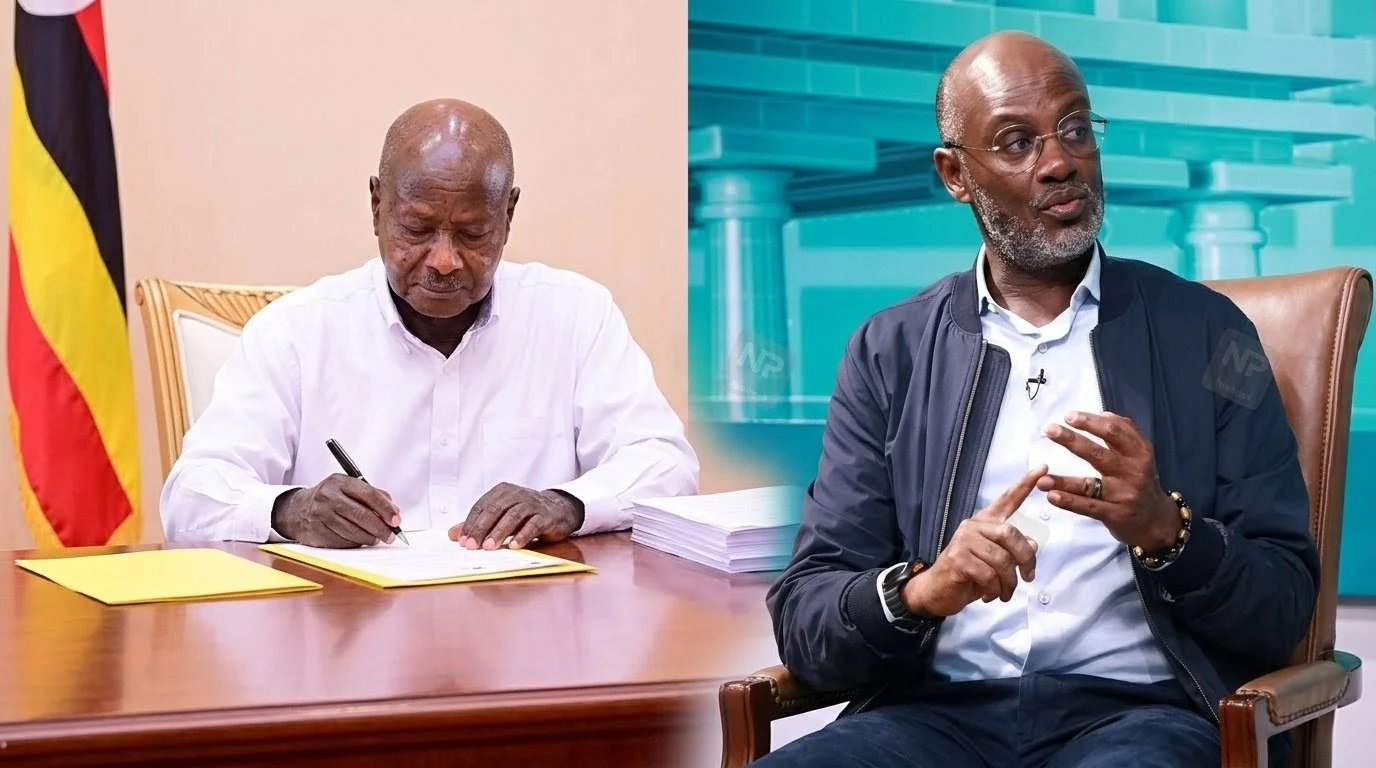
KAMPALA, Uganda — Veteran Ugandan journalist Andrew Mwenda has published a sharply critical opinion piece questioning the decision-making processes around major government-backed investments, arguing that weak institutional guardrails and political dynamics at the top have exposed public funds to high-risk projects.
In his analysis, Mwenda alleges that several individuals have secured large-scale government backing for ambitious ventures based on what he characterises as exaggerated or unverified claims.
He cites the case of a little-known figure, David Senfuka, who reportedly presented a proposal claiming to have developed a cure for major diseases and sought substantial state funding to establish a pharmaceutical plant in Uganda. Mwenda questions both the credibility of the claims and the due diligence process behind such proposals.
The commentary also revisits the controversial funding of Dei Biopharma, associated with Matthias Magoola, which has received significant state support amid promises of producing advanced vaccines and treatments. Mwenda alleges that large public funds were committed despite concerns raised by technocrats and financial experts.
Mwenda situates these cases within a broader pattern of government-supported projects, including infrastructure, manufacturing and health-sector investments that have drawn public debate over cost, viability and procurement processes.
Among the projects he references is the Lubowa International Specialised Hospital, backed by Italian investor Enrica Pinetti, which has faced sustained scrutiny over its cost structure and delivery timelines.
He also points to state interventions in private enterprises, including bailouts and capital injections into companies in construction, agriculture and agro-processing sectors, arguing that such investments often concentrate significant public resources in a limited number of ventures.
A central argument in Mwenda’s analysis is that Uganda’s current approach to state-supported investment may be exposing the economy to excessive risk concentration.
He contrasts this with alternative industrial policy models that distribute public capital across multiple smaller ventures, increasing the probability of success through diversification.
According to Mwenda, concentrating billions of shillings in a handful of projects, particularly those still in early or speculative stages, creates significant fiscal vulnerability if those ventures fail to deliver expected returns.
Mwenda further raises concerns about governance structures and internal accountability mechanisms, suggesting that dissenting technical advice within government may not always carry sufficient weight once political decisions are made.
His analysis frames the issue as one of institutional resilience rather than individual projects, arguing that strong oversight systems are critical to safeguarding public resources, especially in high-value, high-risk investments.
The commentary emerges at a politically sensitive moment, as Uganda faces heightened scrutiny over public spending, anti-corruption enforcement and economic management.
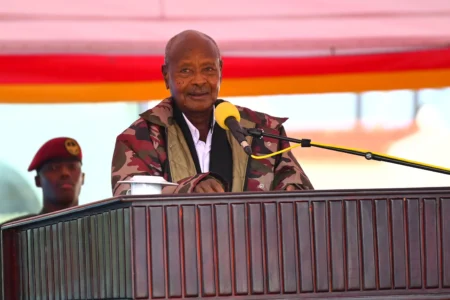
Yoweri Museveni has consistently defended government-led investments as necessary to drive industrialisation, job creation and technological advancement, particularly in sectors where private capital may be reluctant to invest.
Also Read: Uganda succession debate: What happens after Museveni?
Officials have previously argued that strategic state intervention is essential for long-term economic transformation, even where projects carry inherent risks.
Mwenda’s critique ultimately feeds into a broader national debate over how Uganda should balance ambition in industrial development with fiscal discipline and accountability.
While state-backed mega projects can accelerate structural transformation, economists caution that their success depends heavily on rigorous due diligence, transparent procurement processes and sustained oversight.
As Uganda continues to pursue large-scale investments, the tension between rapid development and prudent financial management is likely to remain a defining issue in the country’s economic policy landscape.