


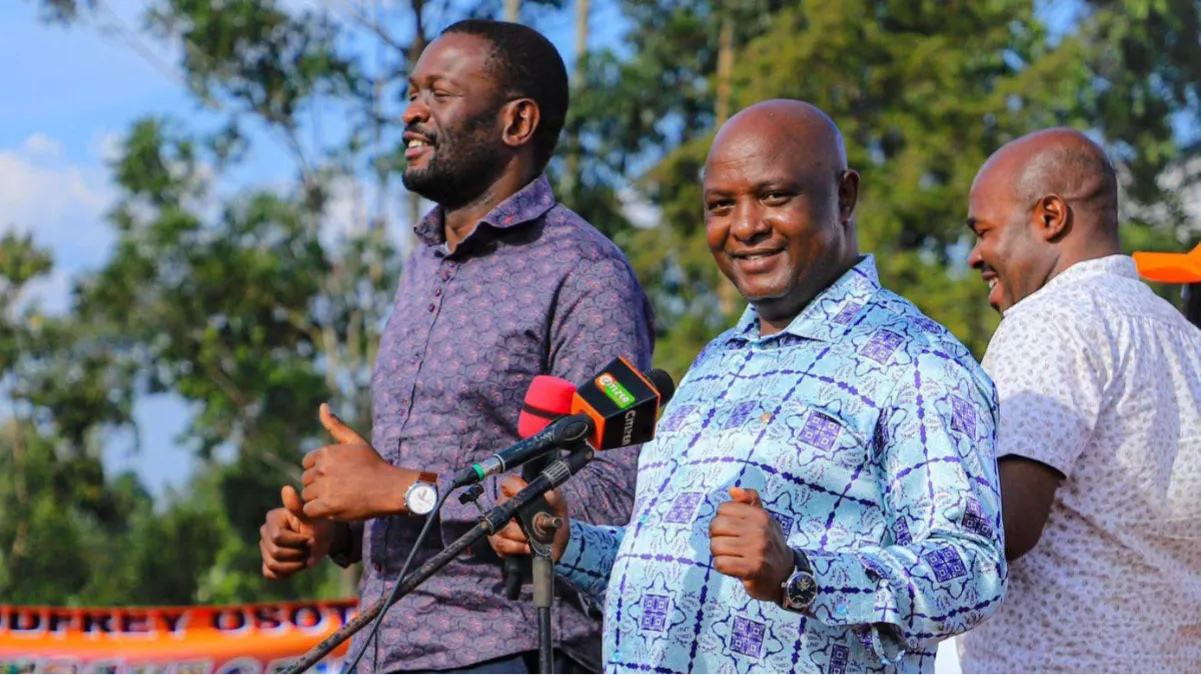
NAIROBI, Kenya — Godfrey Osotsi has stepped down as Deputy Party Leader of the Orange Democratic Movement (ODM), confirming he will not challenge his removal through legal channels.
Addressing the development, Osotsi acknowledged the decision to strip him of the influential position and said he had chosen to move on.
“They have taken away my position as Deputy Party Leader. Today, I announce that I will not go to court and I will not defend myself there. I have let go of that seat,” he said.
He further revealed that he has assumed a new role as Deputy Party Leader within the Linda Mwananchi movement, loosely translated as “Protect the Citizen”, led by Nairobi Senator Edwin Sifuna, signalling a shift in his political alignment.
Osotsi was appointed ODM deputy party leader in 2023 during a leadership reorganisation led by Raila Odinga. The reshuffle was aimed at strengthening party structures following the 2022 General Election and consolidating ODM’s position within the Azimio coalition.
His appointment was widely interpreted as a strategic move to bolster ODM’s foothold in western Kenya, where he has maintained a strong political presence.
However, his tenure was marked by internal disagreements within the party, particularly over questions of loyalty and positioning in relation to the current administration.
His removal comes amid broader leadership changes within ODM, including recent restructuring decisions at the party’s Special Delegates Conference.
These developments have exposed underlying divisions within the party, with some members questioning the direction of its leadership and strategy.
Political analysts point to growing tensions over how ODM engages with national politics, especially amid reports of potential cooperation or dialogue with the ruling United Democratic Alliance (UDA).
Osotsi’s decision not to pursue legal redress has been interpreted as an attempt to de-escalate tensions and avoid a prolonged internal dispute that could further fragment the party.
His move to Linda Mwananchi suggests a broader political recalibration. The platform has increasingly positioned itself as an alternative voice for leaders dissatisfied with mainstream party structures.
While its national influence remains limited, the entry of figures such as Osotsi could strengthen its visibility and organisational capacity ahead of future political contests.
Osotsi’s exit highlights a critical phase of transition within ODM, where internal cohesion is being tested against shifting political realities.
His decision to step aside without legal challenge reflects a calculated political move, prioritising long-term positioning over immediate confrontation.
Also Read: ODM ratifies Oburu Oginga as party leader, drops Godfrey Osotsi from Deputy role
By avoiding a court battle, he preserves political capital while aligning himself with an emerging platform that may offer new opportunities.
For ODM, the departure underscores ongoing internal strains, particularly around loyalty, leadership restructuring, and strategic direction.
The party’s ability to manage dissent while maintaining unity will be central to its relevance heading toward the 2027 general election.
At a broader level, the episode illustrates the fluidity of Kenya’s political landscape, where alliances are increasingly dynamic and individual leaders are repositioning themselves in response to evolving power structures.
Osotsi’s shift may not immediately alter the national balance of power, but it signals the gradual emergence of alternative political formations that could reshape alignments in the years ahead.
