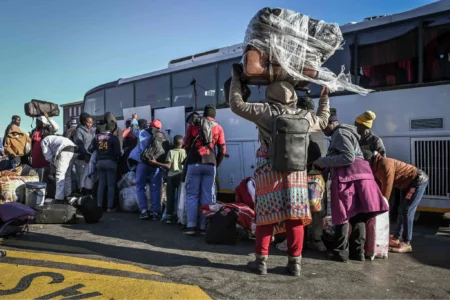


JOHANNESBURG, South Africa — Nearly two decades after one of the deadliest outbreaks of xenophobic violence in South Africa’s democratic history, foreign nationals are once again fleeing attacks, abandoning businesses and boarding evacuation flights home.
The scenes unfolding across South Africa in 2026 are disturbingly familiar.
Migrants from across Africa have reported assaults, looting and intimidation as anti-migrant demonstrations spread through several provinces.
Governments including Uganda, Nigeria, Ghana, Malawi, Zimbabwe and Mozambique have organised emergency repatriation efforts, while thousands of foreign nationals have left the country voluntarily.
The latest violence has revived a question that has haunted South Africa since the deadly attacks of 2008:
Why does xenophobic violence keep returning?
A cycle that never truly ended
In May 2008, violence targeting foreign nationals left more than 60 people dead and displaced tens of thousands.
The attacks shocked South Africa and prompted promises from government leaders, civil society organisations and international partners that such events would never be repeated.
Yet similar violence resurfaced in 2015, 2019 and now 2026.
Each time, the pattern has been strikingly similar: economic frustration, political rhetoric, anti-migrant mobilisation and attacks on foreign-owned businesses.
The latest unrest comes as South Africa continues to grapple with high unemployment, deep inequality, rising living costs and growing public frustration over service delivery failures.
The politics of blame
One of the most persistent explanations offered by anti-migrant groups is that foreigners are taking jobs, housing and economic opportunities from South Africans.
This narrative has become increasingly prominent ahead of local government elections scheduled later this year.
Groups leading recent demonstrations have openly called for mass deportations of undocumented migrants, arguing that immigration is worsening unemployment and crime.
But economists and migration researchers have repeatedly found little evidence that migrants are responsible for South Africa’s structural economic challenges.
Instead, critics argue that migrants have become convenient political targets in a country struggling with longstanding governance failures.
Why previous responses have fallen short
Successive governments have condemned xenophobic violence.
Civil society groups have organised awareness campaigns, marches, dialogue forums and social cohesion programmes.
Yet the violence continues.
One reason is that many interventions focus on the symptoms rather than the underlying drivers.
Public messaging campaigns may encourage tolerance, but they do little to address unemployment, inequality, corruption and declining public trust in institutions.
When economic hardship intensifies, frustrations often find expression through hostility toward outsiders.
Beyond ‘victim journalism’
Migration experts have also questioned how xenophobia is covered.
Much reporting focuses on migrants as victims, highlighting suffering, displacement and loss.
While these stories are important, they can oversimplify a much more complex reality.
Migration reshapes communities.
It creates new economic opportunities but can also generate competition over scarce resources.
Many South Africans living in poor communities face genuine hardships, including unemployment, inadequate housing and limited access to services.
Acknowledging these realities does not justify violence.
However, ignoring them can make it harder to understand why anti-migrant sentiment gains traction.
The stories rarely told
The dominant narrative often portrays migrants as victims and South Africans as perpetrators.
Reality is more complicated.
Across South Africa, millions of citizens live peacefully alongside foreign nationals.
Also Read: Malema condemns xenophobic attacks in South Africa, rejects blame on migrants
Many communities actively protect migrant-owned businesses during periods of unrest.
Many South Africans recognise that migrants are not responsible for their economic struggles.
Likewise, migrants themselves are not a uniform group. They bring different histories, cultures, ambitions and challenges.
Understanding these complexities is essential if South Africa hopes to break the cycle of violence.
A warning from 2026
The current crisis suggests that the lessons of 2008 remain largely unlearned.
While the names of the victims change and the political context evolves, the underlying conditions remain remarkably familiar.
Until South Africa addresses the deeper issues driving public frustration — unemployment, inequality, corruption and weak public services — anti-migrant violence is likely to remain a recurring feature of the country’s political and social landscape.
The latest repatriation flights may move people out of danger.
They do not solve the problem that keeps bringing South Africa back to this point.