

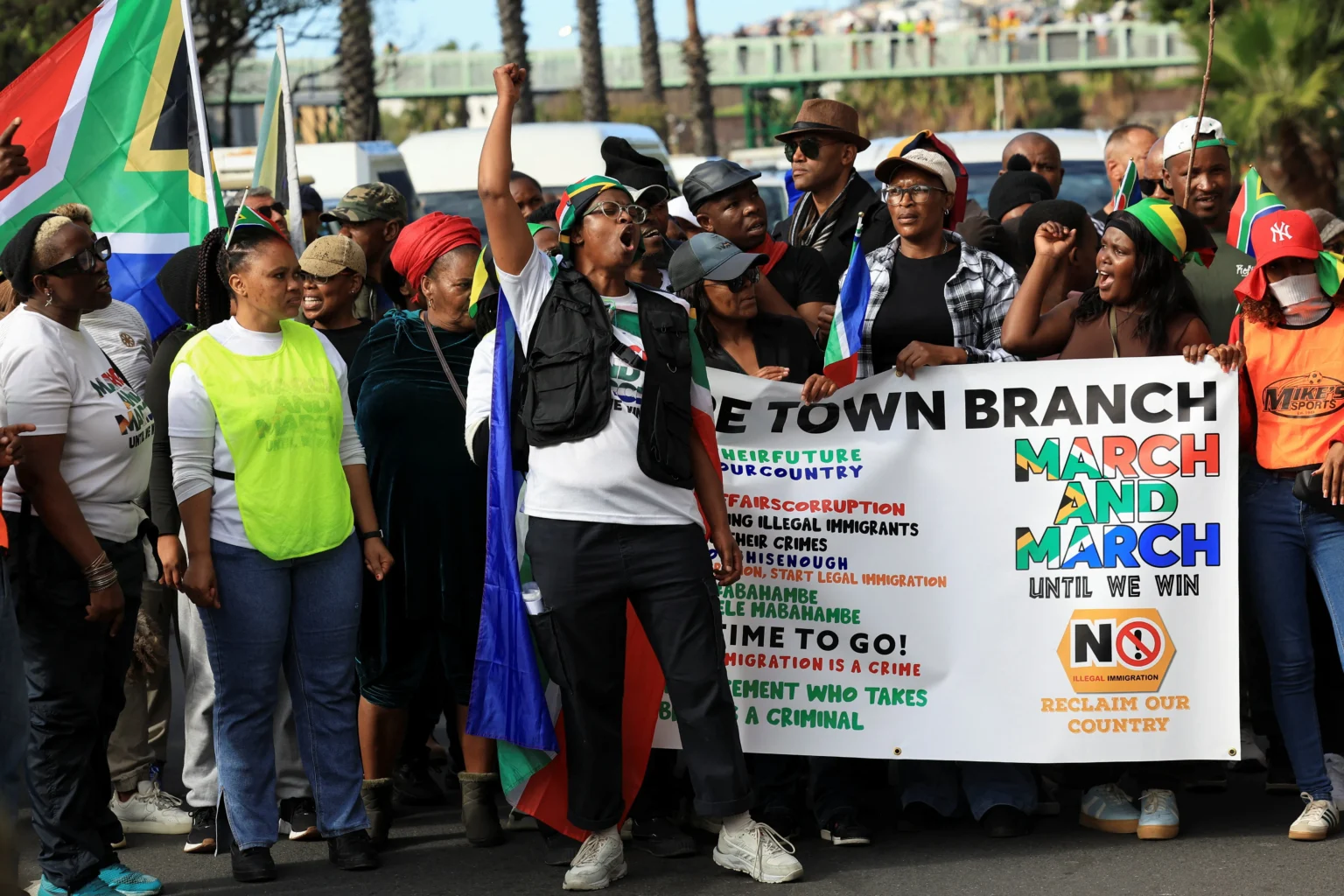
JOHANNESBURG, South Africa — Thousands of people marched in cities across South Africa on Tuesday 30, June 2026 demanding the removal of undocumented foreign nationals, culminating weeks of anti-immigration demonstrations that have already displaced thousands and left at least four people dead.
The nationwide protests followed a campaign led by citizen vigilante groups that had issued an unofficial June 30 deadline for undocumented migrants to leave the country. Demonstrators took to the streets in major cities including Johannesburg, Durban and Cape Town, calling for stricter immigration enforcement and mass deportations.
Security forces were deployed across the country amid fears of violence and unrest, with police maintaining a heavy presence in key urban centres.
In Johannesburg, South Africa’s economic hub, large crowds marched through the city centre carrying national flags and placards. Many businesses remained closed, public transport activity was reduced and security personnel monitored the demonstrations.
Police were forced to intervene in isolated incidents, including reports of looting, stone-throwing and confrontations involving foreign nationals.
In one incident near Johannesburg, security officers escorted a group of foreign nationals away from an angry crowd armed with sticks.
In Durban, demonstrators marched in traditional Zulu attire, carrying spears, shields and whips, reflecting the strong mobilisation in KwaZulu-Natal province.
Meanwhile, in Cape Town, participation was more limited, with around 100 protesters joining a march through the city centre. The demonstration was met by a smaller counter-protest opposing xenophobia and anti-African sentiment.
Many protesters argued that undocumented migrants were competing with South Africans for jobs, housing and business opportunities at a time when the country continues to struggle with economic challenges.
South Africa’s unemployment rate remains above 30 percent, while many communities face persistent poverty, crime and declining public services.
Brightness Gumbi, a 48-year-old demonstrator, said economic hardship had contributed to growing frustrations.
She claimed that local entrepreneurs struggled to secure business premises while foreign nationals appeared to operate successfully.
“I hope through these demonstrations our president will hear our cries and enforce stricter laws,” she said.
However, analysts and migration experts have repeatedly challenged claims that migrants are responsible for South Africa’s economic difficulties, arguing that foreigners are often being unfairly blamed for broader governance and economic failures.
Among the groups leading the demonstrations was the anti-immigration movement March and March, whose leaders demanded stronger action against undocumented migrants.
Speaking to supporters in Durban, movement leader Jacinta Ngobese-Zuma called for large-scale deportations.
“We want mass deportation,” she said.
“For the next six months we want the government to get rid of the people who have not left.”
The demonstrations have intensified pressure on President Cyril Ramaphosa’s government to address concerns over immigration while also preventing further violence.
The latest anti-migrant campaign has already been linked to deadly violence.
According to police, at least four foreign nationals have been killed during recent unrest, including two Mozambicans, one Ethiopian and one Malawian.
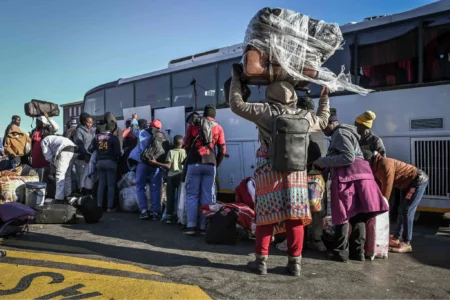
Thousands of migrants have reportedly fled affected communities amid fears of attacks.
Several African governments, including Nigeria, Malawi, Ghana, Zimbabwe and Mozambique, have organised voluntary repatriation programmes for citizens seeking to leave South Africa.
Authorities said more than 25,000 people had already been processed for departure in recent weeks.
Across major cities, hundreds of migrants gathered at collection points awaiting transport assistance to return home.
Many said they had lost jobs or housing as landlords and employers feared being targeted during the campaign.
A 23-year-old Zimbabwean woman waiting for assistance described the growing sense of insecurity.
“The people in South Africa, they don’t want us here. I’m scared,” she said.
Others said they had decided to leave after receiving warnings from neighbours or hearing reports of violence.
“I felt that it is better to try and get home while I still can,” said Adam John, a Malawian national preparing to leave Durban.
Concerned about a repeat of previous episodes of violence, the South African government deployed large numbers of security personnel ahead of the protests.
President Ramaphosa announced additional measures aimed at tackling undocumented immigration while urging community and traditional leaders to help prevent violence.
He called on influential local leaders to use their authority to calm tensions and discourage attacks on foreign nationals.
South Africa has experienced repeated outbreaks of anti-immigrant violence over the past two decades.
In 2008, xenophobic attacks left 62 people dead and displaced thousands.
Also Read: Malema condemns xenophobic attacks in South Africa, rejects blame on migrants
More recently, periodic unrest targeting foreign nationals has resurfaced amid economic hardship and political tensions.
Analysts say the latest campaign comes at a sensitive time, with local government elections scheduled for November.
Labour analyst Dale McKinley argued that immigration had become a political issue being exploited for electoral gain.
“The issue has been politically weaponised,” he said.
As authorities work to prevent further violence, the protests have once again highlighted South Africa’s complex relationship with migration, economic inequality and social cohesion.