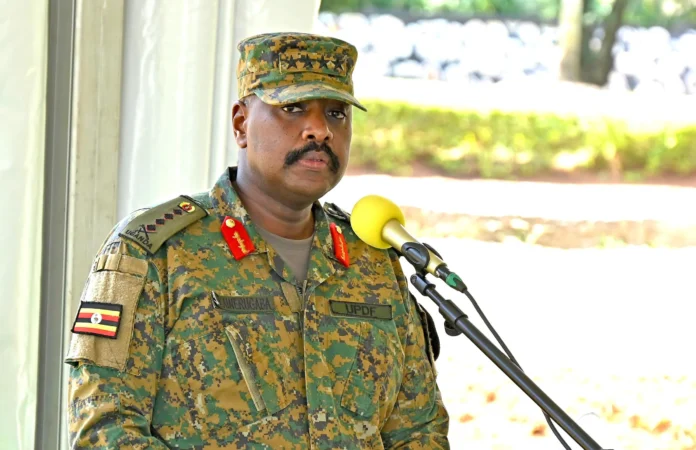


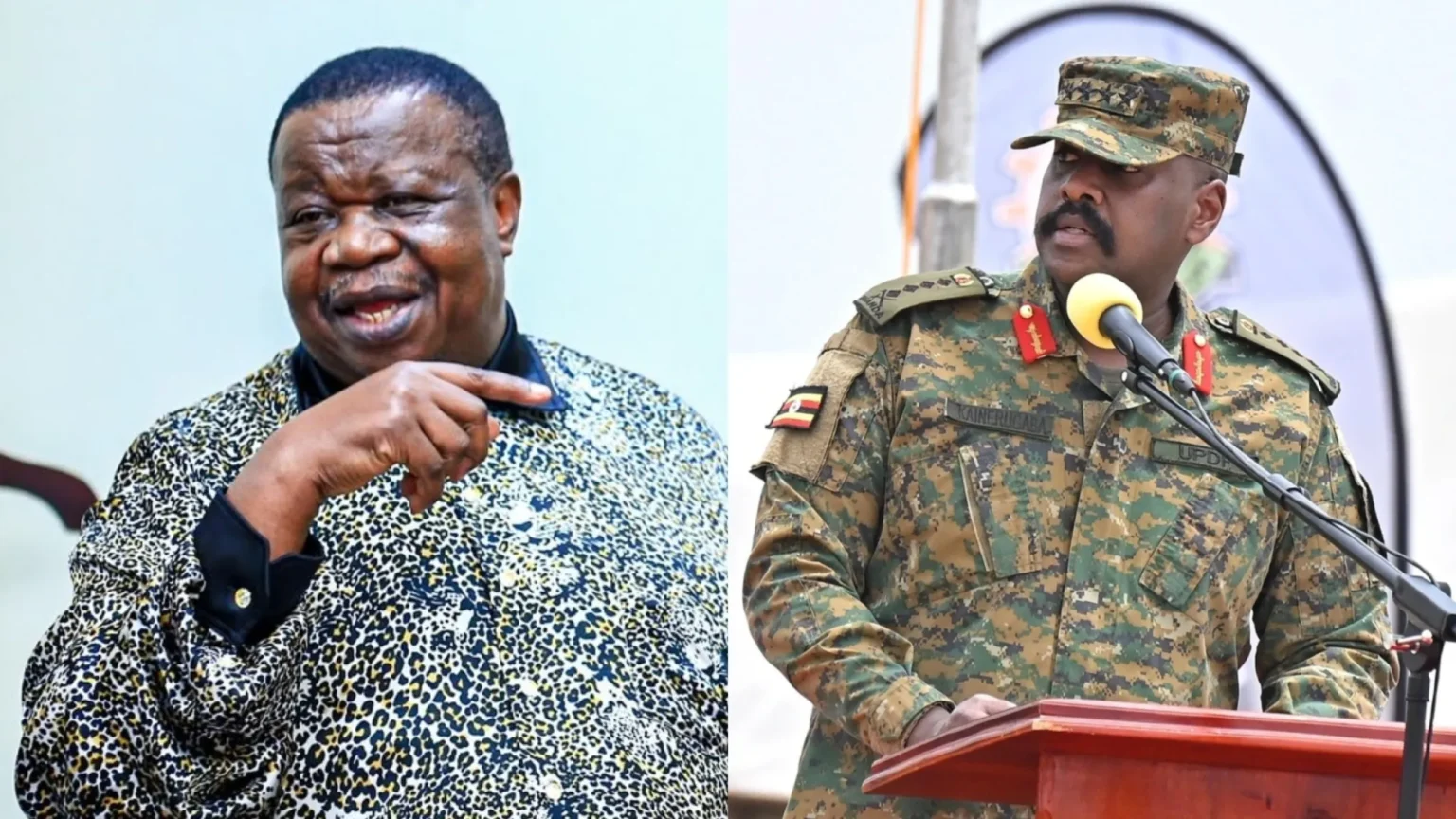
KAMPALA, Uganda — The Chief of Defence Forces (CDF) Gen. Muhoozi Kainerugaba’s latest warning that veteran politician Maj. Gen. (Rtd) Kahinda Otafiire could face arrest has reignited one of the most enduring and symbolically charged fault lines within Uganda’s ruling National Resistance Movement (NRM).
What on the surface appears to be another exchange on social media between two senior figures is, in reality, a reflection of a widening generational and ideological contest inside the ruling establishment—one that increasingly revolves around authority, succession, and the limits of military influence in politics.
The latest confrontation was triggered after Otafiire, the Minister of Water and Environment and one of the most senior surviving figures of the liberation war, publicly urged newly appointed Internal Affairs Minister Prof. Ephraim Kamuntu to act against alleged extrajudicial killings within the police’s Crime Intelligence Directorate.
In a post on X, Otafiire cautioned against “rogue officers” and warned against abuses linked to internal security operations, a statement that appeared to challenge conduct within Uganda’s security apparatus.
Gen. Muhoozi responded sharply, warning that Otafiire was “dangerously close to being arrested,” and accusing him of provoking “great officers” within Crime Intelligence.
The message, framed in combative and militarised language, immediately drew attention given Gen. Muhoozi’s dual role as Chief of Defence Forces (CDF) and one of the most politically influential figures in Uganda’s state structure.
A clash beyond personalities
While the exchange appears personal, political analysts say it reflects a deeper institutional tension between Uganda’s liberation-era establishment, often referred to as “historicals”, and a rising centre of power increasingly associated with Gen. Muhoozi and his political network.
Otafiire is part of the original FRONASA and bush war generation that fought alongside President Yoweri Museveni in the 1981–1986 guerrilla campaign. Over the decades, he has held key ministerial portfolios including Internal Affairs, Justice, Local Government, and East African Community Affairs, earning a reputation as both a blunt speaker and a fiercely independent voice within government.
Gen. Muhoozi, by contrast, represents a newer power structure within the NRM system, anchored in military leadership, presidential proximity, and an expanding political mobilisation network previously associated with the MK Movement, now rebranded as the Patriotic League of Uganda (PLU).
Long-running tensions over succession
The friction between the two figures is not new. During the height of debates over what became known as the “Muhoozi Project,” Otafiire publicly dismissed suggestions of dynastic succession, insisting that “Uganda is not a monarchy”, a remark widely interpreted as resistance to any transition plan favouring the President’s son.
He also questioned the legitimacy of parallel mobilisation structures outside formal NRM channels, positioning himself as a defender of party institutional order.
Gen. Muhoozi, in turn, has long viewed certain senior historical figures as obstacles to what his supporters describe as a “new political order” within the ruling movement.
At various points, he has used his social media platforms to openly criticise senior officials, including earlier declarations that Otafiire would “never again” serve as a minister, statements that were later contradicted by President Museveni’s decision to retain him in Cabinet.
That episode reinforced Otafiire’s political resilience within the system, highlighting the delicate balance Museveni continues to maintain between competing centres of influence.
Security rhetoric and institutional unease
What distinguishes the current confrontation is the explicit invocation of arrest and military authority in response to political criticism.
Otafiire’s recent comments at a ministry handover ceremony, where he suggested that sections of the police ignored directives and concealed information, already signalled rare public discomfort from a senior insider within the security architecture.
His remarks that “if someone wants to hang himself, give them enough rope” were widely interpreted as an acknowledgment of systemic dysfunction within parts of the security establishment.
Gen. Muhoozi’s response, framed in militarised and punitive language, has raised concerns among observers about the normalisation of coercive rhetoric in political discourse, particularly when directed at sitting cabinet ministers and historical figures.
A struggle over the NRM’s future identity
Beyond the immediate exchange, the confrontation highlights a broader struggle over the identity and direction of the NRM as Uganda approaches a post-Museveni political era.
On one side are liberation-era veterans like Otafiire, who emphasise institutional continuity, ideological discipline, and historical legitimacy derived from the bush war.
Also Read: Uganda tensions rise as Gen Muhoozi targets opposition leaders
On the other is a rising power bloc associated with Muhoozi, characterised by a more centralised command style, personalised political messaging, and strong influence within the security sector.
Analysts say these tensions are likely to intensify as questions over succession become more pronounced, especially given Museveni’s long tenure and the absence of a clearly defined transition framework.
Strategic implications
The repeated public clashes also raise questions about civil–military relations in Uganda’s political system, particularly when senior military figures engage directly in partisan disputes or issue threats against civilian politicians.
While both men remain firmly embedded within the ruling establishment, the public nature of their disagreements exposes internal disagreements that are typically managed behind closed doors.
For now, Otafiire retains his position within Cabinet, while Gen. Muhoozi continues to consolidate his influence within both military and political structures.
But the underlying rivalry between the two reflects more than personal animosity, it is a window into a shifting balance of power inside Uganda’s ruling movement, where questions of authority, loyalty, and succession remain unresolved and increasingly contested.