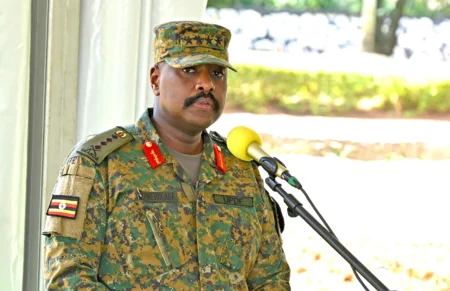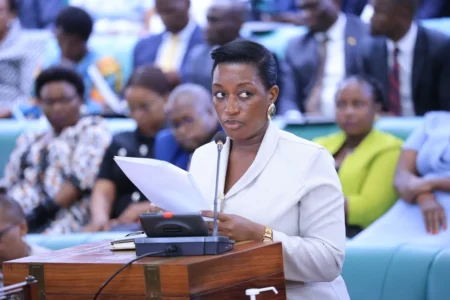
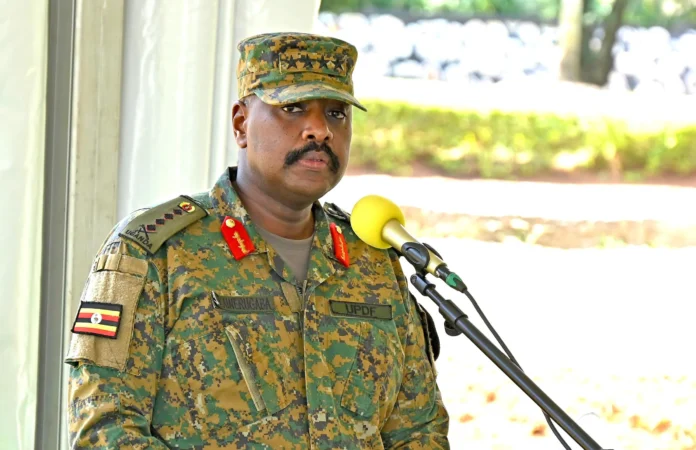


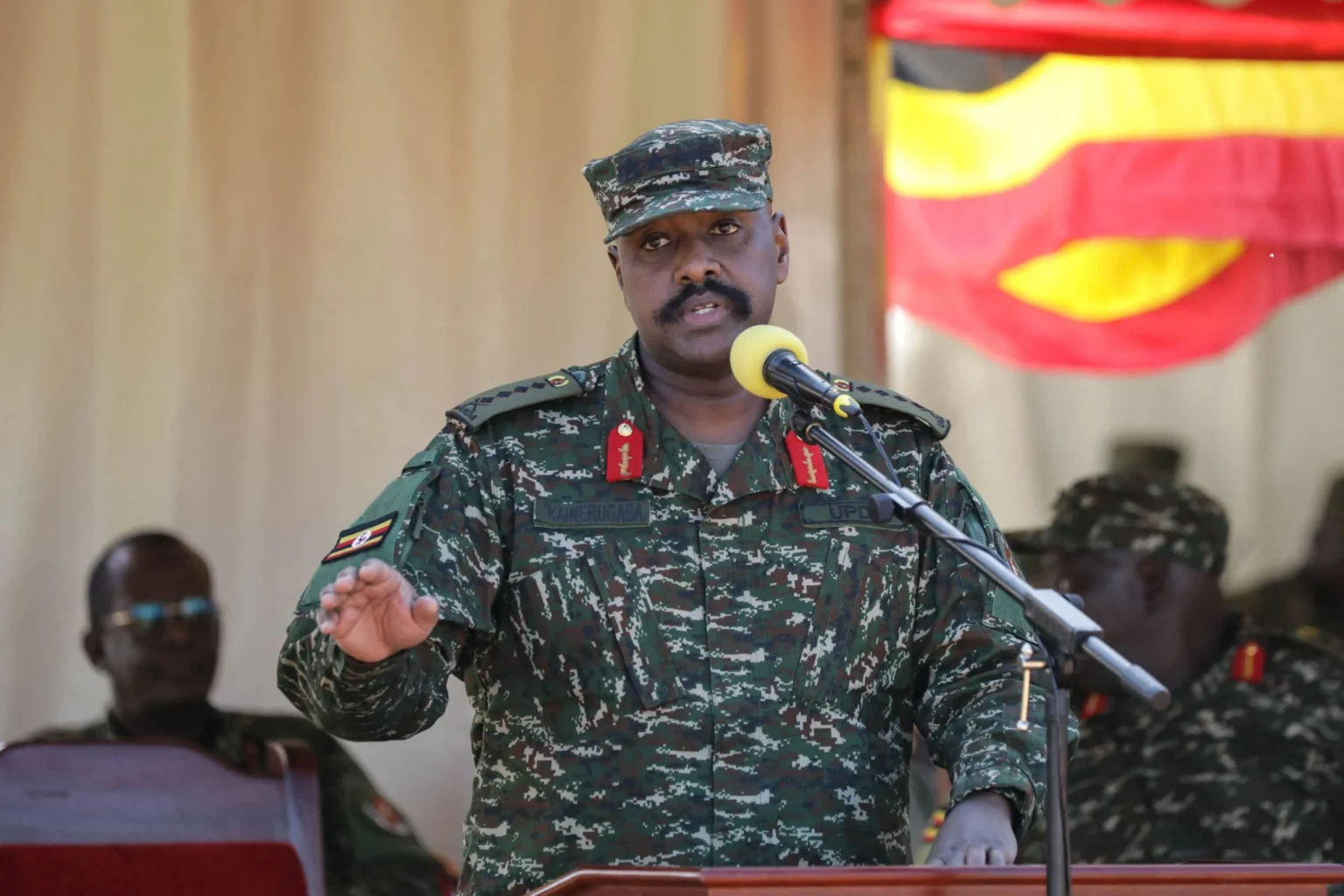
KAMPALA, Uganda — Gen Muhoozi Kainerugaba’s latest public declarations targeting the Leader of the Opposition (LoP) in Parliament, Joel Ssenyonyi, mark a further intensification of a pattern that has increasingly blurred the line between military authority and partisan political influence in Uganda.
In a series of posts on X on June 18, 2026, the Chief of Defence Forces (CDF) stated that he intends to see Ssenyonyi removed from his position and replaced with a candidate of his choosing, whom he said would be “endorsed” by him.
He further indicated that he had instructed the Patriotic League of Uganda (PLU), a political mobilisation platform associated with his supporters, to explore mechanisms for removing the opposition leader from office.
Taken in isolation, such remarks could be dismissed as rhetorical political provocation. However, in the context of Uganda’s evolving civil–military political environment, they carry deeper institutional implications. The fact that they are issued by a serving army chief elevates them beyond standard political commentary into the realm of state power signalling.
The most striking aspect of the latest exchange is not only the intention expressed, the replacement of a sitting parliamentary opposition leader, but the manner in which it is framed: as a personal objective backed by organisational mobilisation.
Gen. Muhoozi’s assertion that a successor “will be endorsed by me” introduces a direct personalisation of institutional political outcomes, raising questions about the independence of parliamentary processes from executive or military influence.
His remarks were met with immediate alignment from allies within the PLU structure. Kasambya County MP David Kabanda publicly responded, “Ok Sir. Mine is to implement,” to which the army chief replied, “Thank you comrade!”
The exchange underscores a political ecosystem in which military leadership, allied political actors and mobilisation networks appear increasingly intertwined in messaging and intent.
The escalation did not end there. Gen. Muhoozi further stated that he had instructed PLU to examine pathways for Ssenyonyi’s removal and warned that both the opposition leader and former MP Ibrahim Ssemujju Nganda could face imminent arrest.
Such statements, directed at elected legislators, raise constitutional and institutional concerns, particularly given the separation traditionally expected between military command structures and civilian political contestation.
This pattern is not new. Over recent years, Gen Muhoozi has become known for a series of provocative social media interventions targeting opposition figures. These have included threats directed at veteran opposition leader Dr Kizza Besigye and National Unity Platform (NUP) leader Bobi Wine, both of whom have been central figures in Uganda’s opposition landscape.
In several instances, he has used public platforms to suggest punitive measures, including arrest and, in earlier controversial posts, even extreme punitive language that drew domestic and international attention.
The latest remarks against Ssenyonyi therefore appear to extend an established trajectory rather than represent an isolated incident. What distinguishes this episode, however, is the explicit focus on parliamentary leadership itself — a position that, while political in nature, is anchored in formal legislative processes and party structures.
Critically, Uganda’s constitutional framework provides for civilian supremacy in governance, with the military expected to remain apolitical in its institutional conduct. However, the increasing visibility of senior military figures in partisan discourse has fuelled debate about whether this boundary is being eroded in practice.
Supporters of Gen Muhoozi’s public posture often argue that his statements reflect political opinion rather than institutional policy. Yet the weight of his position as Chief of Defence Forces (CDF) inevitably complicates that distinction.
In systems where military leadership is tightly linked to state authority, public political statements carry implicit institutional resonance, regardless of intent.
For opposition figures, the implications are more immediate. The combination of public criticism, alleged surveillance, reported arrests of political associates, and direct threats against officeholders contributes to a climate of uncertainty.
The warning that opposition leaders could be arrested, in particular, raises concerns about whether political disagreement is increasingly being framed through a security lens.
At the parliamentary level, the suggestion that the Leader of the Opposition (LoP) could be “removed” through externally driven mobilisation efforts also raises procedural questions.
The position is not appointed by executive discretion but is determined by parliamentary majority structures within opposition ranks.
Any attempt to influence its occupancy outside formal political mechanisms would therefore raise constitutional and institutional concerns.
Also Read: Byanyima condemns Lukwago detention, accuses Muhoozi of undermining rule of law
What is unfolding, therefore, is not simply a personal feud between political actors, but a broader stress test of institutional boundaries in Uganda’s governance system.
The intersection of military authority, political mobilisation and legislative leadership is becoming increasingly visible, particularly through digital platforms where political messaging is immediate and unfiltered.
Ultimately, Gen Muhoozi’s latest interventions reinforce an emerging reality: Uganda’s political contestation is no longer confined to parliamentary chambers or party structures alone. It is increasingly shaped in the public digital space by actors whose institutional roles carry both formal authority and political weight.
As these dynamics evolve, the central question is not only about individual statements, but about institutional precedent, and whether repeated public assertions of political intent by senior military leadership are gradually redefining the expected limits of civil–military separation in Uganda’s political order.