



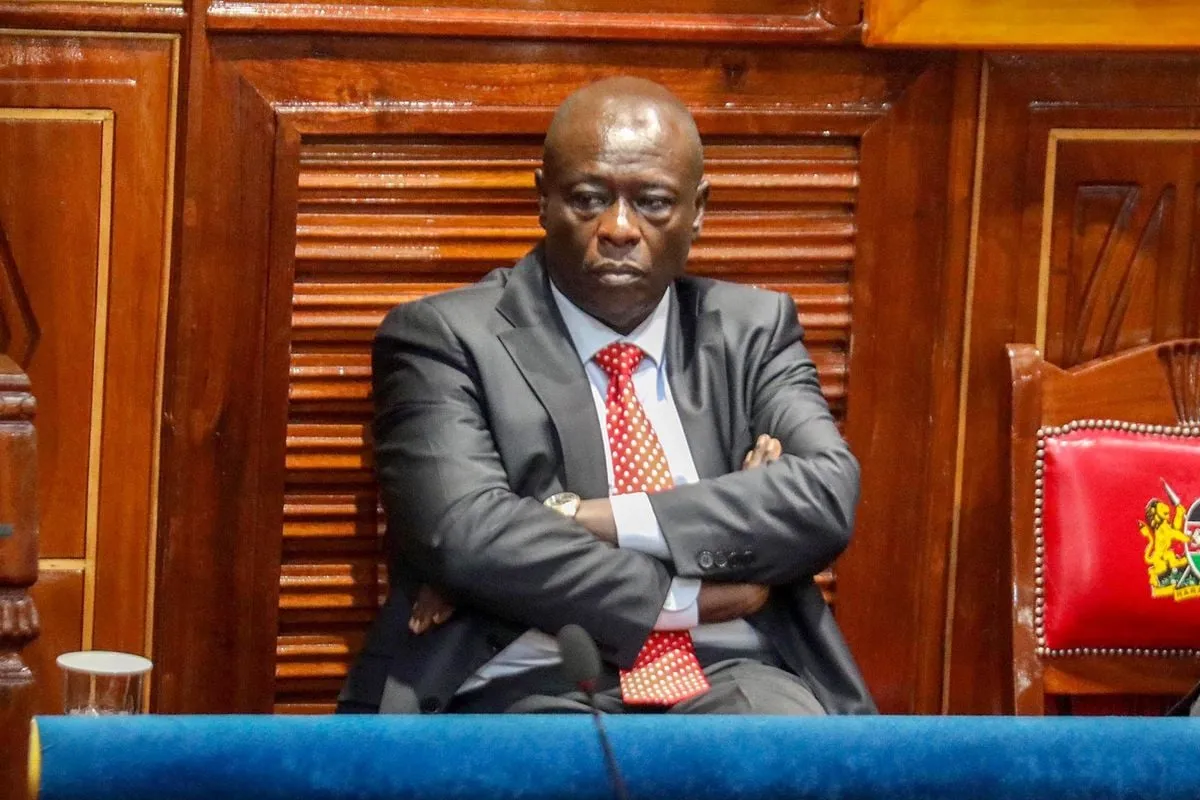
NAIROBI, Kenya — Former Deputy President Rigathi Gachagua suffered a major legal defeat on Monday after the High Court upheld his impeachment, ruling that Parliament acted within the Constitution and followed due process in removing him from office.
In a landmark judgment delivered nearly 20 months after his ouster, a three-judge bench comprising Justices Eric Ogola, Anthony Mrima and Freda Mugambi dismissed consolidated petitions challenging the October 2024 impeachment, finding that both the National Assembly and the Senate acted lawfully and within their constitutional mandate.
The ruling cements Gachagua’s removal from office and validates the subsequent appointment of Deputy President Kithure Kindiki, bringing one of Kenya’s most consequential constitutional and political disputes closer to its conclusion.
The court rejected claims that the impeachment process was unconstitutional, politically predetermined, procedurally flawed, or conducted without meaningful public participation.
Court rejects bias claims against MPs and Senators
A central pillar of Gachagua’s challenge was the argument that lawmakers who participated in the impeachment process were biased and had already predetermined the outcome.
However, the court found no evidence to support allegations of bias, conflict of interest, or bad faith among Members of Parliament and senators.
Delivering the judgment, Justice Ogola held that the accusations were based on political assumptions rather than objective evidence.
“The allegations of bias, predetermination and conflict of interest advanced against the Speakers, MPs and senators are unsubstantiated. They rest on political inference and suspicion rather than objective evidence capable of satisfying the required threshold,” the court ruled.
The judges noted that impeachment is inherently a political-constitutional process and that elected representatives are not expected to approach such proceedings without prior political views or knowledge of the issues involved.
“The mere fact that members supported or opposed the impeachment of His Excellency Gachagua cannot, standing alone, establish constitutional bias,” Justice Ogola stated.
The bench emphasized that the Constitution requires legislators to remain open to evidence and arguments during proceedings rather than being politically neutral.
“Legislators are not expected to approach impeachment as blank slates, devoid of political opinion or prior knowledge,” the court observed.
Parliament’s public participation process upheld
The court also upheld the public participation exercise conducted by the National Assembly, dismissing arguments that the process failed to meet constitutional standards.
According to the judges, the evidence demonstrated that Parliament undertook a nationwide public participation exercise that was open, accessible and conducted in good faith.
“The evidence before this court shows that the door was opened widely, accessibly, and in good faith,” the bench ruled.
The judges acknowledged that large-scale national exercises may experience logistical challenges but held that isolated shortcomings could not invalidate the entire process.
“It is to be expected that logistical and operational challenges may arise in certain isolated cases. Such localised deficiencies would not invalidate the entire process,” the court stated.
The bench further rejected claims that public participation was defective because Gachagua’s response to the impeachment charges was not publicly available during the consultation period.
“The purpose of public participation in the impeachment process is substantively and functionally distinct from the adversarial hearing to which the respondent is entitled. It was not and was never intended to be a mini trial of the charges,” the court held.
Court affirms judiciary’s oversight role
While upholding the impeachment, the judges reaffirmed that impeachment proceedings remain subject to judicial review whenever constitutional violations are alleged.
“We find that the impeachment proceedings challenged in these petitions are justiciable and that this Court possesses jurisdiction under Articles 22, 23 and 165 of the Constitution,” Justice Ogola said.
However, the bench clarified that courts cannot substitute Parliament’s political judgment with their own assessment of whether impeachment charges are sufficiently serious.
“We reiterate that the court is not a political arbiter but a constitutional one,” the judgment stated.
The judges stressed that the judiciary’s role is limited to examining whether constitutional procedures were followed.
“The separation of powers does not mean separation from the Constitution,” Justice Ogola added.
Kindiki’s appointment declared constitutional
The court also dismissed challenges against the nomination and approval of Kithure Kindiki as Deputy President.
Justice Freda Mugambi held that the National Assembly conducted the approval process in an open, transparent and constitutionally compliant manner.
The bench found that Parliament’s proceedings met constitutional requirements through transparency, public accessibility and accountability.
“The debate was televised, the proceedings were recorded in Hansard, the press was free to report, and members of Parliament were directly accountable to their constituents for the manner in which they exercised their votes,” the court noted.
The judges ruled that public participation was not constitutionally required for the approval of a Deputy President nominee under Article 149.
“For the foregoing reasons, we hold that public participation was not constitutionally required for the nomination and approval of His Excellency Kindiki as Deputy President,” the court ruled.
The decision effectively validates Kindiki’s appointment and closes another significant legal challenge arising from Gachagua’s removal.
Gachagua abandons reinstatement bid
Court proceedings further revealed that Gachagua had abandoned his earlier request seeking reinstatement as Deputy President.
Instead, he is now pursuing compensation, damages and retirement benefits arising from what he argues was an unlawful removal from office.
Also Read: Court reveals Gachagua’s impeachment compensation demands
His legal team had sought declarations that Parliament violated his constitutional rights, denied him a fair hearing and failed to meet the required constitutional threshold for impeachment.
The former Deputy President is seeking compensation covering salaries, benefits, pensions and other entitlements he would have earned had he completed his term.
Historic impeachment
Gachagua was impeached in October 2024 after both the National Assembly and the Senate upheld multiple charges against him, making him the first Deputy President in Kenya’s history to be removed from office through impeachment.
Also Read: Court awards Gachagua Sh50 million in impeachment damages
The charges included allegations of gross violation of the Constitution, abuse of office, undermining the authority of the President and Cabinet, promoting ethnically divisive politics, and accumulating unexplained wealth through companies linked to him and his family.
He consistently denied the allegations, arguing that the impeachment was politically motivated and designed to force him out of office.
Despite those objections, Parliament proceeded with the impeachment, paving the way for Kindiki’s nomination and eventual appointment as Deputy President.
Monday’s judgment now represents a significant victory for Parliament and the Executive, while dealing a major setback to Gachagua’s efforts to overturn one of the most consequential political decisions in Kenya’s recent history.