


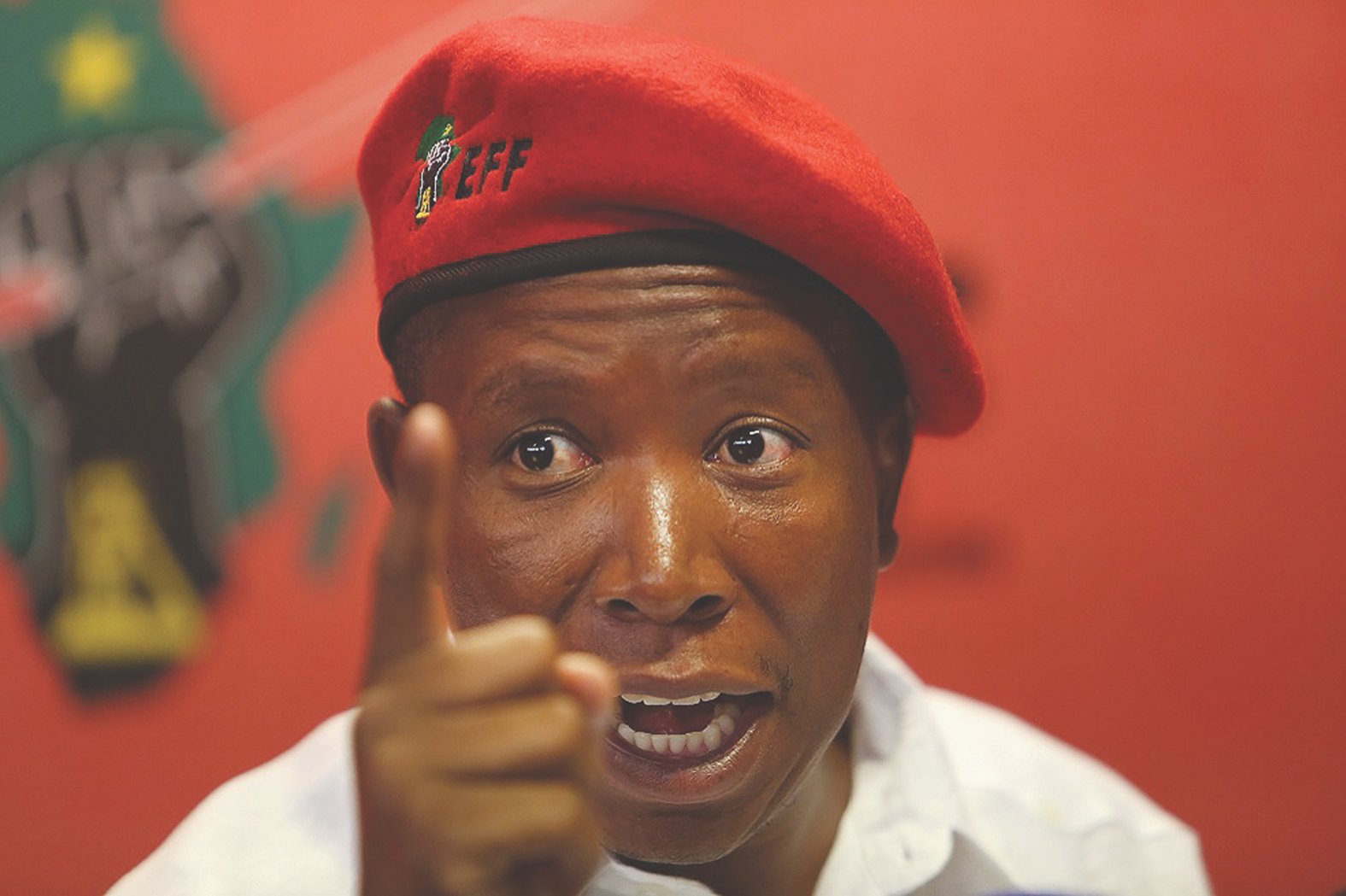
JOHANNESBURG, South Africa — South African opposition politician Julius Malema, the firebrand leader of the Economic Freedom Fighters (EFF), has been found guilty of unlawfully discharging a firearm in public, an offense that carries a maximum sentence of 15 years in prison.
The conviction stems from a 2018 incident where a video showed Malema firing multiple shots into the air during the party’s fifth-anniversary celebrations in the Eastern Cape province.
Malema was convicted on five distinct offenses, including the unlawful possession of a firearm and ammunition, discharging a firearm in a public space, and reckless endangerment. His former bodyguard, Adriaan Snyman, who was charged alongside him, was acquitted.
According to the South African news site SowetanLIVE, Malema was accused of firing between 14 and 15 live rounds from a stage in front of an estimated 20,000 EFF supporters. In his defense, Malema claimed the firearm was not his and that he had fired the shots solely to energize the crowd.
It took magistrate Twanet Olivier three days to deliver the ruling, telling Malema, “you are found guilty as charged.” The case has been postponed to January 2026 for pre-sentencing arguments.
Unfazed by conviction, vows no retreat
The conviction is the second major legal setback for Malema in recent months, following his conviction for hate speech in August of this year. Malema, known for his inflammatory rhetoric against the white minority and calls for wealth transfer to the black majority 31 years after the end of apartheid, appeared undeterred by the judgment.
Outside the East London regional court, he issued a defiant statement to his supporters:
“Going to prison or death is a badge of honour. We cannot be scared of prison [or] to die for the revolution. Whatever they want to do, they must know we will never retreat,” he said.
The EFF leader immediately vowed to challenge the ruling, stating he would pursue the appeal all the way to the Constitutional Court, South Africa’s highest judicial authority.
High-profile controversies and political fallout
Malema’s prosecution originated from a case opened by the Afrikaner lobby group AfriForum, which has a contentious history with the EFF and was also instrumental in the earlier hate speech conviction.
The Equality Court ruled in August that Malema’s previous remarks—including a statement following an alleged assault on an EFF member that “No white man is going to beat me up… you must never be scared to kill. A revolution demands that at some point there must be killing”—demonstrated “an intent to incite harm.”
The EFF, however, maintains that the remarks were taken out of context.
Malema’s controversies have attracted international attention. In May, President Donald Trump featured a video of the EFF leader, including clips of him chanting “Kill the Boer [Afrikaner], Kill the farmer” and discussing land occupation, during a heated meeting with South African President Cyril Ramaphosa at the White House.
Trump cited the footage as “evidence” of an alleged genocide against white Afrikaners—a claim widely refuted by independent human rights organizations and researchers.
Also Read: UK denies entry to South African politician Julius Malema over ‘public good’ concerns
Furthermore, a month later, Malema was denied entry to the United Kingdom, with the Home Office deeming his presence “non-conducive to the public good” due to his support for Hamas and comments regarding white South Africans.
Ian Cameron, a Member of Parliament for the opposition Democratic Alliance (DA), South Africa’s second-largest party, welcomed the conviction.
“A man who fires live rounds at a political rally demonstrates exactly the kind of thuggery the EFF is prepared to unleash on South Africa,” Cameron stated, adding that the case addresses not only Malema’s conduct but also the “culture of chaos, violence and criminality that the leader of the EFF embodies and promotes.”
Legal expert Ulrich Roux told this publication that there is a “good chance” Malema could serve a prison sentence. “He now needs to present evidence to the court to show why… he should not receive the minimum sentence of 15 years,” Roux explained.
Under the South African constitution, a prison sentence exceeding 12 months “without the option of a fine” disqualifies an individual from serving as an MP, though this disqualification only takes effect once the appeal process has been fully exhausted.
