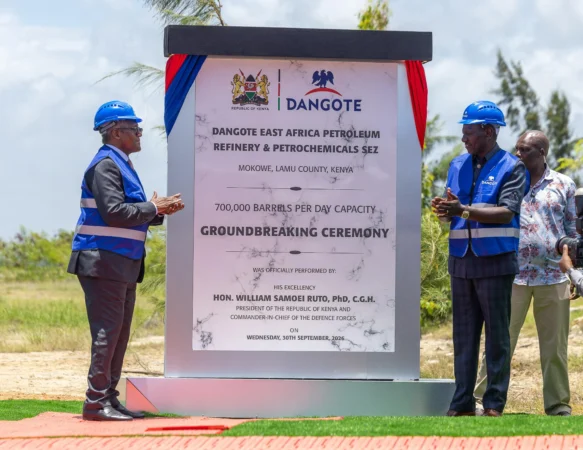




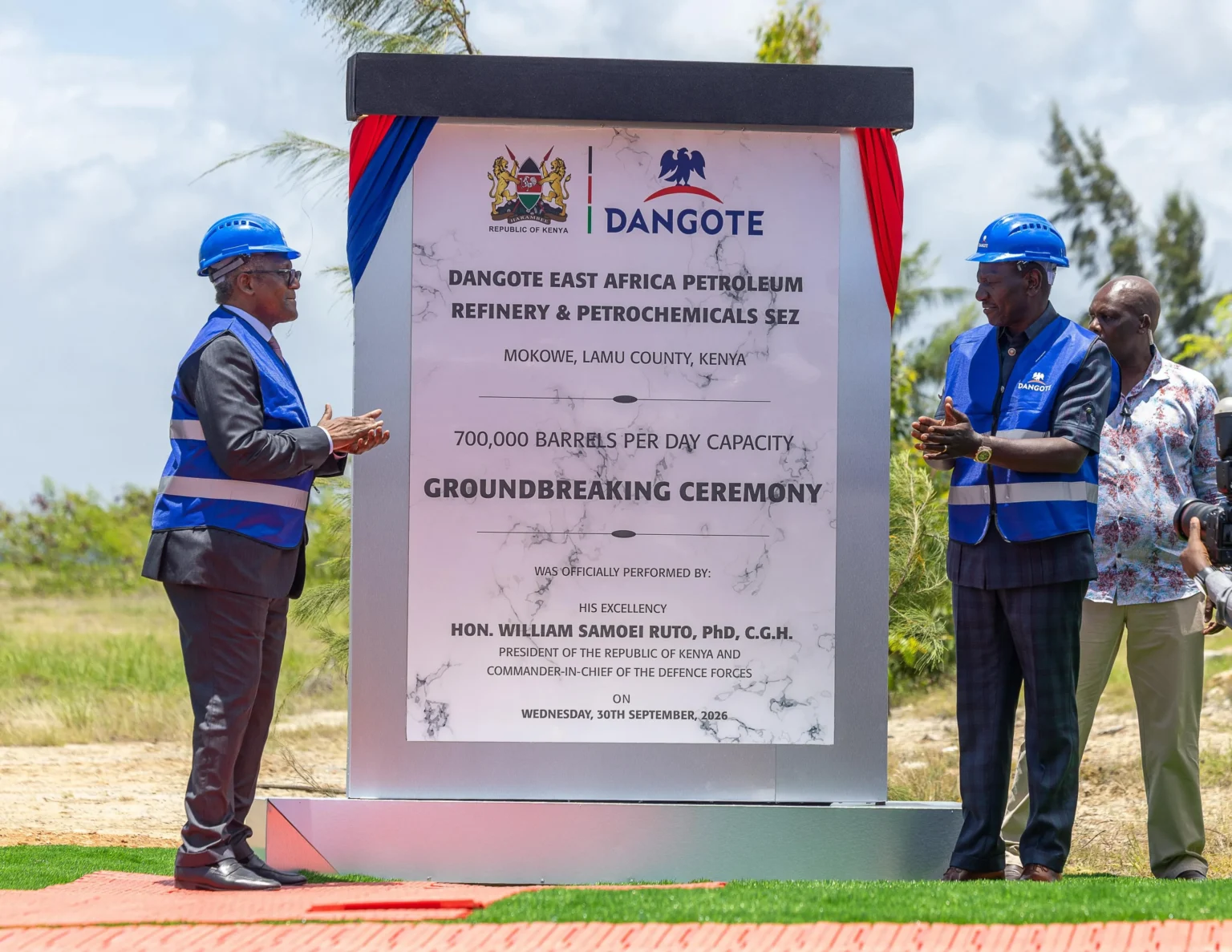
LAMU, Kenya — Businessman Aliko Dangote has promised to establish a training school in Lamu for 1,000 residents as construction begins on his planned KSh2.2 trillion East Africa Oil Refinery.
Speaking during the refinery’s groundbreaking ceremony in Lamu on Wednesday, Dangote told Governor Issa Timamy that the training programme would prepare local residents for employment opportunities arising from the project and the wider industrial development expected around it.
Dangote said the programme would target Lamu residents with engineering degrees, diplomas and other relevant qualifications.
“Before we start our first pile, which will be in the next couple of days, I want to assure you we are coming here to set up a training school that will train 1,000 of your people,” he said.
He said the aim was to equip residents with skills that could allow them to take up positions during construction and later stages of the refinery’s development.
Dangote also indicated that people with engineering qualifications would have significant opportunities as the project expands.
“Anybody who has an engineering degree or diploma or whatever has a job. His job is guaranteed,” he said.
The statement is Dangote’s commitment at the groundbreaking ceremony and does not by itself constitute a formal employment guarantee for every engineering graduate.
Jobs beyond the refinery
Dangote said the project should not be viewed simply as a facility for processing crude oil, arguing that an investment of its scale would create a much broader industrial ecosystem.
“When we build an industrial project of this kind, you don’t simply build a refinery. You build possibilities around it, which none of us can quantify,” he said.
The planned refinery is designed to process 700,000 barrels of crude oil a day and is expected to become one of the largest industrial projects in East Africa.
Dangote has previously said the wider project could require more than 60,000 workers at its peak, while government officials have separately cited employment estimates of about 50,000. The figures refer to the broader employment potential of the development and should not be interpreted as a confirmed number of permanent refinery jobs.
The group also expects businesses to emerge around the refinery, creating opportunities in areas such as engineering, logistics, manufacturing, energy and other services.
Dangote has previously said local businesses would be encouraged to supply goods and services to the project.
Lamu residents seek a share of the investment
The announcement comes after sustained calls by Lamu leaders for local residents to benefit directly from the multibillion-shilling investment.
Local leaders have urged the developers to prioritise residents for employment, training and business opportunities associated with the refinery and related infrastructure.
Governor Timamy has repeatedly called for local communities to secure a meaningful share of the economic benefits expected from the project.
The new training school could provide a route for young people with technical and engineering backgrounds to gain skills tailored to the refinery and associated industries.
The project has, however, also faced opposition from some local residents over land rights and compensation.
Also Read: Ruto vows Dangote Lamu refinery will proceed despite court dispute
A group of 133 residents has challenged aspects of the development in court, citing claims over ancestral land and compensation. The legal dispute has led to interim orders affecting activities on parts of the proposed project site.
Despite the legal challenges, Dangote and the Kenyan government proceeded with the September 30 groundbreaking ceremony.
A wider industrial project
Dangote said the refinery would create opportunities extending beyond oil processing, with associated industries expected to develop as construction progresses.
The project is expected to cost about $16 billion, with completion targeted for around 2030. It is modelled on Dangote’s large refinery in Lagos, Nigeria.
The Kenyan refinery is also expected to form part of a wider energy and industrial complex in Lamu, with a proposed power-generation component and links to regional petroleum markets.
For Lamu residents, however, the immediate focus is whether the promised training, employment and business opportunities translate into tangible benefits for the communities hosting the project.
Dangote’s pledge to train 1,000 residents is the first major local skills commitment announced at the start of construction and could become an important test of how directly the project benefits the county’s workforce.