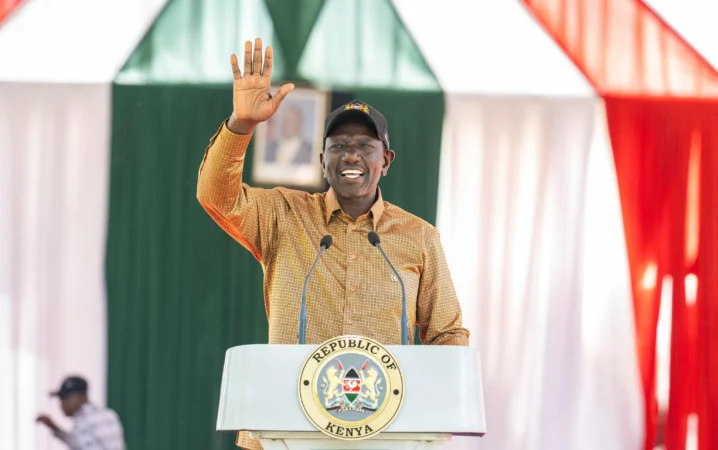


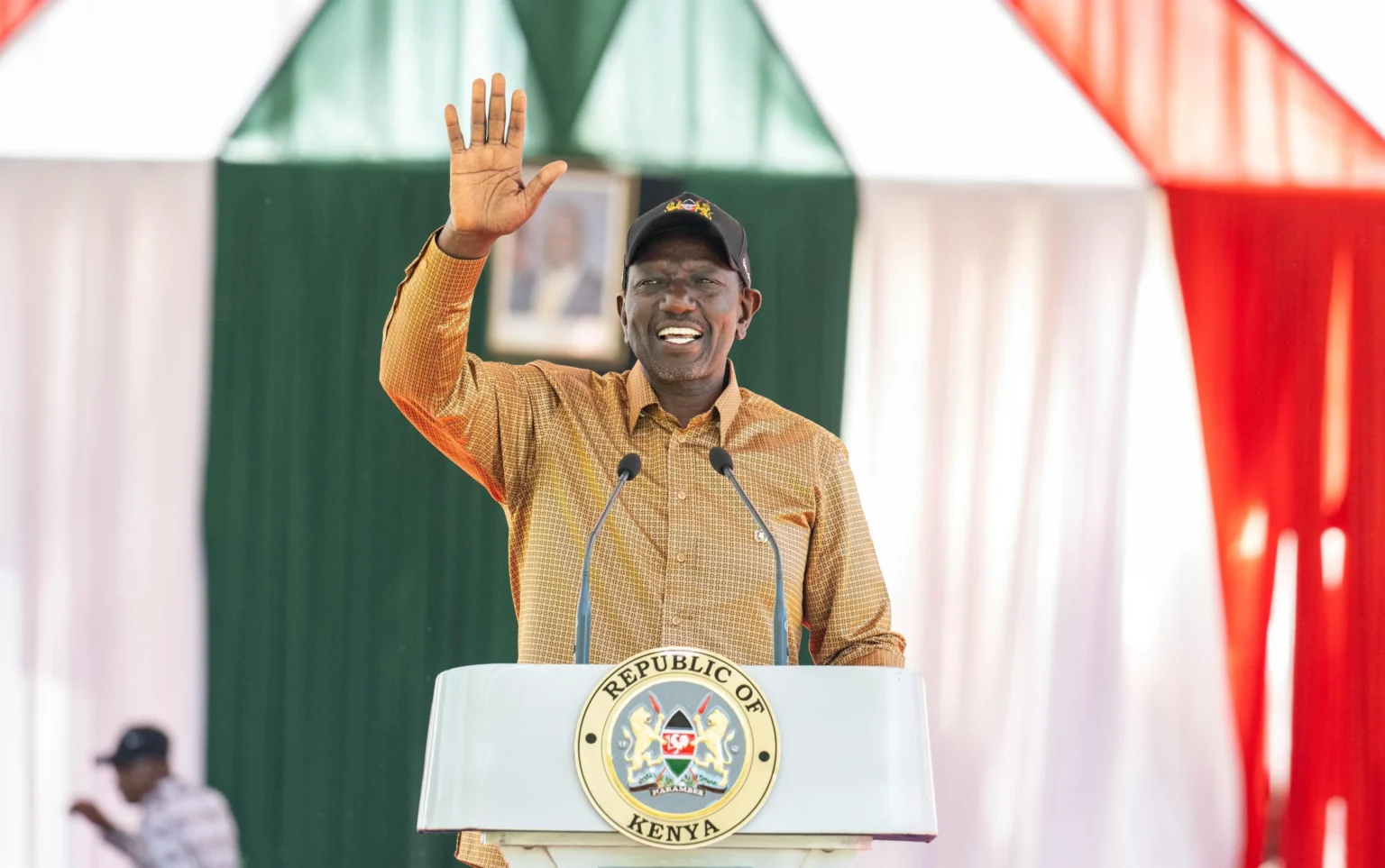
BUNGOMA, Kenya — President William Ruto has intensified his defence of his administration’s performance, declaring that his government has fulfilled its campaign commitments and deserves another five years in office.
Speaking at Nzoia Sugar Factory in Bungoma County during his Western Kenya engagements, Ruto challenged his political opponents to present their own development records rather than accuse his administration of failing to deliver on its promises.
The President maintained that his government’s performance should be judged against tangible projects and reforms, particularly in agriculture, education, healthcare and infrastructure.
“Every commitment that we made to the people of Kenya, we have done our best. And today we have a record that Kenyans can see,” he said.
He accused his competitors of criticising his administration without presenting convincing alternatives, insisting that Kenyans should examine what different political leaders have achieved before deciding who should govern the country.
“Our competitors who think that they can lie to Kenyans that we made promises that we have not kept, we are waiting for you, with a track record. We have a track record of delivery,” Ruto said.
His remarks come as political parties and opposition leaders increasingly turn their attention to the 2027 General Election, with the President seeking to make his administration’s development record a central argument for a second term.
Sugar industry becomes centrepiece of Ruto’s development defence
Ruto placed particular emphasis on reforms in the agricultural sector, using the sugar industry to illustrate what he described as a turnaround in the fortunes of Kenyan farmers.
The President cited improvements in sugarcane production and factory operations, alongside reforms in the coffee and tea sectors, arguing that farmers were beginning to receive better returns from their agricultural investments.
His remarks carry particular significance in Bungoma, where sugarcane farming supports thousands of households and the performance of Nzoia Sugar Company has long been closely linked to the region’s economic fortunes.
For years, Kenya’s sugar industry struggled with mounting factory debts, operational inefficiencies, delayed payments to farmers and competition from imported sugar.
The government subsequently pursued reforms that included leasing State-owned sugar factories to private operators, arguing that improved management would restore production and strengthen the industry.
During his November 18 State of the Nation Address, Ruto reported that sugarcane crushing increased by 57 per cent between January and October 2026, while sugar production rose by 60 per cent.
He also announced a Sh1.2 billion bonus package for sugarcane farmers, with payments expected to begin the following week.
However, the ultimate measure of the reforms will be whether farmers receive the promised payments, factories remain financially sustainable and improved production translates into consistently higher household incomes.
The sugar sector therefore offers an important test of the administration’s agricultural promises beyond the statistics presented at political gatherings.
Ruto highlights healthcare expansion and education reforms
Beyond agriculture, the President cited changes in healthcare financing and education as evidence that his government was implementing its development agenda.
He defended the transition from the National Hospital Insurance Fund (NHIF) to the Social Health Authority (SHA), arguing that the new system had expanded access to healthcare financing.
“Today health is more organised, reaches more people. The health safety net that was only available to eight million people is now available to 33.7 million people,” he said.
The government has presented increased SHA registration as a major achievement of its healthcare reforms.
However, registration figures alone do not establish whether every enrolled household can access treatment when needed. Questions surrounding claims processing, hospital payments, access to medicines and the availability of services remain important measures of the system’s effectiveness.
The Health Ministry’s October 2026 sector report put SHA registrations at 33.05 million by September 30, while the President cited 33.7 million in his November address. The difference reflects the importance of identifying the reporting date when comparing registration figures.
In education, Ruto pointed to teacher recruitment, additional classroom construction and the implementation of the Competency-Based Curriculum (CBC).
His administration has also defended changes to education financing, presenting them as part of efforts to improve access and distribute public resources more effectively.
Nevertheless, the reforms continue to face scrutiny over school funding, infrastructure requirements, teacher shortages and the financial burden on parents.
For households, the question is whether the changes are improving learning conditions and making education more affordable.
Infrastructure and housing form another pillar of Ruto’s case
The President also highlighted infrastructure development, citing approximately 7,000 kilometres of roads under construction as evidence of his administration’s investment in transport networks.
He pointed to plans to extend the Standard Gauge Railway beyond Naivasha towards western Kenya, alongside the affordable housing programme and the construction of modern markets.
Ruto said housing contracts worth approximately Sh1.2 trillion had been secured, while the government was pursuing the construction of 600 modern markets across the country.
These projects form part of the administration’s wider economic strategy, which argues that investment in infrastructure, housing and markets can stimulate construction, create employment and improve access to commercial opportunities.
But there is an important distinction between projects announced, contracts awarded, construction underway and completed infrastructure.
The number of roads being constructed, for example, should not be confused with kilometres of roads already completed and accessible to the public.
Similarly, the housing programme’s success will ultimately be judged by affordability, the number of completed homes, access to financing and whether intended beneficiaries can secure the houses.
These are the issues that will determine how far the government’s infrastructure claims translate into measurable benefits for ordinary Kenyans.
Economic performance becomes a key political battleground
Ruto also challenged his critics to engage his administration on economic performance, arguing that government statistics provided evidence of progress.
“Those challenging us about the economy, we are ready for that conversation. Our numbers, statistics speak for themselves,” he said.
Also Read: Can Ruto survive a United Opposition in Kenya’s 2027 election?
The economic debate is likely to feature prominently as the country approaches the 2027 elections.
While the government can point to its economic indicators and development investments, households will also assess its performance through the cost of food, fuel, electricity, rent, transport and access to employment.
For many Kenyans, economic recovery is meaningful only when it translates into improved purchasing power and more reliable sources of income.
This presents a challenge for the administration: defending macroeconomic progress while addressing the financial pressures that continue to shape household decisions.
The opposition, meanwhile, is likely to use the same economic pressures to question whether government policies have delivered the improvements promised during the 2022 election campaign.
A second-term argument increasingly centred on delivery
Ruto’s declaration that his administration deserves another term signals a growing effort to frame the 2027 election around its development record.
Rather than relying solely on political alliances and campaign promises, the President wants voters to assess his administration through projects, reforms and economic statistics.
But the opposition is also preparing to challenge that narrative, with political leaders expected to scrutinise the government’s record on taxation, employment, public debt, healthcare, education and the cost of living.
The contest will therefore involve more than competing claims about development achievements. It will also test whether the administration can demonstrate that its policies have produced lasting improvements in the lives of ordinary citizens.
For Ruto, the challenge is to convince Kenyans that the progress he describes justifies another five years in office.
For his opponents, the task is to establish whether they can offer a credible alternative rather than simply criticising the government.
Ultimately, the President’s declaration that his government has delivered opens a wider political question: should Kenyans judge his administration by the projects it says it has undertaken, or by the improvements they can actually see and experience in their daily lives?
That debate is likely to become increasingly important as the country moves towards the 2027 General Election.