


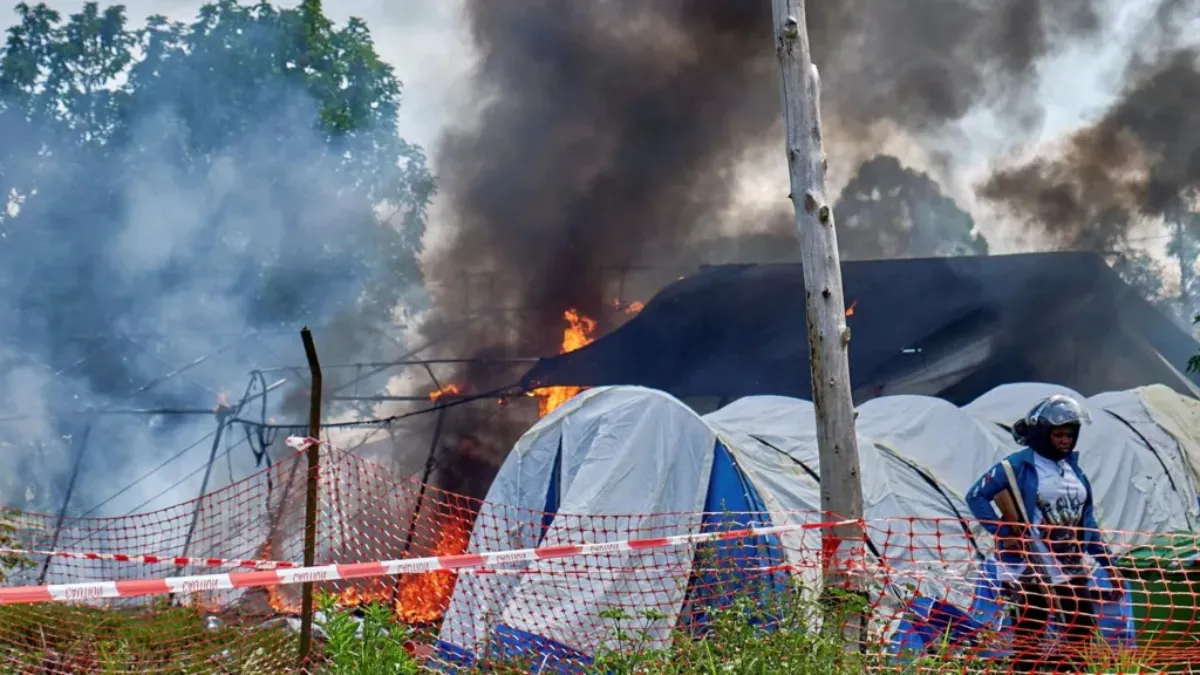
BUNIA, DR Congo — A wave of unrest has erupted at the epicentre of the Ebola outbreak in eastern Democratic Republic of Congo (DRC) after an angry crowd set fire to sections of a hospital following a dispute over the burial of a suspected Ebola victim.
The incident occurred at Rwampara General Hospital near Bunia in Ituri province, where the majority of confirmed and suspected Ebola cases have been reported.
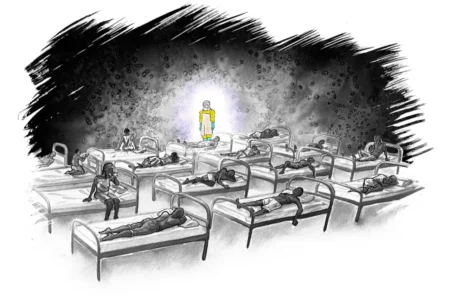
According to local officials, tensions escalated after health authorities blocked family members from taking the body of a young man believed to have died from Ebola, insisting on conducting a safe and controlled burial in line with public health protocols.
Violence erupts over burial restrictions
Local politician Luc Malembe Malembe said mourners reacted angrily, throwing stones and setting fire to isolation tents within the hospital compound.
“They started throwing projectiles at the hospital. They even set fire to tents that were being used as isolation wards,” he said.
Police were forced to intervene, firing warning shots to disperse the crowd as the situation spiralled into chaos. A healthcare worker was reportedly injured during the violence, while security forces later moved in to secure the facility.
Authorities confirmed that medical staff were placed under military protection amid fears of further attacks.
Misinformation fuels community resistance
The unrest has exposed a deepening challenge facing health authorities — public mistrust and misinformation surrounding the Ebola outbreak.
Community members reportedly disputed the cause of death, with relatives insisting the victim had succumbed to typhoid rather than Ebola. Some locals went further, claiming the virus itself was fabricated.
Jean Claude Mukendi, a regional Ebola response coordinator, said the resistance reflects a lack of public awareness.
“People are not properly informed… for some, Ebola is seen as an invention by outsiders,” he said.
Officials warned that such beliefs risk accelerating the spread of the virus, particularly when communities resist containment measures such as isolation and controlled burials.
High-risk conditions intensify outbreak threat
Health experts stress that Ebola victims remain highly infectious after death, making safe and dignified burials a critical component of outbreak containment.
World Health Organization (WHO) guidelines require trained teams in protective gear to handle bodies to prevent further transmission.
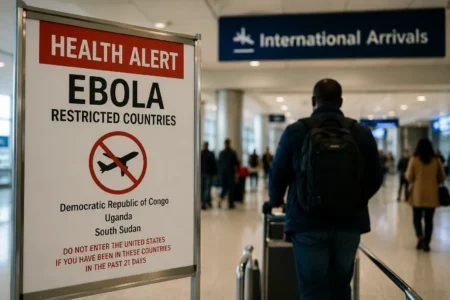
Also Read: US issues travel advisory over Ebola outbreak in DRC, Uganda and South Sudan
The situation in Ituri is further complicated by:
- Ongoing insecurity and conflict
- Weak health infrastructure
- High population mobility
- Limited access to accurate health information
These factors have created conditions for rapid and often undetected transmission.
Outbreak expands amid security concerns
The violence comes as the Ebola outbreak, driven by the rare Bundibugyo strain, continues to spread.
- More than 170 deaths have been reported in DR Congo
- Over 700 suspected cases have been identified
- Cases have crossed into neighbouring Uganda
The outbreak has already been declared a Public Health Emergency of International Concern by the World Health Organization (WHO), raising alarms about regional and global risks.
Further concern has emerged after a case was reported in South Kivu, a region under the control of M23 rebels, complicating response efforts in areas with limited government oversight.
Containment efforts under pressure
Despite the destruction, medical charity teams confirmed that patients from the affected isolation units were accounted for and continue to receive care.
Authorities say they are intensifying:
- Community sensitisation campaigns
- Surveillance and contact tracing
- Security around health facilities
DR Congo’s Foreign Minister Thérèse Kayikwamba Wagner acknowledged the gravity of the situation, describing it as “very frightening” while urging calm and cooperation.
The incident underscores a recurring pattern seen in past Ebola outbreaks: public distrust can be as dangerous as the virus itself.
Without community cooperation, health experts warn that even the most robust medical response risks failure, particularly in regions already grappling with conflict and fragile governance.