


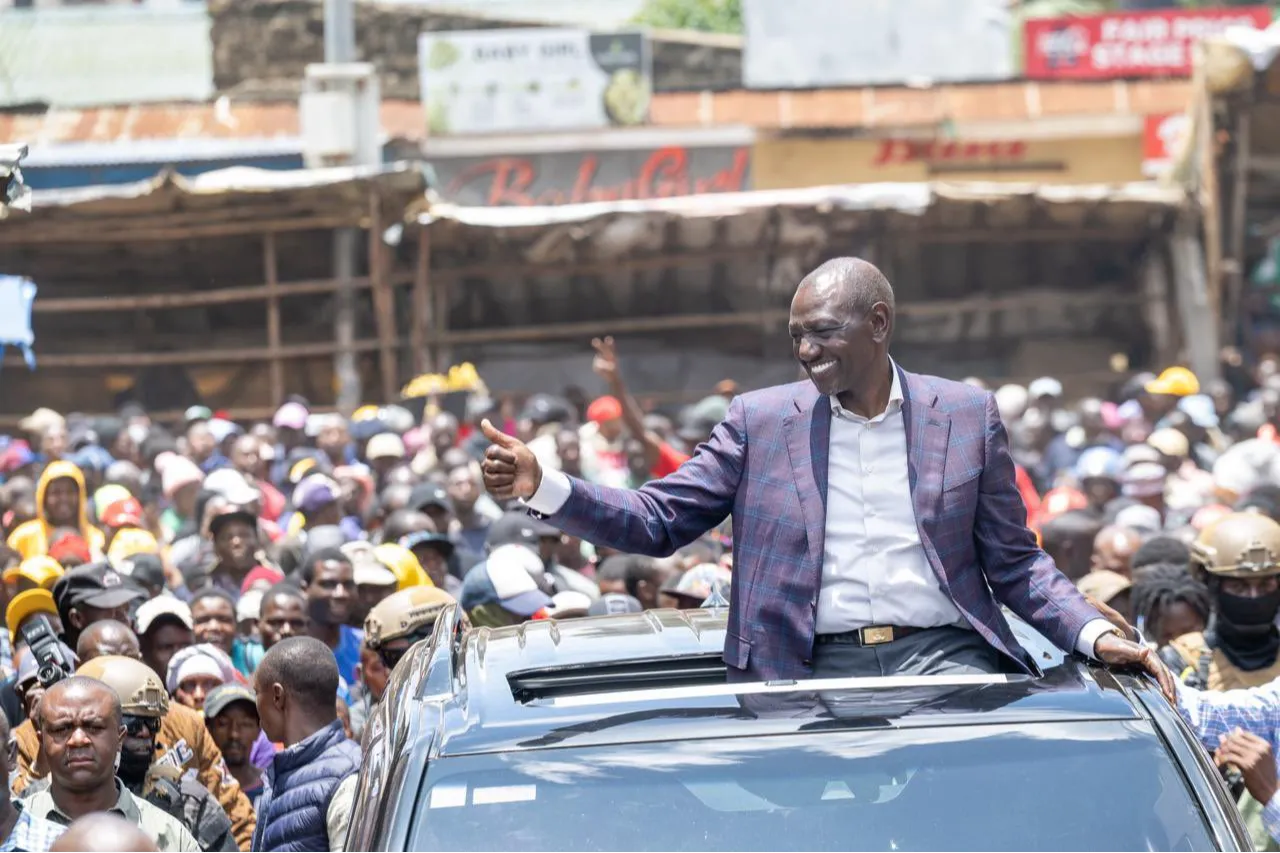
NAIROBI, Kenya — Teargas and brief disruptions marked President William Ruto’s development tour of Nairobi’s Dagoretti South and Dagoretti North constituencies on Tuesday, as he reaffirmed his commitment to cooperation talks between the ruling UDA party and the opposition ODM.
The Head of State inspected several projects before addressing a roadside rally, where he dismissed criticism from sections of the opposition and defended what he described as a “broad-based” political arrangement aimed at national unity.
At one point, a group of youths attending the rally partially blocked the presidential motorcade, briefly stalling the procession. Security officers were seen pushing back crowds as the convoy made multiple stops across the two constituencies.
Witnesses reported moments of commotion, with teargas deployed to disperse sections of the crowd as officers struggled to contain surging supporters attempting to approach the President’s vehicle. The motorcade intermittently paused, prompting President Ruto to signal for it to proceed.
Such disruptions come amid heightened political mobilisation in Nairobi, where rival factions have intensified grassroots activity ahead of expected political realignments.
Development projects inspected
During the tour, President Ruto visited Mutuini Hospital in Dagoretti South, commissioned a new workshop block at PC Kinyanjui Technical Training Institute, inspected ongoing construction at Riruta Modern Market, and inaugurated a tuition block at Kawangware Primary School in Dagoretti North.
He also announced plans to begin construction of a new international airport, framing it as part of Kenya’s long-term economic transformation agenda.
“Tumetangaza leo kwamba ujenzi wa uwanja mpya wa ndege unaanza kabla ya mwezi wa sita,” Ruto stated.
Although Kenya already operates major international airports including Jomo Kenyatta International Airport, the President did not provide detailed timelines or funding structures for the proposed new facility.
UDA–ODM cooperation
President Ruto reiterated his support for ongoing cooperation talks between the United Democratic Alliance (UDA) and the Orange Democratic Movement (ODM), despite resistance from ODM’s Linda Mwananchi faction and criticism from segments of the opposition.
“Sisi tutaendelea kuwa pamoja kwenye broad-based ili tulete Wakenya pamoja, hao wengine hawana sera, ni siasa za chuki na ukabila,” the President added.
The cooperation discussions follow months of political tension and bipartisan negotiations aimed at easing post-election divisions and stabilising governance.
Several ODM lawmakers present at the rally publicly endorsed the talks.
Dagoretti North MP Beatrice Elachi stated; “Na sisi tukiwa ODM tumesema kwamba tutaendelea kushirikiana na rais.”
Dagoretti South MP John Kiarie noted; “Sisi tutaendelea kukuunga mkono rais maana unasema na kutenda.”
Ruaraka MP TJ Kajwang added; “Na sisi kama ODM kupitia Parliamentary Group tumepitisha kwamba tutazungumza na UDA ili tuendeleze ushirikiano.”
Lang’ata MP Felix Odiwuor highlighted; “Wakenya wanataka umoja na ustawi na sisi tutaendelea kuleta Wakenya pamoja.”
National–county cooperation
The President and Nairobi Governor Johnson Sakaja also defended the cooperation agreement between the national and county governments, arguing that it would improve service delivery in the capital.
“Tumetoa Ksh.80 billion kwa kaunti ya Nairobi ili tumalize shida za takataka, ukosefu wa maji safi na kadhalika,” Ruto pointed out.
“Maelewano kati ya kaunti na serikali kuu yanalenga kuboresha utoaji wa huduma muhimu kwa wakazi wa Nairobi,” Sakaja remarked.
Also Read: Ruto introduces Jalang’o as ‘Nairobi Senator’ in Dagoretti South
The national government has in recent months pledged increased fiscal support to Nairobi County amid persistent challenges related to waste management, water shortages and urban infrastructure strain.
The Dagoretti tour comes against a backdrop of shifting political alliances and growing scrutiny over governance performance, economic pressures and rising cost-of-living concerns.
While the UDA–ODM talks are framed as a unity effort, critics argue that they risk diluting opposition oversight. Supporters, however, say bipartisan cooperation is necessary to maintain political stability and accelerate development projects.
Tuesday’s events underscored both the intensity of grassroots politics in Nairobi and the high stakes surrounding emerging political alignments ahead of future electoral cycles.
