

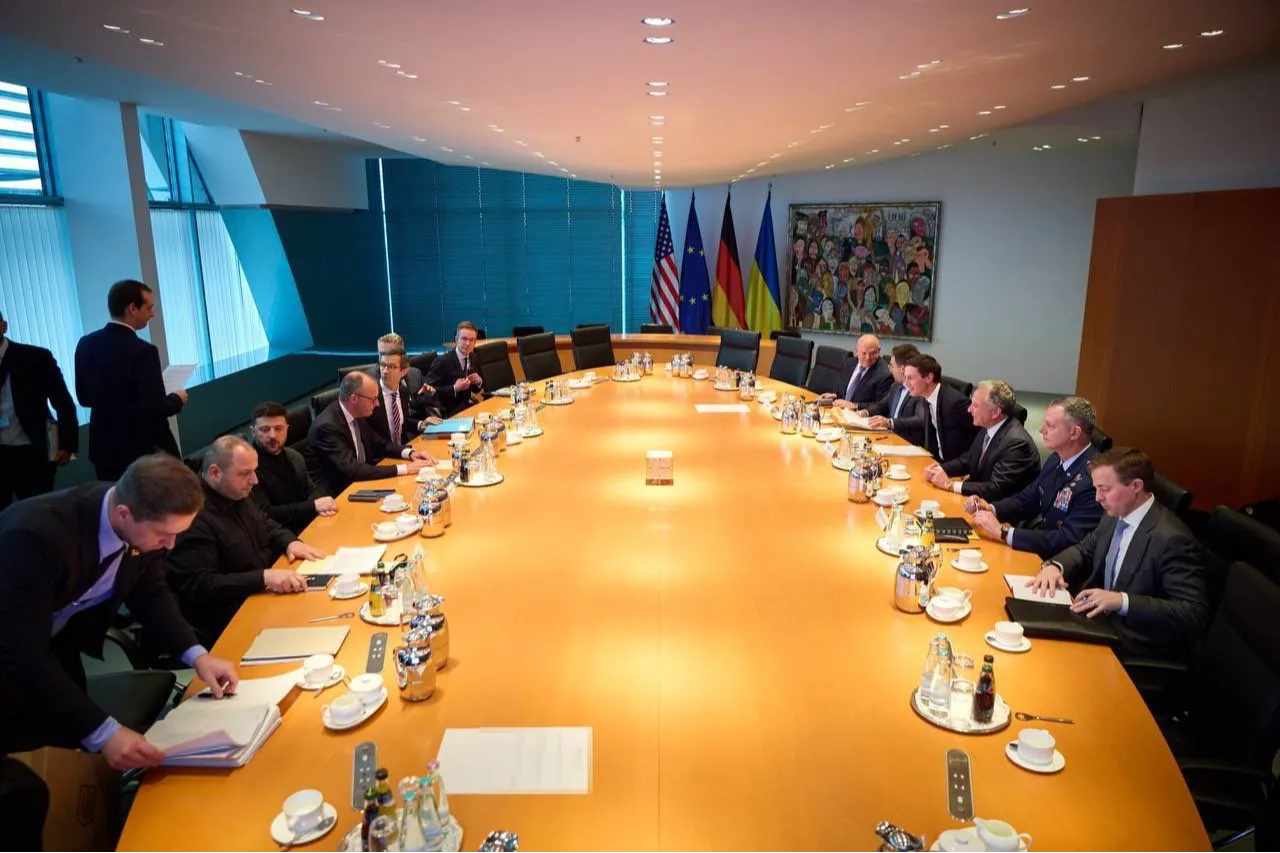
BERLIN, Germany — Diplomatic efforts to secure a peace deal between Ukraine and Russia have intensified in Berlin, where high-level discussions between Kyiv and Washington have entered a second consecutive day.
The summit, hosted by German Chancellor Friedrich Merz at the Chancellery, brought together Ukrainian President Volodymyr Zelensky and chief negotiator Rustem Umerov with U.S. envoy Steve Witkoff and Jared Kushner.
The group held an intensive five-hour session on Sunday, with a U.S. readout confirming that “A lot of progress was made.”
The NATO compromise
In a significant shift in diplomatic strategy, President Zelensky indicated a willingness to shelve Ukraine’s long-standing ambitions for NATO membership in exchange for alternative, ironclad security arrangements.
Acknowledging opposition to Kyiv’s bid from “some partners from the US and Europe,” Zelensky stated he is now pursuing security guarantees modeled after NATO’s Article 5 mutual protection clause.
“And this is already a compromise on our part,” Zelensky remarked on Sunday.
While Moscow has consistently labeled Ukrainian NATO membership as a “red line,” the Kremlin signaled cautious engagement on Monday, noting: “This issue is one of the cornerstones and requires special discussion.”
Disputed borders and the ‘sensitive’ Donbas issue
A central friction point in the Berlin talks remains the sovereignty of the Donbas region. While Zelensky expressed openness to freezing the conflict along the current front line, he maintained a firm stance on troop withdrawals, insisting on reciprocity from Moscow.
Zelensky clarified that he is not prepared to withdraw Ukrainian forces from their current positions in the Donbas unless Russian forces do the same in their respective occupied zones.
For the arrangement to be equitable, the President noted that Russia would have to withdraw an equal distance. This specific matter was described by the President as “extremely sensitive and heated.”
The role of the US and European allies
The American delegation, led by Witkoff and Kushner—and supported by NATO Supreme Allied Commander Europe General Alexus Grynkewich—is acting as a primary conduit for Russian interests.
Zelensky observed that the U.S. team “so to speak present the Russian side’s perspective, because they relay Russia’s signals, demands, steps, and indications of readiness or lack thereof.”
The Kremlin has indicated it is waiting for the U.S. to provide the “concept” emerging from Monday’s discussions.
Further talks are expected to expand on Monday evening to include European Commission President Ursula von der Leyen and other continental leaders.
Economic pressure and the frozen asset plan
The negotiations coincide with a dire humanitarian situation in Ukraine, where over a million households face winter power outages following sustained Russian strikes on energy infrastructure.
Simultaneously, the European Union is navigating a contentious debate over a plan to transfer €90 billion in frozen Russian assets to aid the Ukrainian economy.
Also Read: US and Ukraine signal major breakthrough in peace plan after high-stakes Geneva talks
While EU governments recently agreed to immobilize these assets indefinitely, consensus on their transfer remains elusive.
EU foreign policy chief Kaja Kallas admitted the talks were “increasingly difficult,” but added: “But we’re doing the work, and we still have some days.”
This Berlin summit represents the first face-to-face encounter between Zelensky and the current U.S. envoy, Steve Witkoff. The outcome of these talks could redefine the security architecture of Europe for decades to come.