


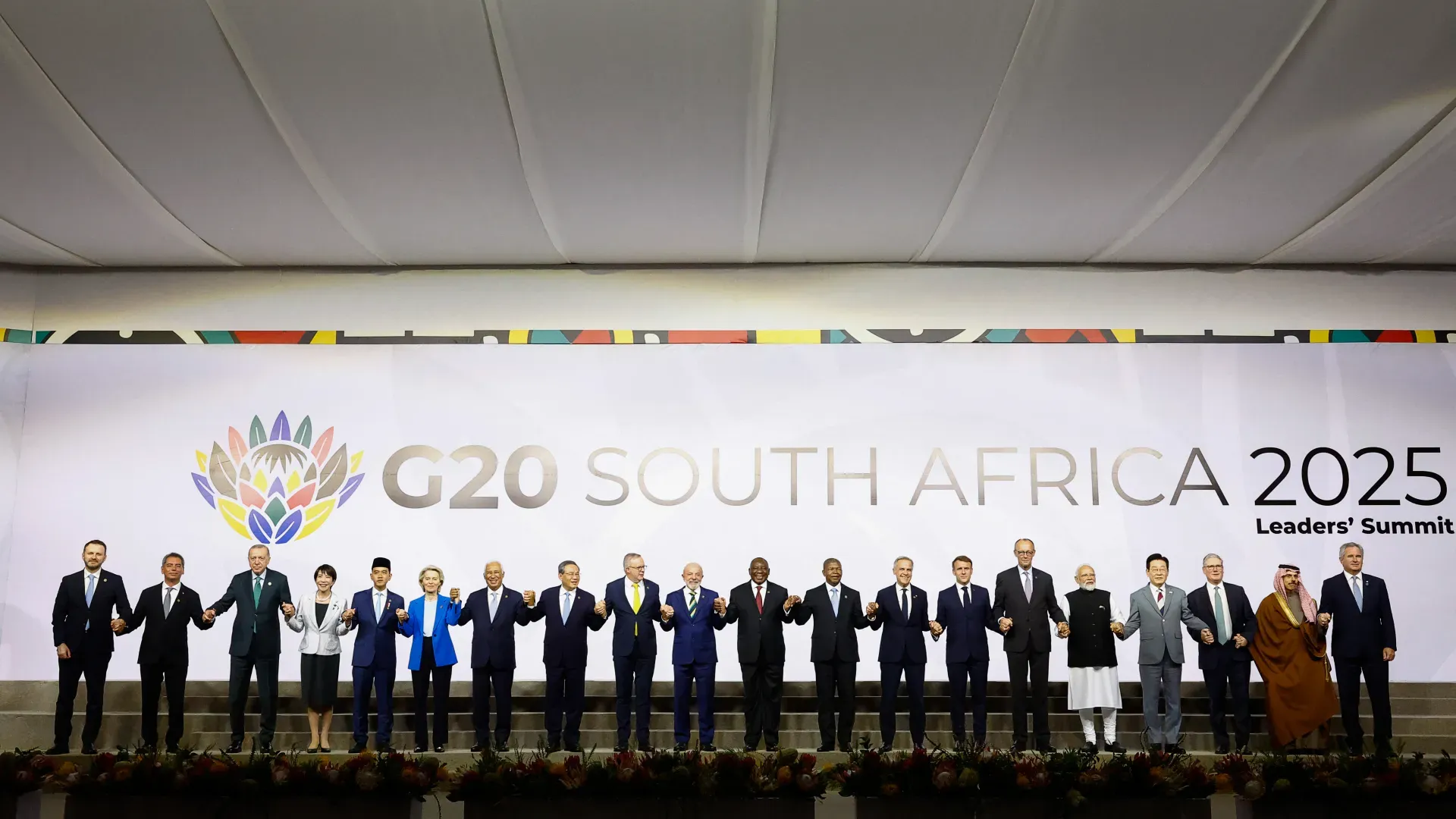
JOHANNESBURG, South Africa — The first G20 summit held on African soil concluded on Sunday with a decisive show of unity, as world leaders adopted a joint declaration committing to “multilateral co-operation” despite a high-profile boycott by the United States.
The historic gathering of the world’s major economies in Johannesburg proceeded under the shadow of profound diplomatic tensions.
The final declaration, which addressed critical issues such as climate change mitigation and economic inequality, was successfully adopted in the face of objections from Washington.
Shared goals over differences
Speaking at the closing ceremony on Sunday, South African President Cyril Ramaphosa hailed the summit’s outcome as a victory for global diplomacy.
He stated that the agreement demonstrated that “shared goals” outweighed the countries’ differences, signaling a refusal to let geopolitical rifts paralyze international progress.
The US boycott and 2026 hosting
The summit was marked by the conspicuous absence of American President Donald Trump, who chose to abstain from the G20 because of a widely discredited claim that South Africa’s white minority is the victim of large-scale killings and land grabs.
Despite the boycott, the G20 cycle continues. The United States is scheduled to host the G20 in 2026, with the summit expected to be held at Trump’s golf course in Florida.
Handover snub
Tensions over the US absence spilled over into the summit’s final protocols. The ceremonial handover of the presidency, which was meant to happen at the end of the summit on Sunday, did not take place.
Diplomatic sources indicate the delay was due to South Africa’s refusal to hand over the gavel to a low-ranking diplomat.
It is expected to take place next week, involving junior officials, likely at the Department of International Relations and Cooperation (DIRCO) offices.
Global leaders react
World leaders were quick to dismiss the impact of the American absence. Brazilian President Luiz Inácio Lula da Silva remarked that “it didn’t matter much” that Trump had not attended, adding that multilateralism was “more alive than ever”.
German Chancellor Friedrich Merz took a more critical stance, stating it had not been a “good decision” for the US to abstain.
Also Read: Cyril Ramaphosa hits back at Trump’s G20 boycott, says ‘absence is their loss’
He told Vivid Voice News that what he had noted at the G20 was that “the world is currently undergoing a realignment and that new connections are being formed”, hinting at a shifting global order where US participation is no longer the sole prerequisite for consensus.
A call for just peace
In a significant diplomatic breakthrough, delegates reached a consensus on working towards “just, comprehensive, and lasting peace” in Ukraine, Sudan, the Democratic Republic of Congo, and the “Occupied Palestinian Territory”.
The specific mention of the conflict in Sudan was particularly welcomed by regional observers.
“I think for the first time, [at] the G20 now they bring the Sudan conflict [to the forefront] after more than two years,” Sudanese commentator and journalist Saeed Abdalla told local broadcaster Newzroom Afrika, highlighting the summit’s success in elevating neglected African crises to the global stage.
