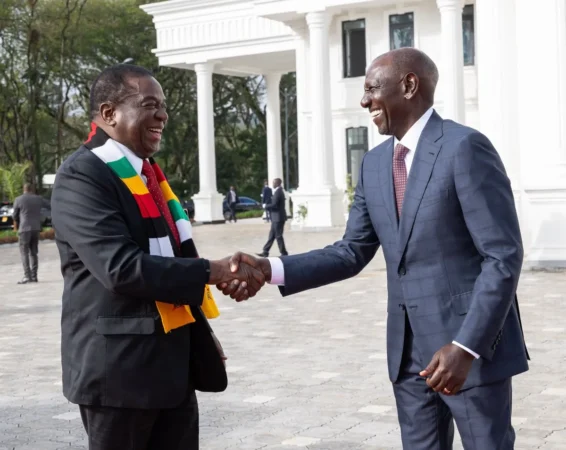


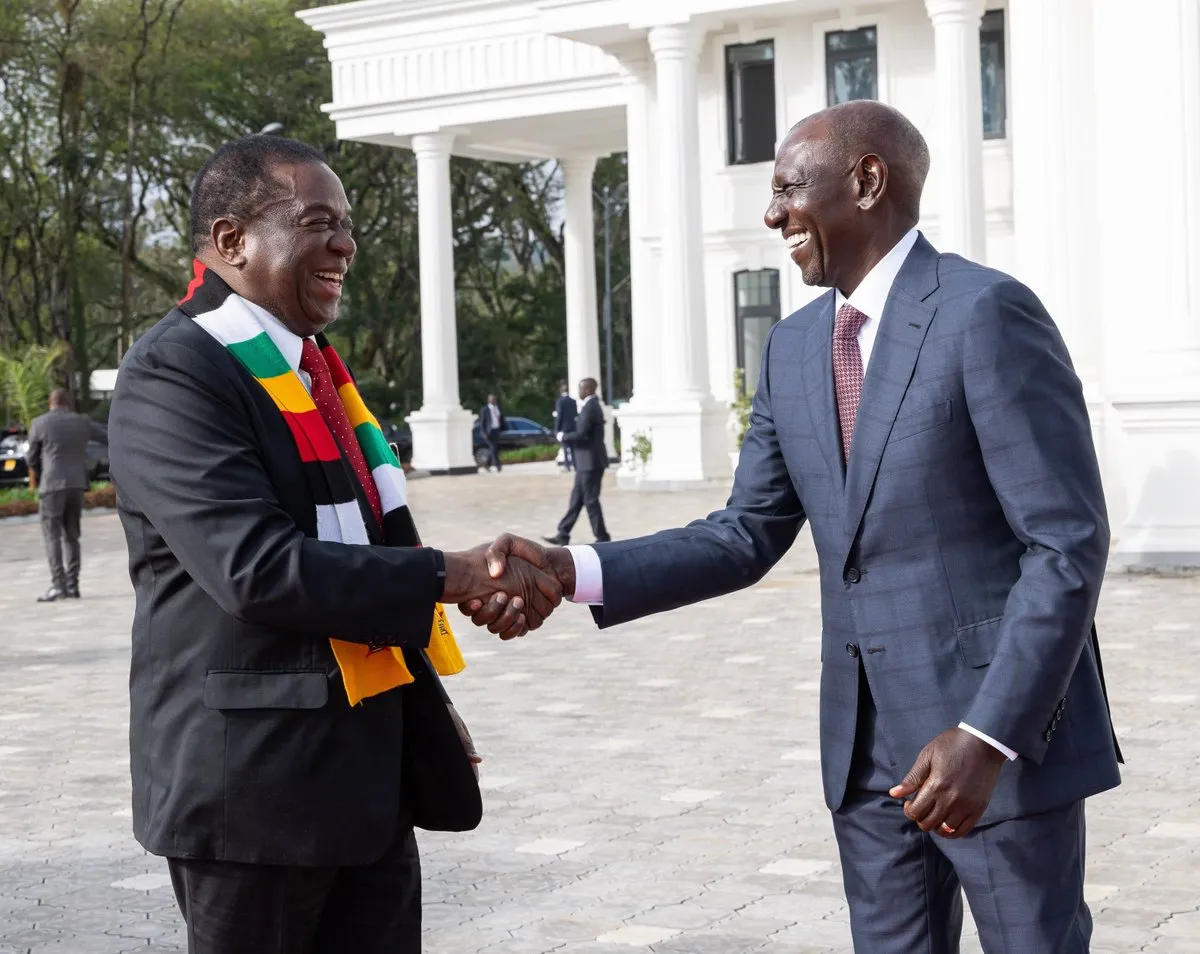
NAIROBI, Kenya — Zimbabwean President Emmerson Mnangagwa has challenged a Kenyan journalist over his understanding of the country’s economic situation, insisting that Zimbabwe’s economy and currency are stable before offering to finance a fact-finding visit to Harare.
The unusual exchange unfolded during a joint press briefing with President William Ruto at State House, Nairobi, on Friday, November 27, after Kenya Broadcasting Corporation (KBC) radio presenter Austin Miramba questioned Mnangagwa about Zimbabwe’s history of high inflation and currency instability.
Miramba asked what lessons Kenya could draw from Zimbabwe’s economic experience, particularly its struggles with inflation and the depreciation of its currency, the Zimbabwe Gold (ZiG).
Drawing a comparison with Kenya, the journalist recalled a period when the Kenyan shilling weakened significantly, with the US dollar trading at approximately KSh162 before recovering to around KSh130 following government intervention.
He then asked Mnangagwa how his administration was addressing Zimbabwe’s economic challenges and what measures had helped stabilise its currency.
But the question prompted a sharp response from the Zimbabwean leader, who disputed the journalist’s description of the country’s current economic position.
“Young man, you are highly misinformed. Zimbabwe’s economy is very stable. Our currency is very stable,” Mnangagwa said.
He questioned the information informing Miramba’s assessment and urged him to reconsider his sources, arguing that they did not reflect developments in Zimbabwe.
Mnangagwa offers to pay for journalist’s visit
Rather than end the exchange with a rebuttal, Mnangagwa invited the KBC journalist to travel to Zimbabwe and independently assess the country’s economic conditions.
He offered to meet the cost of the visit and said Miramba would be free to travel to different parts of the country, speak to people and ask questions without security officers following him.
The president also requested that the journalist return to brief him on his findings.
“I invite you to come to Zimbabwe, and I will pay for your visit. So you can satisfy yourself as to what is happening. I will allow you to visit any part of the country, ask any question, no security will be following you behind, and then at the end of the day you will come tell me at state house on what is happening in Zimbabwe, you are welcome,” Mnangagwa said.
The Zimbabwean leader acknowledged that his country had experienced serious economic difficulties but maintained that those challenges had been addressed through regional and continental support.
“Yes, we had those challenges, but I’m happy that with the support of SADC and the entire African continent, we have been able to resolve those economic challenges, and Zimbabwe is thriving,” he said.
Ruto subsequently backed the proposed visit, promising that Kenya would facilitate the journalist’s travel documents.
He defended Miramba’s question as legitimate journalistic curiosity, saying the reporter had no hidden agenda.
“We will facilitate, Mr. President, the visit of our young man. We’ll give him a visa. I confirm that he’s just an inquisitive young man. He has no other intention,” Ruto said.
The Kenyan president linked the exchange to the importance of reliable information, particularly at a time when misinformation and disinformation can shape public understanding of political and economic developments.
He also referred to a media cooperation agreement signed by Kenya and Zimbabwe during the visit, arguing that stronger communication between the two countries could improve access to credible information.
Zimbabwe’s currency: Signs of stability, but questions remain
Mnangagwa’s remarks come as Zimbabwe seeks to rebuild confidence in its monetary system after years of severe inflation, currency depreciation and repeated changes to its currency arrangements.
The country introduced the Zimbabwe Gold, commonly known as ZiG, in April 2024. The gold-backed currency was designed to restore monetary stability and reduce dependence on foreign currencies, particularly the US dollar.
Recent official figures indicate a substantial improvement in inflation.
According to Zimbabwe’s September 2026 economic review, annual inflation measured in ZiG stood at 3.7 per cent, up from 2.89 per cent in August. The Reserve Bank of Zimbabwe reported that the official exchange rate averaged ZiG26.70 against the US dollar during the third quarter, closing September at approximately ZiG26.80.
However, the official exchange rate does not tell the entire story.
The central bank’s own figures showed that the parallel-market exchange rate remained weaker than the official rate, with the premium standing at around 15 per cent for much of the third quarter.
That gap matters because it reflects continuing differences between the official foreign-exchange market and the rates available outside it.
The International Monetary Fund (IMF) has acknowledged Zimbabwe’s improving economic performance, citing lower inflation, a broadly stable exchange rate and stronger mineral exports and remittance inflows. However, its October 2026 assessment also identified risks to the economic outlook, including the possibility of drought and renewed pressure from commodity and energy prices.
Zimbabwe’s recent progress therefore represents an improvement from its earlier economic turmoil, but sustaining confidence in the ZiG will depend on more than keeping the official exchange rate stable.
For businesses and ordinary households, access to foreign currency, purchasing power, price stability and confidence in the monetary system remain important measures of economic recovery.
Kenya and Zimbabwe deepen bilateral cooperation
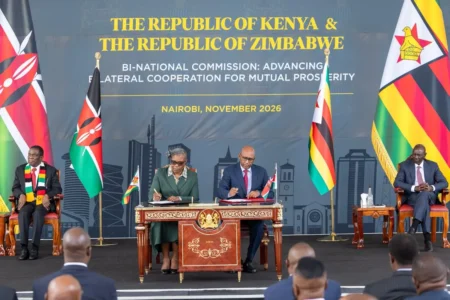
The exchange took place as the two presidents co-chaired the inaugural Kenya-Zimbabwe Bi-National Commission, a framework intended to strengthen political oversight and accelerate cooperation between Nairobi and Harare.
The meeting followed Ruto’s state visit to Zimbabwe, during which the two governments agreed to elevate their bilateral relationship and establish a higher-level mechanism for monitoring joint commitments.
The presidents witnessed the signing of seven memoranda of understanding covering immigration, housing, trade, customs, media, culture and diplomatic training.
According to Kenya’s State House, the latest agreements bring the total number of bilateral cooperation instruments between the two countries to 24.
Also Read: Kenya and Zimbabwe sign media deal to strengthen African news coverage
Mining was also identified as an area with significant potential for collaboration, with Zimbabwe highlighting its platinum-group metals and lithium resources, while Kenya brings opportunities in gold and niobium.
Ruto also called for the immediate and unconditional lifting of unilateral sanctions imposed on Zimbabwe, arguing that the restrictions disproportionately affect ordinary citizens.
Kenya further welcomed Zimbabwe’s election to serve on the United Nations Security Council for the 2027–2028 term.
A test of journalistic independence
Beyond the diplomatic exchanges, Mnangagwa’s offer presents an important question about how journalists should approach government-funded fact-finding trips.
The invitation could provide Miramba with an opportunity to examine Zimbabwe’s economic recovery beyond official statements and published statistics. But the credibility of any resulting reporting will depend on the journalist’s ability to retain editorial independence.
That would mean seeking perspectives from economists, businesses, consumers, independent researchers and ordinary citizens, rather than relying exclusively on government briefings.
It would also require transparent disclosure of who financed the trip and whether the journalist was able to access the people, places and information necessary to test the president’s claims.
For Mnangagwa, the proposed visit offers an opportunity to present Zimbabwe’s economic recovery directly to a regional audience. For Miramba, it is an opportunity to establish whether the official narrative matches conditions on the ground.
The real test will not be whether the journalist changes his opinion, but whether the evidence gathered during the visit supports the president’s confident assessment of Zimbabwe’s economy.