




ABU DHABI, United Arab Emirates — The global race for Artificial Intelligence (AI) leadership is increasingly being shaped by more than the technology companies developing advanced models. Governments are competing to secure computing infrastructure, attract specialist talent, control critical data, expand digital economies and influence the rules governing how artificial intelligence is developed and deployed.
While the United States and China remain the dominant forces in frontier AI development, the United Arab Emirates (UAE) is pursuing a different but increasingly ambitious strategy: positioning itself as a global centre for AI investment, infrastructure, research and practical applications.
From Dubai’s technology-driven economic ambitions to Abu Dhabi’s expanding artificial intelligence infrastructure, the UAE is investing heavily in a future in which AI is expected to influence everything from government services and financial markets to healthcare, energy, education and international trade.
The country’s ambition is not simply to become a consumer of technology developed elsewhere. It wants to attract the companies, capital, researchers and computing resources needed to participate in shaping the next generation of artificial intelligence.
Recent developments suggest that this ambition is moving beyond policy announcements and into major infrastructure projects, international partnerships and industrial applications.
The global AI revolution is changing the balance of economic power
Artificial Intelligence (AI) has moved rapidly from a specialised technology used by researchers and technology companies into a major force reshaping the global economy.
Generative AI systems can now produce written content, analyse complex information, generate software code, process images and assist with scientific research. More advanced systems are increasingly capable of performing multiple tasks with limited human supervision.
The scale of this transformation is reflected in the 2026 AI Index Report by Stanford University’s Institute for Human-Centred Artificial Intelligence.
The report found that global corporate investment in AI reached a record $581.69 billion in 2025. Organisational adoption also climbed to 88 per cent, while generative AI reached an estimated 53 per cent of the global population within three years of its introduction.
The United States continues to dominate private AI investment and the development of leading models, while China has emerged as a formidable competitor in research, industrial applications and technological innovation.
However, the competition is no longer limited to developing the most powerful AI model.
Countries increasingly recognise that leadership also depends on access to advanced semiconductors, reliable electricity, high-capacity data centres, skilled workers and secure digital infrastructure.
This has created opportunities for countries outside the traditional centres of technological power to establish themselves as important players in the AI economy.
The UAE is seeking to exploit precisely that opportunity.
UAE’s AI ambitions began with a long-term national strategy
The country’s current ambitions are built on a national strategy adopted in 2019, when the UAE Cabinet approved the National Strategy for Artificial Intelligence 2031.
The strategy set out a goal of making the UAE one of the world’s leading countries in artificial intelligence by 2031.
Rather than treating AI as an isolated technology sector, the government identified it as a tool for transforming public administration, strengthening economic competitiveness and improving productivity across priority industries.
The strategy identified eight strategic objectives, including attracting international AI talent, developing research capabilities, expanding the country’s technological infrastructure, encouraging innovation and establishing effective governance and regulation.
It also identified sectors where AI could deliver substantial economic and social benefits, including transport, healthcare, education, energy, tourism and government services.
The strategy projected that artificial intelligence could contribute as much as AED335 billion to the UAE economy.
That figure represents an ambition and economic projection rather than money already generated. Nevertheless, it demonstrates the scale of the government’s expectations for the technology.
The strategy also reflects a broader economic calculation. The UAE has spent decades diversifying its economy beyond oil, developing international financial services, tourism, logistics, aviation, real estate and trade.
Artificial intelligence offers another opportunity to build high-value industries and strengthen the country’s position in an increasingly technology-dependent global economy.
Dubai and Abu Dhabi are becoming central to the UAE’s AI ambitions
Although the UAE’s artificial intelligence ambitions are national, Dubai and Abu Dhabi are particularly important to their implementation.
Dubai has spent years building an international reputation as a centre for business, finance, tourism, logistics and technological innovation.
Its strategy is to use that established commercial ecosystem to attract technology companies, entrepreneurs, investors and international talent.
The emirate’s Dubai Universal Blueprint for Artificial Intelligence reflects its ambition to accelerate AI adoption across government and the private sector, while creating an environment in which businesses can develop and commercialise new technologies.
Dubai’s commercial strengths provide an important advantage. Its international connectivity, business infrastructure, financial services industry and large expatriate professional community offer technology companies access to markets, capital and talent.
Artificial intelligence can also be integrated into sectors already central to the emirate’s economy, including aviation, tourism, property, retail, transport and financial services.
Abu Dhabi, meanwhile, has become a major centre for sovereign investment, advanced research and large-scale AI infrastructure.
Its technology ecosystem includes G42, one of the UAE’s most prominent artificial intelligence and technology groups, alongside research institutions, international technology partnerships and major computing infrastructure projects.
The two emirates therefore contribute different but complementary strengths to the national ambition: Dubai’s commercial and international business environment and Abu Dhabi’s growing capacity to finance, develop and host strategic technology infrastructure.
Stargate UAE puts the country at the centre of global AI infrastructure competition
One of the most significant developments in the UAE’s artificial intelligence ambitions was the announcement of Stargate UAE in May 2025.
The project brought together G42, OpenAI, Oracle, NVIDIA, SoftBank Group and Cisco to develop a major AI infrastructure cluster in Abu Dhabi.
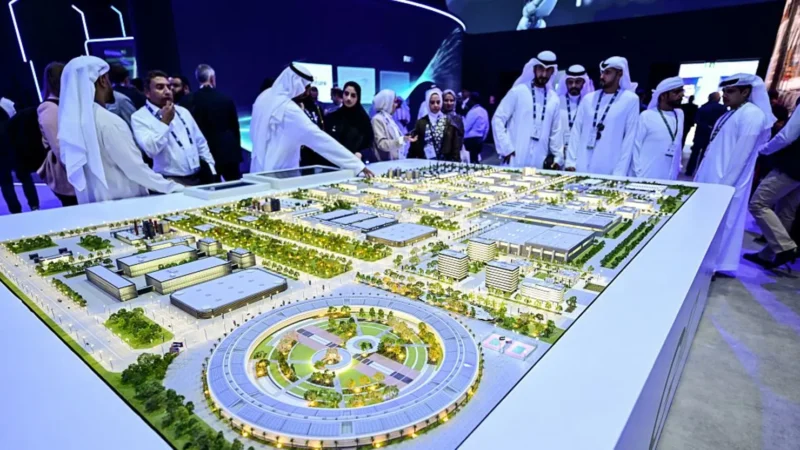
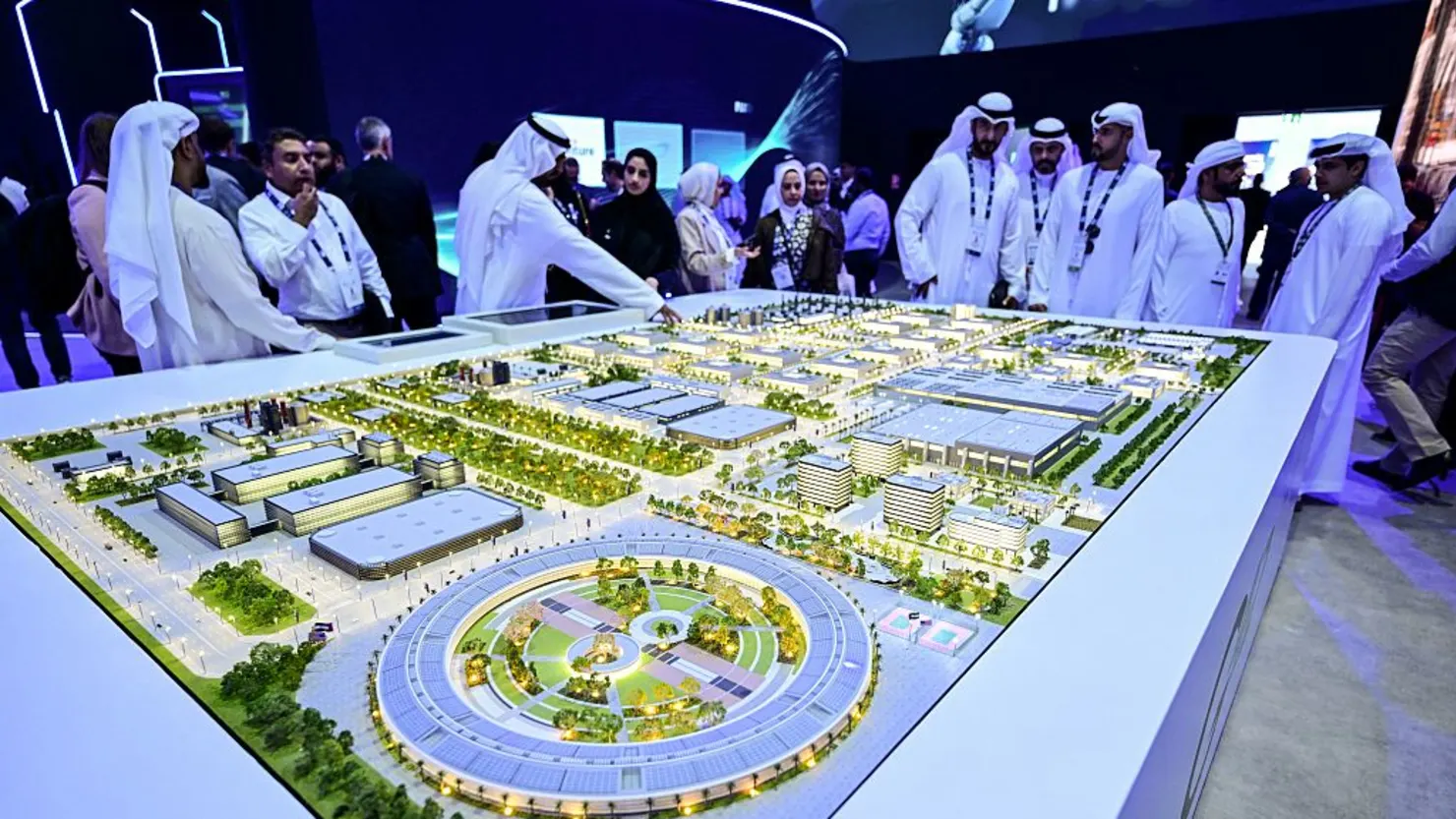
According to the Abu Dhabi Media Office, Stargate UAE is part of a planned five-gigawatt UAE-US AI Campus spanning approximately 10 square miles.
The wider campus is intended to provide large-scale computing capacity to support advanced AI development and deployment.
The initial Stargate UAE cluster is designed to have one gigawatt of computing capacity, with the first 200-megawatt phase expected to become operational in 2026.
The project is particularly significant because advanced AI systems require enormous computing resources. Training and operating increasingly sophisticated models depend on specialised processors, high-performance networks and data centres capable of handling demanding workloads.
By attracting companies such as OpenAI, Oracle and NVIDIA, the UAE is seeking to become more than a regional market for imported AI products. It wants to become a location where the infrastructure supporting the global AI economy is developed and operated.
The project also highlights the growing importance of international partnerships in the technology race.
No single country or company controls every component of the AI supply chain. Advanced chips, cloud infrastructure, software, capital and research expertise are distributed across different countries and organisations.
The UAE’s strategy is to bring many of these capabilities together through partnerships with major international technology companies.
Microsoft’s multibillion-dollar commitment signals growing confidence in the UAE
Another important indicator of the country’s ambitions is Microsoft’s expanding presence.
In November 2025, the technology giant announced plans to invest and spend $15.2 billion in the UAE between 2023 and the end of 2029.
Microsoft said the amount included its $1.5 billion equity investment in G42, spending on advanced AI and cloud data centres, local operating expenses and planned infrastructure expansion.
The announcement also highlighted the importance of developing local expertise alongside physical infrastructure.
Microsoft said it was expanding engineering operations in Abu Dhabi and supporting AI research, education and skills development.
Its AI for Good Lab in Abu Dhabi is also working with researchers on large language models for underrepresented languages, including languages spoken in Kenya, Uganda, Tanzania, Malawi and the Democratic Republic of Congo.
This is particularly relevant to developing regions, where many communities remain underserved by AI systems trained primarily on widely available English and other major-language datasets.
If successful, such research could help expand access to AI-powered services in education, healthcare, public administration and other sectors across Africa.
However, Microsoft’s investment announcement should be understood in its stated context: it covers spending across several years, including expenditure already made and planned commitments, rather than a single new cash injection.
AI is becoming part of the UAE’s government and industrial operations
The country’s ambitions are also reflected in efforts to integrate artificial intelligence into public administration and major industries.
In June 2026, Sheikh Mohammed bin Rashid Al Maktoum approved the establishment of the UAE Artificial Intelligence and Data Authority.
The new institution brings together responsibilities previously held by separate government entities dealing with artificial intelligence, digital government and data management.
It is intended to coordinate national AI priorities, lead the national strategy, improve the sharing and management of government data and support the development of AI-powered public services.
The authority’s mandate also includes developing policies, standards and regulatory frameworks to guide the use of artificial intelligence across federal institutions.
The creation of a central authority reflects an important shift in the UAE’s approach: moving from individual AI initiatives towards a more coordinated national system.
The private sector is also expanding its use of the technology.
On November 2, 2026, Abu Dhabi National Oil Company announced a partnership with OpenAI and G42 to deploy advanced AI systems across its operations.
ADNOC said the initiative would use interconnected AI agents to support decisions across areas including production, processing, refining, logistics and trading.
The company said the technology would initially be applied to field master planning, connecting information from thousands of wells and multiple facilities to help prepare complex development plans more quickly.
ADNOC described the partnership as part of its ambition to become one of the world’s most technologically advanced and AI-enabled energy companies.
The announcement illustrates how the UAE is seeking to apply AI beyond government services and consumer-facing applications, extending it into industries that remain central to the country’s economy.
The UAE is attracting attention in global AI adoption
The country’s progress is also reflected in the adoption of generative AI among its population.
Stanford University’s 2026 AI Index Report placed the UAE among the countries with the highest rates of generative AI adoption, estimating that approximately 64 per cent of its population was using the technology.
This is a significant indicator because a country’s AI ambitions depend not only on the availability of infrastructure and investment but also on whether businesses, workers, students and public institutions actually use the technology.
Widespread adoption can create demand for new services, encourage entrepreneurship and accelerate the development of skills needed in an AI-driven economy.
However, high adoption rates should not automatically be confused with technological independence.
Using foreign-developed AI applications is different from developing proprietary models, controlling advanced semiconductor supply chains or producing the research needed to compete at the frontier of the technology.
The UAE’s longer-term challenge is to convert its strong adoption and investment environment into deeper domestic research, innovation and commercial capabilities.
The challenges behind the UAE’s AI ambitions
Despite its substantial financial resources and international partnerships, the UAE faces challenges that could determine how far its ambitions are realised.
The first is the cost and complexity of AI infrastructure.
Large data centres require enormous quantities of electricity, advanced cooling systems, reliable networks and specialised equipment.
The International Energy Agency has projected that global data-centre electricity consumption could rise from approximately 485 terawatt-hours in 2025 to around 950 terawatt-hours by 2030.
AI-focused data centres are expected to account for a particularly rapid increase in demand.
For the UAE, this creates a strategic question: how can it expand computing infrastructure while maintaining energy security, managing water requirements and pursuing its environmental commitments?
The Stargate UAE campus is expected to draw on nuclear, solar and natural gas energy sources, according to the project announcement. Its long-term environmental performance will depend on how effectively these sources are integrated and how efficiently the infrastructure operates.
The second challenge concerns access to advanced semiconductors.
The most powerful AI systems depend on specialised chips and a highly concentrated global supply chain. Access to these technologies is influenced by international trade rules, export controls and geopolitical relationships.
The UAE’s partnership with American technology companies therefore carries strategic importance beyond commercial investment.
It also highlights the need to maintain international confidence over cybersecurity, data protection and the use of advanced computing technologies.
Another challenge is developing a sufficiently deep domestic talent base.
Attracting international specialists can accelerate progress, but long-term technological leadership also requires investment in local researchers, engineers, entrepreneurs and institutions capable of developing new technologies.
There are also wider concerns about employment, algorithmic bias, privacy, misinformation and the accountability of automated systems.
Also Read: Artificial intelligence is surging in Africa. Why are millions still jobless?
As governments and companies integrate AI into increasingly sensitive decisions, the question of who is responsible when systems make mistakes becomes more important.
The UAE’s ability to establish credible governance frameworks will therefore be central to the sustainability of its ambitions.
Can the UAE become a global AI power?
The UAE is not yet in the same position as the United States or China in terms of frontier model development, global research output or the breadth of its technology industries.
But measuring AI leadership only by the number of advanced models developed within a country’s borders would overlook the wider competition taking place.
The next phase of the AI revolution will also be shaped by countries that can provide computing infrastructure, attract international capital, develop talent, establish trusted regulatory environments and deploy the technology across major industries.
The UAE is positioning itself to compete in these areas.
Its national AI strategy, Dubai’s technology ambitions, Abu Dhabi’s infrastructure investments, partnerships with major global technology companies and expanding industrial applications demonstrate a sustained effort to build a competitive AI ecosystem.
The country also has advantages that many emerging technology markets struggle to match, including access to substantial investment capital, international business networks, established infrastructure and a government willing to make technology a central part of its economic planning.
However, the real test will not be the number of investment announcements or the size of proposed data centres.
It will be whether these investments produce globally competitive companies, meaningful scientific research, skilled local talent, productive industries and technology that delivers measurable benefits to society.
The UAE’s ambition is clear: to become one of the countries shaping the future of artificial intelligence rather than simply adapting to changes created elsewhere.
Whether it achieves that goal by 2031 will depend on how effectively it turns its financial resources, international partnerships and national strategy into lasting technological capabilities.