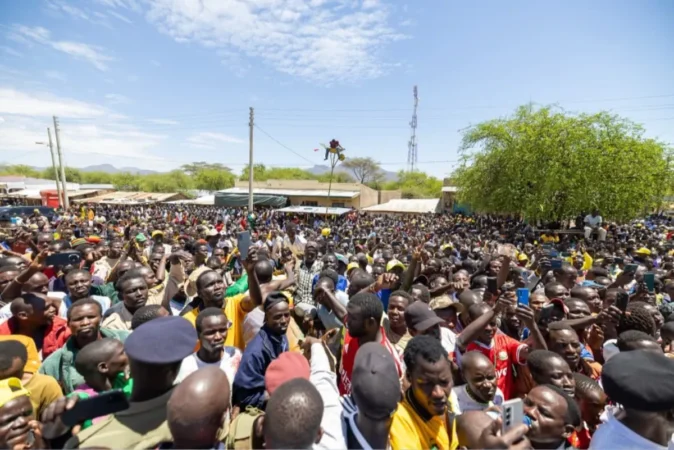



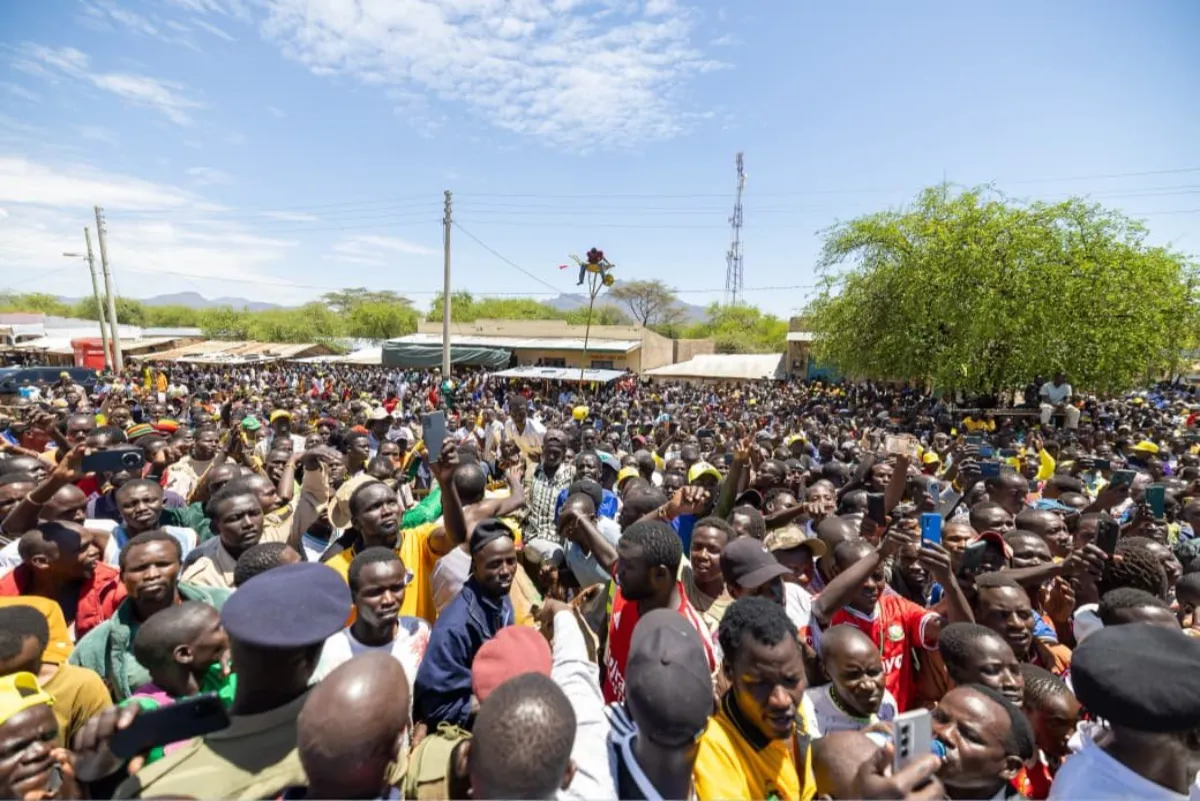
WEST POKOT, Kenya — A man perched on a wheelbarrow several metres above the ground became one of the most talked-about sights during President William Ruto’s development tour of West Pokot County on Wednesday, turning an otherwise policy-focused rally into a striking display of political symbolism.
As Ruto addressed residents in Konyao, Kacheliba Constituency, the supporter remained seated on a wheelbarrow mounted on a metal pole, blowing a vuvuzela and flashing the two-finger salute associated with the United Democratic Alliance (UDA) and its re-election campaign.
The scene was unusual, but the symbolism was familiar. The wheelbarrow has been central to Ruto’s political identity since his rise through the “hustler” movement, which presented small traders, casual workers and low-income earners as the constituency whose economic aspirations deserved greater political attention. UDA officially describes the wheelbarrow as a symbol of the value, dignity and respect of work.
Yet the spectacle also drew attention to a more consequential question: how should Kenyans assess the promises made at political rallies, particularly in areas where access to reliable roads, electricity and water remains a development concern?
The wheelbarrow and the politics of economic inclusion
Ruto’s wheelbarrow symbolism was built around the argument that ordinary Kenyans should have a greater stake in economic growth. Its appeal lay in its association with work, enterprise and the ambition to improve one’s circumstances, rather than wealth or established political influence.
At the West Pokot rally, the elevated display gave that symbolism a dramatic visual expression. It communicated support for the President in a way that was easily visible to the crowd and likely to attract attention beyond the event.
But political symbolism is not, by itself, evidence of the success of an economic agenda. Nor can the actions of one supporter establish the views of an entire county or electorate.
The more meaningful measure is whether the economic opportunities invoked by the “hustler” message become tangible through better infrastructure, more reliable public services and improved access to markets. That is where the rally’s development announcements deserve closer scrutiny.
KSh21 billion road programme raises delivery questions
During the rally, Ruto said the government had committed KSh21 billion to road construction across West Pokot, describing the investment as part of a broader effort to promote equitable development across Kenya.
The programme is intended to cover approximately 200 kilometres of roads. During the same tour, the President launched the Konyao–Kiwawa–Alale road project, while other reporting identified the KSh1.84 billion upgrade of the Konyao–Kiwawa section of the Lodwar–Lorugum–Lorengippi–Loya road.
Reliable road networks can reduce travel times and transport costs, improve access to schools and health facilities, and help farmers and livestock traders reach markets. For communities that depend on agriculture and livestock, better connectivity can also influence the prices they receive for their produce and the cost of essential goods.
However, the value of a major infrastructure announcement cannot be measured by its headline figure alone. Residents need to know which roads are covered, how the money will be allocated, when construction is expected to begin and end, and what standards contractors must meet.
The KSh21 billion figure should therefore be assessed against project-level budgets, procurement records, implementation schedules and actual expenditure. The distinction between an announced investment, money appropriated in a budget, funds released and work completed is essential to public accountability.
The government’s stated objective is to improve connectivity and expand economic opportunities. Whether that objective is achieved will depend on implementation, construction quality and the maintenance of the roads after completion.
Electricity promises and the cost of being left behind
Electricity access was another major theme of the President’s visit. Ruto said KSh1 billion had been set aside for last-mile rural electrification in Kacheliba, arguing that residents should not continue to be disadvantaged by inadequate access to power.
The programme was presented as part of a wider effort to connect homes and businesses to the national electricity network. Reporting on the tour also cited plans to connect 1,960 households in Kacheliba through a KSh336 million project and to extend electricity connections to 10,000 homes across West Pokot.
Reliable electricity can support small businesses, improve the conditions under which students study, and make certain health services and other essential facilities easier to operate. For traders and entrepreneurs, it can reduce dependence on costly alternatives and create opportunities for productive activity.
But the number of households promised connections is only one measure of success. Residents will also need to know when connections will be completed, how much households will pay to connect, whether the supply will be reliable and whether the electricity will be affordable for low-income families.
The government’s description of Kacheliba as an area that has lagged behind highlights the development challenge. It also makes timely delivery particularly important: communities should be able to judge progress through completed connections and functioning services, rather than announcements alone.
Dams and water security in an arid region
Ruto also pointed to the proposed National Infrastructure Fund as a means of supporting dams and other infrastructure in arid and semi-arid areas. He said the investments could provide water for domestic use, irrigation and livestock farming.
Water infrastructure could have far-reaching implications for households and livelihoods in areas where rainfall is unreliable. If properly planned and maintained, dams and associated distribution systems can support livestock, improve water security and create opportunities for agricultural production.
However, large water projects require careful feasibility studies, environmental safeguards, transparent procurement and sustainable management. Their benefits depend not only on construction but also on whether water reaches the intended communities and whether local users can access it fairly.
The reference to the National Infrastructure Fund also raises questions about financing, project selection and oversight. Residents and taxpayers need clarity on how proposed projects will be prioritised, how they will be funded and how their costs and benefits will be monitored.
Development versus political messaging
The rally combined infrastructure announcements with Ruto’s criticism of the opposition, which he accused of relying on rhetoric rather than offering practical solutions. That exchange reflects the wider political contest over who can credibly claim to represent development and economic inclusion.
For the government, visible projects offer an opportunity to demonstrate its record and communicate its priorities. For the opposition, the same commitments provide grounds to demand evidence of delivery, scrutinise spending and question delays or shortcomings.
Neither political messaging nor criticism should replace examination of the evidence. A road project should be judged by its funding, construction progress and usefulness to residents. An electrification programme should be assessed by completed connections and the quality and affordability of supply. A dam should be measured by its capacity to deliver sustainable water access.
Also Read: Disrespect or Dissent? Shoe hurled at President Ruto fuels debate and condemnation
The wheelbarrow spectacle may have captured the cameras, but it cannot answer those questions. Its political meaning is clear as a display of allegiance; its broader significance should not be exaggerated into proof of countywide support or endorsement of every government policy.
The real test begins after the rally
West Pokot’s development needs should not be reduced to a contest over political symbols. The central issue is whether public investment can address practical barriers to economic activity and access to essential services.
The KSh21 billion road programme, the electricity commitments and the proposed water infrastructure could bring significant benefits if they are properly funded and delivered. But the public interest requires clear project lists, credible timelines, transparent expenditure and regular progress reports.
The wheelbarrow raised above the crowd was a memorable image. The more consequential measure of the tour will be what residents can see and use after the political crowds have dispersed: roads that are completed and maintained, homes connected to reliable electricity, and water projects that serve communities.
For West Pokot residents, development will ultimately be measured not by the height of a political symbol, but by the distance between a promise and its delivery.