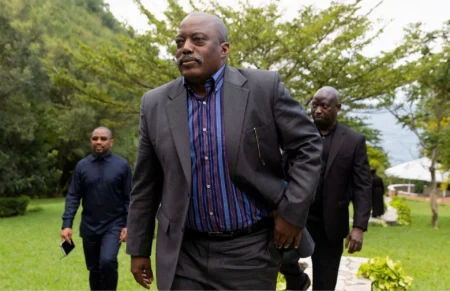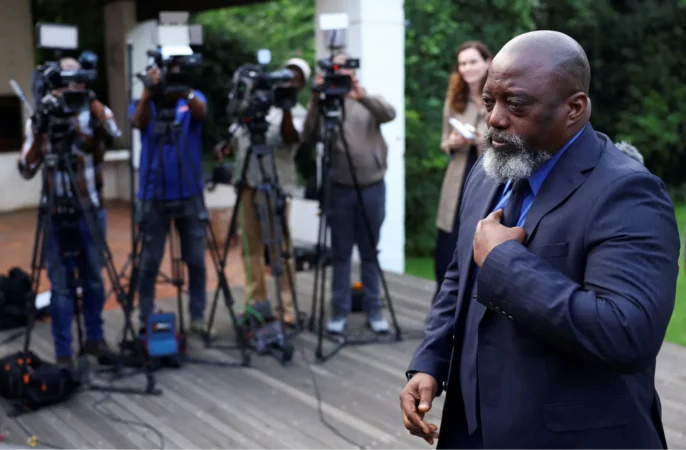


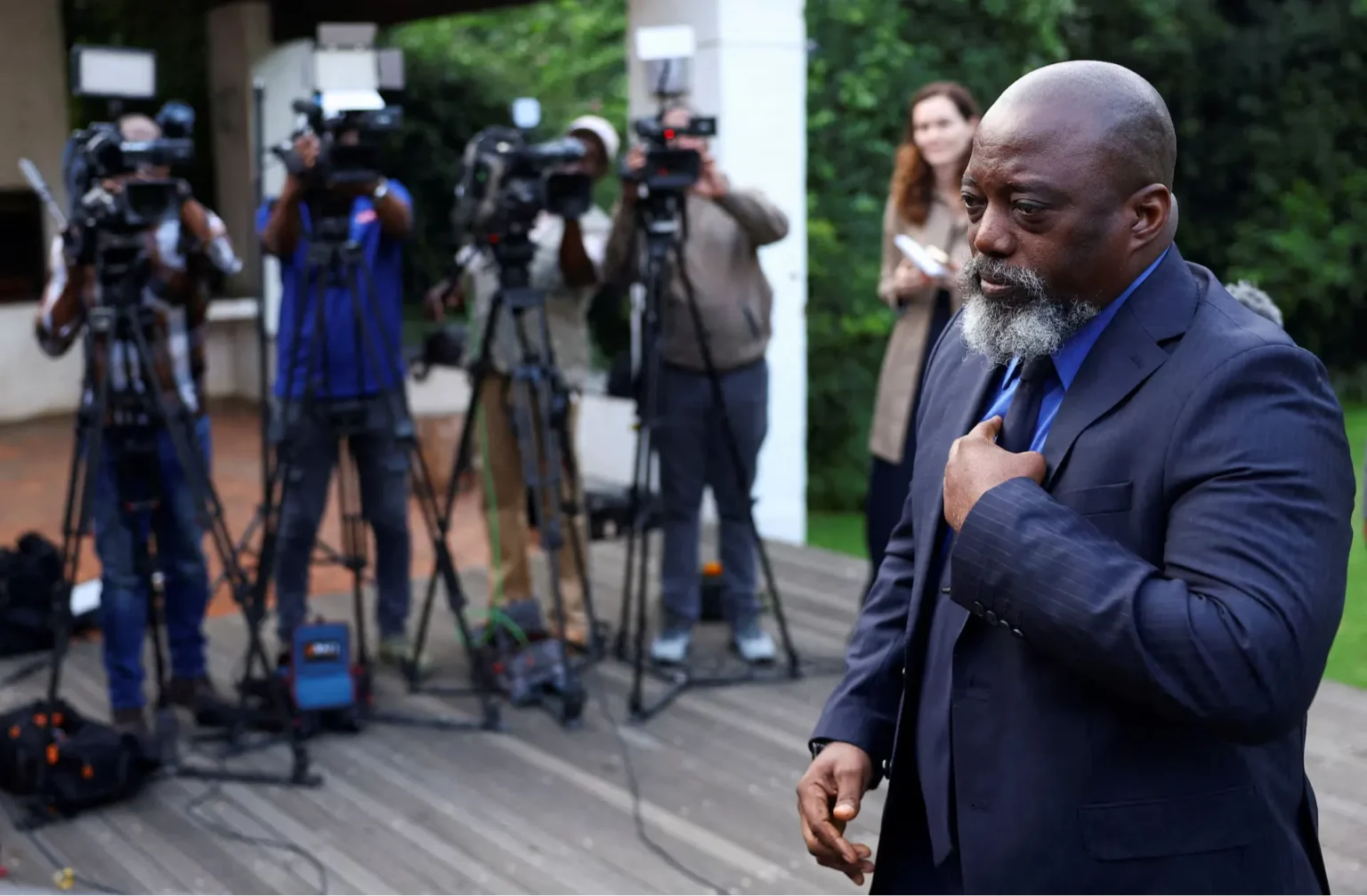
KINSHASA, DR Congo — Former Democratic Republic of Congo (DRC) President Joseph Kabila is facing growing resistance from within his political camp after taking the leadership of a new political-military coalition involving figures linked to the M23 rebellion.
Several former allies have distanced themselves from Kabila’s latest move, while a senior official in his People’s Party for Reconstruction and Democracy (PPRD) has resigned, exposing divisions over whether the opposition to President Félix Tshisekedi’s government should be pursued through constitutional politics or armed struggle.
The fallout follows the announcement of the Front for the Refoundation of the Nation (FRN) in the eastern city of Goma on Monday, October 12. The coalition brings together Kabila and prominent figures associated with the Alliance Fleuve Congo (AFC) and M23, the armed movement fighting government forces in eastern Congo.
The development marks a more direct role for Kabila in an insurgency that his government had previously accused him of supporting, allegations he denied.
Former minister rejects Kabila’s armed struggle
Former Human Rights Minister Marie-Ange Mushobekwa, who served during Kabila’s presidency, publicly distanced herself from his decision to lead the new movement.
In a statement posted on X overnight between October 12 and 13, Mushobekwa recalled her years working alongside the former president but said she could not support his turn towards armed confrontation.
“Now that he chooses to take the armed path to defend his political convictions, I decide to distance myself from this path to which I am neither closely nor remotely linked,” she said.
Mushobekwa added that she would continue pursuing democratic change through opposition politics in Kinshasa rather than joining the armed movement.
“Peace will only come through frank, inclusive and constructive dialogue,” she said, calling for negotiations to resolve the country’s political and security crisis.
Her position highlights a distinction within the Congolese opposition: opposition to Tshisekedi’s administration does not necessarily mean support for an armed campaign against it.
Senior PPRD official disowns the movement
Aristote Ngarime, the PPRD’s national secretary for communication and media, also publicly rejected the new coalition.
In a statement dated October 12, Ngarime said he disavowed the political positions and actions associated with the creation of the FRN and rejected responsibility for decisions taken by the new movement.
He reaffirmed his commitment to the Congolese Constitution and national laws, declaring that he was opposed to rebellion.
His statement raises questions about how Kabila’s party will relate to the FRN and whether officials who favour conventional political opposition will remain within the former president’s political organisation.
The public distancing by Ngarime and Mushobekwa suggests that Kabila’s new direction has not secured unanimous backing among his former associates.
Patrick Nkanga resigns after nearly 20 years
Another significant development is the resignation of Patrick Nkanga Bekonda, rapporteur of the PPRD’s Political Bureau, who announced his departure from the party after joining it in 2006.
Nkanga described the decision as difficult and painful, saying he was ending his responsibilities within the party and would take time to consider his political future.
He expressed gratitude to colleagues and indicated that he hoped to contribute to building a credible alternative based on peaceful and constitutional values.
However, Nkanga did not explicitly say his resignation was caused by Kabila’s appointment as FRN leader. His departure came in the immediate aftermath of the coalition’s announcement, adding to uncertainty surrounding the PPRD’s future direction.
Tshisekedi allies intensify criticism
The formation of the FRN has also drawn criticism from figures aligned with Tshisekedi’s ruling Union for Democracy and Social Progress (UDPS).
Peter Kazadi, a former deputy prime minister and interior minister, argued that Kabila’s formal appointment had removed uncertainty about his relationship with the armed opposition.
Kazadi dismissed the FRN as a reconfiguration of the existing AFC–M23 alliance rather than a fundamentally new movement, urging Congolese citizens to support national institutions and protect the country’s territorial integrity.
Deputy Prime Minister Jacquemain Shabani Lukoo also criticised Kabila’s association with the rebellion.
Opposition figure Marley Vuvu, meanwhile, announced that his MRC movement was withdrawing its support for the former president, arguing that political change should not be pursued through another armed movement.
The reactions illustrate how Kabila’s decision is reshaping political alliances beyond the ruling party, including among figures who oppose the current administration but do not support the use of force.
New coalition includes former adversaries
The FRN brings together Kabila with several figures associated with the AFC–M23 alliance, including former electoral commission chairman Corneille Nangaa, M23 political leader Bertrand Bisimwa and military commander Sultani Makenga.
The alliance is significant because M23 fought against Kabila’s government during its 2012–2013 rebellion before being defeated by Congolese forces backed by United Nations troops.
The new coalition says it aims to unite resistance forces to challenge what it describes as tyranny. Its adviser, Claude Ibalanky, said the movement would pursue its objectives “by any means necessary, including force”.
The group has presented itself as an alternative to Tshisekedi’s administration, accusing it of failing to address insecurity and weakening democratic institutions.
The government had not issued an immediate response to the coalition’s announcement in reports published on October 13.
US sanctions and death sentence add to pressure
Kabila’s move comes amid mounting legal and international pressure over alleged links to the rebellion.
On April 30, 2026, the United States imposed sanctions on the former president, accusing him of supporting M23 and the AFC.
The US Treasury alleged that he provided financial assistance to the alliance and encouraged Congolese soldiers to defect. These are US government allegations, which Kabila has denied.
Also Read: DR Congo military court sentences former president Joseph Kabila to death
In September 2025, a Congolese military court sentenced Kabila to death in absentia on charges including treason and war crimes linked to the conflict. Kabila has rejected the proceedings as politically motivated and denied supporting M23.
The new coalition could also complicate diplomatic efforts to end the fighting in eastern Congo. Representatives of the Congolese government and M23 were expected to take part in further talks in Qatar in November, although analysts have warned that Kabila’s formal leadership of the movement could make negotiations more difficult.
Political future of Kabila’s camp uncertain
Kabila’s influence has long rested on the PPRD and a wider network of former government officials and political allies built during his presidency from 2001 to 2019.
The FRN’s creation could strengthen his position within the armed opposition, but the departures and public objections among former associates point to a risk of fragmentation within his traditional political base.
The responses from Mushobekwa and Ngarime are particularly significant because both rejected armed struggle while maintaining a commitment to opposition politics. Nkanga’s resignation adds to the uncertainty, although he did not directly attribute his decision to the new coalition.
Whether the departures develop into a broader break within Kabila’s political camp remains unclear. What is evident is that his decision to lead the FRN has opened a new divide over the methods through which Congo’s political future should be contested, at a time when the conflict in the east remains unresolved.