




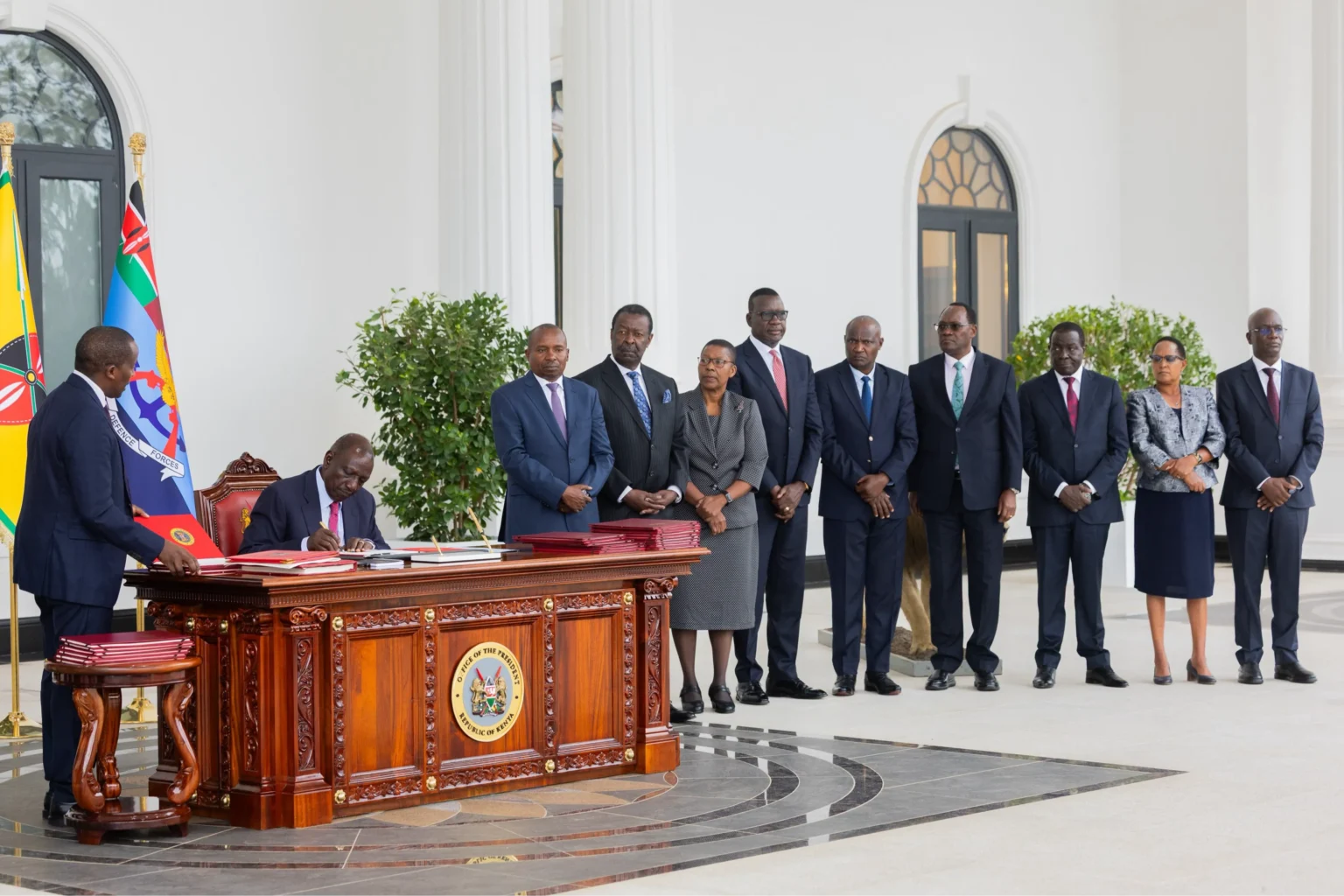
NAIROBI, Kenya — President William Ruto has signed four Bills into law, introducing changes to public finance management, air passenger service charges, population planning and the administration of trusts.
The four laws were assented to on Tuesday, September 8, 2026, at State House, Nairobi.
They are the National Council for Population and Development Bill, Air Passenger Service Charge (Amendment) Bill, Public Finance Management (Amendment) Bill 2025 and Trust Administration Bill.
The legislation forms part of wider efforts to update Kenya’s legal and institutional framework governing public finances, national planning and financial administration.
Population council given statutory foundation
The National Council for Population and Development (NCPD) Bill provides a statutory foundation for the council through an Act of Parliament.
The Bill originated from the Cabinet and was transmitted to Parliament through the Office of the Attorney General. It was sponsored by the Leader of the Majority Party and passed by the National Assembly in 2024 before proceeding to the Senate, which introduced amendments.
The two Houses subsequently reached agreement on the final version, which was presented to the President for assent in August.
Under the new law, the existing council will continue operating, although its name will change. It will remain under the Ministry of Finance through the State Department for National Planning.
The legislation is intended to strengthen the council’s legal standing, enabling it to fulfil Kenya’s international obligations and work alongside population and development institutions in other countries.
Airlines given 25-day deadline on passenger charges
The Air Passenger Service Charge (Amendment) Bill changes the framework for collecting and remitting passenger service charges.
Airlines and authorised collection agents will be required to remit the charges collected to the designated government authority within 25 days after the end of the month in which the charges were issued.
The amendments are intended to streamline the remittance process while allowing administrative expenses incurred in collecting the charges to be deducted.
The law also retains statutory oversight mechanisms to ensure the funds are managed in accordance with the Constitution and the Public Finance Management Act.
New rules for managing public finances
The Public Finance Management (Amendment) Bill 2025 introduces several changes to the management and oversight of public funds at both national and county levels.
The law establishes a framework for transferring functions between the national and county governments, covering issues including costing, financing, accountability, and the transfer of assets and liabilities.
It also introduces a framework for accrual accounting, requiring public entities to adopt the applicable accounting standard.
County governments will be required to complete their finance bills before the beginning of the next financial year, bringing their budget cycle into closer alignment with that of the national government.
The law further requires statutory deductions, including taxes and pension contributions, to be remitted to the relevant institutions after they are deducted.
Accounting officers will now have two months instead of three after the close of the financial year to submit financial statements to the Auditor General for audit.
Parliament will also have 21 days, up from 14, to consider the Budget Policy Statement. The extension is intended to provide additional time for consultation and public participation.
The same 21-day period will apply to county assemblies considering the County Fiscal Paper.
Trust laws consolidated and modernised
The Trust Administration Bill consolidates the Trustees Perpetual Succession Act of 1923 and the Trustees Act of 1929, bringing the administration of trusts under a more modern legal framework.
The two statutes have undergone several amendments over the decades but were considered insufficient to address contemporary issues surrounding the management and administration of trusts.
Also Read: Ruto signs KSh150bn JKIA expansion deal without new taxes
The new law provides for the administration of trusts and establishes transitional arrangements for existing trustees.
It also incorporates requirements linked to anti-money laundering measures and efforts to combat illicit financial flows.
The reforms are intended to strengthen Kenya’s framework for trust administration as the country seeks to maintain its position as a regional financial and investment centre.
Together, the four laws introduce changes across several areas of government administration, from national population planning and public finance to aviation revenue collection and the management of private trusts.