

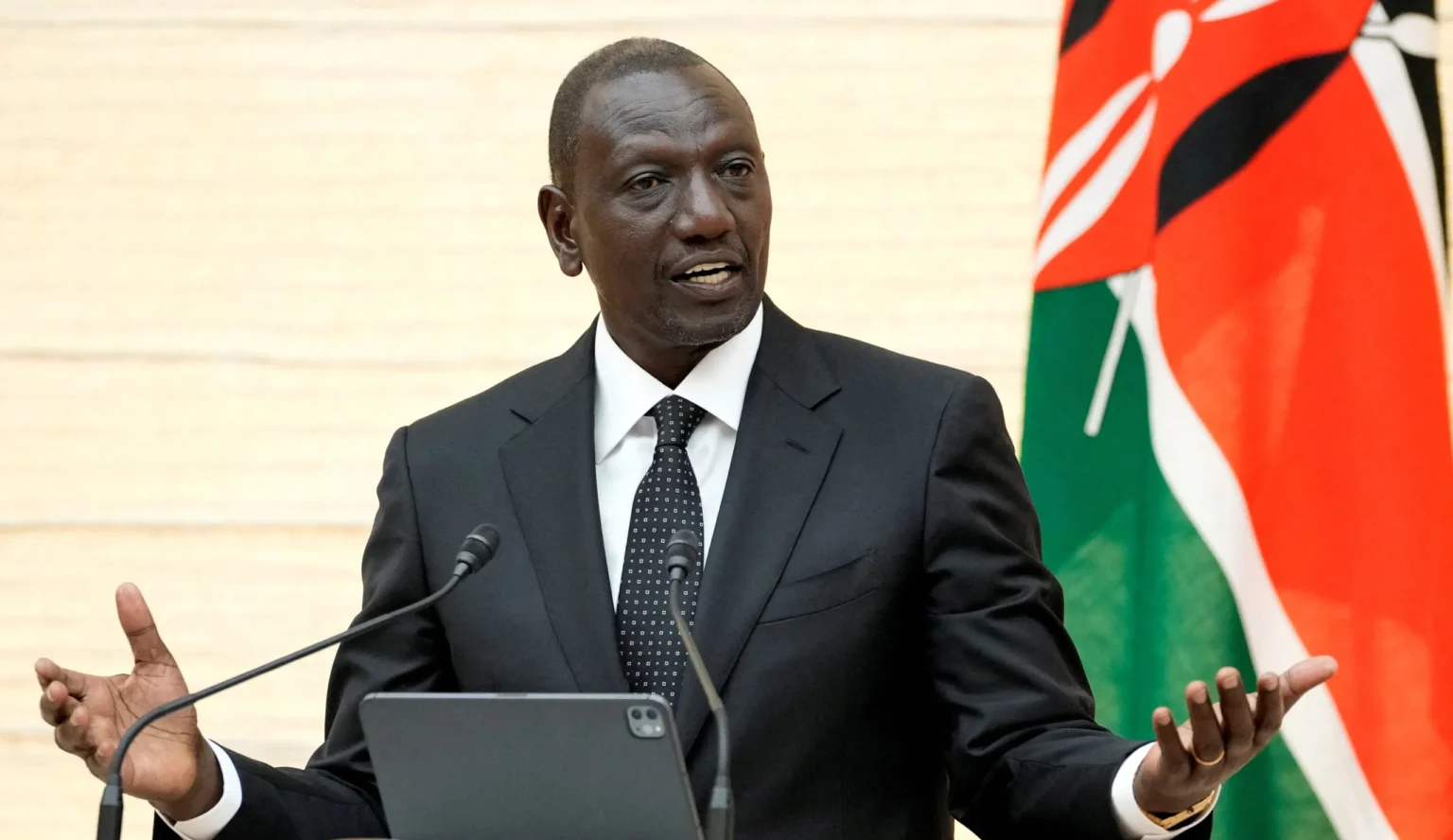
NAIROBI, Kenya — President William Ruto has ordered a crackdown on foreign nationals operating small-scale businesses in Kenya, directing authorities to begin shutting down such enterprises from Monday, September 7.
Ruto said the government would move to protect Kenyan traders from competition in businesses such as hawking and small retail, while insisting that Kenya remained open to foreign investment that creates jobs and expands production.
“From next week, all traders doing those small businesses should close them,” Ruto said on Wednesday, September 2, while addressing Micro, Small and Medium Enterprise (MSME) traders at State House in Nairobi.
He specifically questioned why foreigners, including Chinese nationals, should come to Kenya to operate small shops or work as hawkers.
“It cannot be that a person comes from China or elsewhere to be a hawker or open a small shop,” he said.
Ruto said Kenya had worked to improve economic conditions and attract investment, arguing that foreign investors should establish businesses capable of generating employment rather than compete directly with Kenyans in small-scale trading.
The President also called for the fast-tracking of legislation that would identify categories of businesses to be reserved for Kenyan citizens.
Ruto directed National Assembly Majority Leader Kimani Ichung’wah and Trade Cabinet Secretary Lee Kinyanjui to advance the proposed legislation, while other government officials were asked to engage traders and stakeholders on the proposed restrictions.
The proposed law is expected to provide a legal framework for restricting foreign participation in selected areas of small-scale trade.
The scope of Monday’s enforcement, however, was not immediately detailed, including the precise categories of businesses that will be targeted and how authorities will distinguish between foreign-owned businesses covered by the directive and those operating legally under existing permits.
The announcement comes amid increasing pressure from Kenyan traders over competition from foreign-owned businesses.
Small-scale traders have recently protested what they describe as growing competition from Chinese retailers and other foreign operators, particularly those selling imported goods directly to consumers.
On Tuesday, Nairobi traders staged demonstrations over what some described as a “Chinese invasion” of the retail sector. The protests followed concerns over competition from businesses such as China Square.
The issue has also emerged alongside wider complaints from traders about the rising cost of importing goods and changes to customs valuation rules.
Ruto’s latest directive therefore comes at a time when the government is under pressure to address the operating environment for small and medium-sized businesses.
The government’s proposed restrictions are likely to attract scrutiny because Kenya is a major regional destination for migrants, refugees and asylum seekers.
Kenya hosted approximately 857,065 refugees and asylum seekers as of June 30, 2026, according to the Department of Refugee Services. About 13.8 per cent of that population lived in urban areas, including Nairobi.
The refugee population is not, however, synonymous with the foreign nationals targeted by Ruto’s announcement. Refugees and asylum seekers are subject to a separate legal and administrative framework, and the government’s approach to their right to work or operate businesses depends on their legal status and documentation.
The distinction will be important as enforcement begins, particularly in Nairobi and other urban centres where foreign nationals engage in a range of economic activities.
Migrants from other African countries can be found working in sectors including salons and barber shops, construction, transport and street vending, while others operate small retail and food businesses.
Kenya’s position as a regional economic hub has also facilitated cross-border movement, particularly within the East African Community (EAC).
The crackdown is likely to revive debate over the treatment of foreigners working in Kenya and the balance between protecting local economic opportunities and maintaining the country’s reputation as an open regional market.
Tensions between Kenyan traders and foreign nationals have occasionally spilled into public confrontations.
In July, a video showing a Kenyan man confronting a Burundian trader in Nairobi and accusing him of taking opportunities from Kenyans triggered widespread debate and condemnation.
The incident prompted calls for the protection of Burundian nationals in Kenya, while Kenyan authorities sought to reassure citizens of Burundi and other East African countries living in the country.
The latest directive also comes against the backdrop of growing anti-migrant sentiment elsewhere on the continent, particularly in South Africa, where protests over undocumented migration have periodically triggered concerns about xenophobia.
Ruto’s order sets Monday, September 7, as the starting point for enforcement against foreigners involved in the targeted small-scale businesses.
Also Read: Nairobi traders protest over Sh3.2m KRA customs benchmark
The immediate questions are how broadly the directive will be applied, which businesses will be affected and what legal procedures authorities will use when enforcing the order.
The government is simultaneously seeking legislative changes that would formally identify businesses reserved for Kenyan citizens.
For thousands of foreign nationals earning a living in Kenya’s informal economy, the coming days could therefore determine whether they can continue operating, must change their businesses or will be required to leave sectors targeted by the new restrictions.