

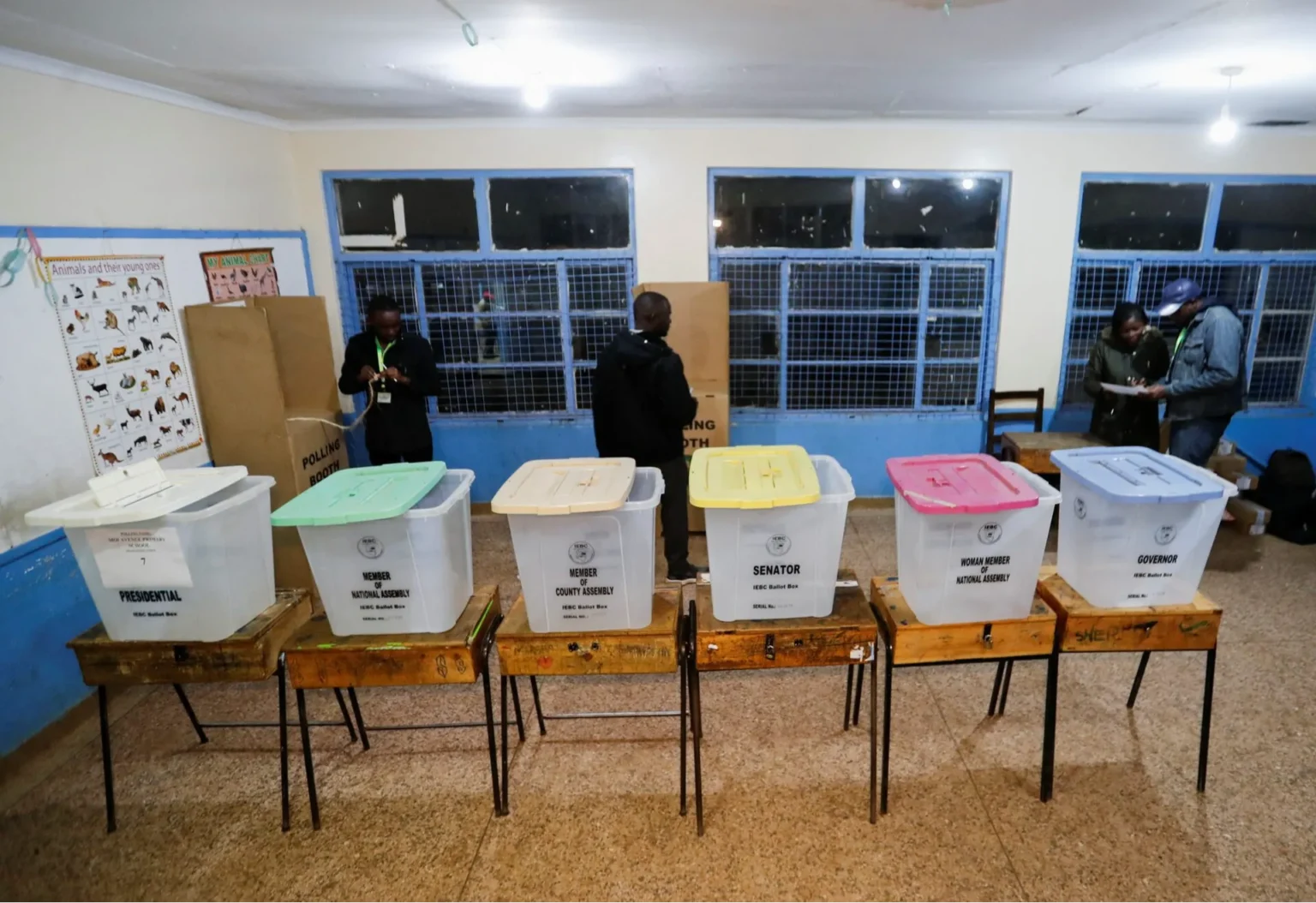
NAIROBI, Kenya — Kenya is exactly one year away from the 2027 General Election, with the Independent Electoral and Boundaries Commission (IEBC) already deep into preparations for a vote that will test its technology, finances, voter registration systems and ability to command public confidence.
The presidential election is scheduled for Tuesday, August 10, 2027, according to the IEBC’s official election operations plan.
But while the political contest is already taking shape, the machinery required to deliver the election is moving largely away from the public spotlight.
Voter registration, procurement of election technology, preparation of polling infrastructure, political-party compliance, recruitment and training of election officials, security coordination and results transmission systems are all being assembled ahead of polling day.
The scale of the undertaking is considerable.
The road to August 10, 2027
The IEBC has already published a detailed timetable setting out key deadlines for candidates and political parties.
Public officers intending to contest the election must resign by February 9, 2027, six months before polling day.
Political parties must submit their membership lists and details of planned party primaries to the IEBC by March 16, 2027.
Party primaries and the resolution of internal disputes must be completed by May 9, while independent candidates must submit their names and symbols by the same date.
The formal nomination period will run from May 29 to June 11, 2027.
The official campaign period will also begin on May 29 and end on August 7, 48 hours before polling day. Campaigning will be permitted between 7am and 6pm.
Political parties and independent candidates must submit the names of their national, county, constituency and polling-station agents by July 27.
The timetable means that by this time next year, Kenyans will have already voted.
The question is whether the institutions responsible for delivering that vote will be ready.
IEBC’s technology test
One of the biggest challenges is technology.
The Kenya Integrated Election Management System (KIEMS) is central to voter identification and electronic transmission of results. The commission plans to replace 45,352 older KIEMS kits, while retaining 14,000 kits purchased in 2022.
In total, 59,352 kits are required — 55,393 for polling stations and 3,959 for training.
The technology question matters because Kenya’s elections increasingly depend on electronic systems while the final results remain anchored in legally prescribed physical forms and verification procedures.
The commission therefore faces the dual challenge of ensuring that technology works and that there are adequate manual safeguards when it does not.
The 2027 election will also require more polling infrastructure. Current planning points to 55,393 polling stations, compared with 46,229 used in 2022.
That expansion will have implications for staffing, logistics, security, connectivity and the transportation of election materials.
A bigger voter register
The voter register has already begun expanding.
Following enhanced continuous voter registration between September 2025 and April 28, 2026, IEBC announced that 2,612,725 new voters had been added to the register.
Of these, 267,249 were registered through continuous registration at constituency offices, while 2,345,476 were registered during the 30-day nationwide mass registration exercise.
The figure surpassed the commission’s target of 2.5 million new voters for the mass registration exercise.
But registration is only one part of electoral participation.
The decisive question will be how many of those newly registered voters actually turn out on polling day.
That matters because Kenya’s 2022 election demonstrated how turnout can shape the balance of power across regions.
What the 2022 numbers tell us
Kenya had 22,120,458 registered voters in 2022.
IEBC’s final presidential results showed William Ruto winning with 7,176,141 votes, or 50.49 per cent, against Raila Odinga’s 6,942,930 votes, or 48.85 per cent.
The margin was just over 233,000 votes.
That narrow difference illustrates why voter registration, turnout and regional mobilisation will remain central to the 2027 contest.
But the political map is no longer the same as it was in 2022.
The Raila factor is gone
Perhaps the biggest change is the absence of Raila Odinga.
The former prime minister and veteran opposition leader died on October 15, 2025, aged 80, after decades at the centre of Kenyan politics.
Odinga had run for president five times and commanded a substantial national political following.
His death has therefore removed a major political anchor from the 2027 contest and created a question that will shape the opposition campaign: who inherits the political coalition and voter base he left behind?
Potential presidential contenders including Kalonzo Musyoka, Fred Matiang’i and Martha Karua have featured prominently in discussions about the opposition’s future, while President Ruto is seeking a second term.
The ruling camp is also navigating questions around coalition-building and the choice of a running mate.
For now, however, the field remains fluid.
The cost of an election
Delivering a national election is expensive.
In February 2026, IEBC presented Parliament with a KSh63.9 billion budget proposal for the 2027 General Election, including more than KSh1 billion for meals.
But the figure subsequently changed.
Parliament later approved approximately KSh74.8 billion, making the 2027 election cycle the country’s most expensive election yet. The increase reflects, among other things, technology replacement, logistics and the growing operational requirements of the poll.
The financial burden is therefore another test for the commission.
IEBC has previously warned that unpaid bills and inadequate financing could disrupt preparations. Independent election observers have also identified substantial unfunded exposure in the commission’s preparations.
The election will also receive external support.
In July, IEBC and the United Nations Development Programme signed a KSh1.7 billion electoral support programme aimed at strengthening preparedness, including voter registration, civic education, training and outreach.
The credibility question
For IEBC, perhaps the greatest challenge is not simply conducting an election but convincing Kenyans that the election was conducted fairly.
Kenya’s electoral history is marked by disputes over results, technology, transmission, voter registers and alleged irregularities.
Also Read: Mudavadi warns opposition against underestimating Ruto ahead of 2027 election
The commission has therefore been seeking to strengthen its systems well before polling day.
The credibility of the 2027 election will depend on more than functioning KIEMS kits.
It will require accurate voter registers, transparent procurement, adequate polling materials, effective results transmission, credible returning officers, trained election officials and clear communication with political parties and voters.
Security will also be critical, particularly as political competition intensifies.
One year to go
The countdown to August 10, 2027 is therefore about much more than politicians touring the country.
It is about whether the institutions that underpin Kenya’s democracy can deliver a credible election at scale.
The IEBC has already completed one major voter-registration exercise, established key electoral timelines and begun preparing its technology and infrastructure.
But major tests remain.
The commission must procure and deploy thousands of KIEMS kits, expand polling infrastructure, train election officials, manage political-party nominations, coordinate security and ensure that results can be transmitted and verified without undermining public confidence.
And then there is the political environment.
With President Ruto seeking re-election, a fragmented opposition searching for a new centre of gravity after Odinga’s death, and political alliances shifting ahead of the campaign season, the 2027 election is likely to be fiercely contested.
For voters, however, the immediate issue is simpler.
One year from today, Kenyans will not be preparing to vote.
They will be voting.
The effectiveness of the preparations underway now will determine whether that day is remembered as another disputed election — or as a credible demonstration of Kenya’s democratic institutions.