

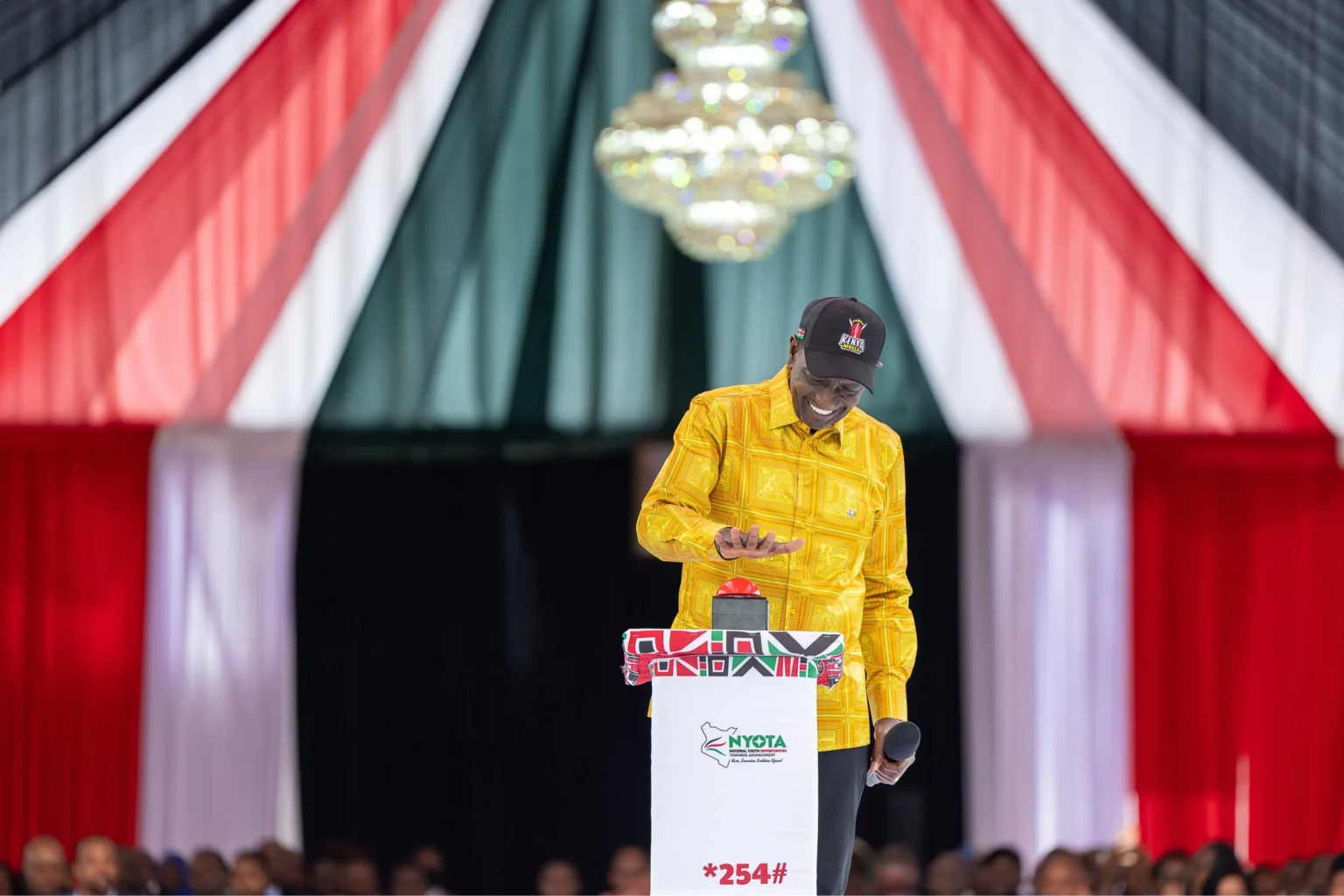
NAIROBI, Kenya — President William Ruto transformed the launch of the second phase of the National Youth Opportunities Towards Advancement (NYOTA) programme into a nationwide live broadcast on Friday, coordinating Cabinet Secretaries and senior government officials stationed across the country in what amounted to one of the most extensive government communication exercises seen in recent years.
The event, held at Nairobi’s Ulinzi Sports Complex, saw Ruto preside over the release of the second tranche of NYOTA funding while simultaneously linking up with government officials in multiple counties to receive real-time updates on the programme’s implementation and impact.
Through a split-screen live feed that resembled a major television news broadcast, the President took on the role of moderator, moving from county to county as Cabinet Secretaries reported on how beneficiaries were using government grants to establish and expand businesses.
The carefully choreographed exercise came as the government rolled out more than KSh3 billion in funding to over 122,000 young entrepreneurs under the programme.
Cabinet joins nationwide rollout
The event began with Deputy President Kithure Kindiki providing updates from Nakuru before the President abruptly switched attention to Kakamega, where Prime Cabinet Secretary Musalia Mudavadi was waiting to address the gathering.
“I need to move to Kakamega now. The Prime Cabinet Secretary is really waiting to get into the programme. I’m now the producer of this show. Mr Prime Cabinet Secretary, the floor is yours,” Ruto said, drawing laughter from the audience.
The live links continued throughout the event, with senior officials reporting from different regions of the country.
Cabinet Secretary for Labour and Social Protection Alfred Mutua joined from Machakos, while Co-operatives and MSMEs Development Cabinet Secretary Wycliffe Oparanya reported from Kapenguria.
Other officials who participated included Cabinet Secretary for East African Community Affairs Beatrice Askul Moe from West Pokot, Treasury Cabinet Secretary John Mbadi from Kisumu, Health Cabinet Secretary Aden Duale from Garissa and Water Cabinet Secretary Alice Wahome from Murang’a.
Public Service Cabinet Secretary Geoffrey Ruku also joined from Chuka, where he interacted with beneficiaries from Embu, Meru and Tharaka Nithi counties.
Throughout the programme, the President appeared to personally direct the sequence of live reports, deciding which county would come on air next and engaging directly with beneficiaries and government officials.
Government seeks to showcase youth enterprise success
The nationwide broadcast appeared designed not only to distribute funds but also to publicly demonstrate the programme’s reach and impact.
Government officials highlighted businesses established through earlier NYOTA grants, presenting examples of beneficiaries who had used the funds to launch retail enterprises, agricultural projects, service businesses and small manufacturing ventures.
The initiative forms part of the Kenya Kwanza administration’s broader effort to tackle youth unemployment through enterprise development and financial inclusion.
According to government figures, the programme has targeted thousands of young people who previously lacked access to startup capital and formal financing channels.
New benefits for NYOTA beneficiaries
Beyond the disbursement of funds, the President used the occasion to announce additional measures aimed at helping young entrepreneurs grow their businesses.
Among the most significant was a directive to the Intergovernmental Budget and Economic Council (IBEC) and county governments to develop and implement a two-year business permit waiver for all NYOTA beneficiaries.
“Having seen what these young entrepreneurs have achieved with modest support, the government of Kenya now has a responsibility to remove the barriers that still stand in their way. Success should never be constrained by unnecessary bureaucracy,” Ruto said.
The waiver is expected to reduce compliance costs for newly established businesses and allow beneficiaries more time to stabilize their enterprises before incurring additional regulatory expenses.
National identification system planned
The President also directed the Ministry of Co-operatives and MSMEs Development to establish a national NYOTA identification mechanism.
According to Ruto, the identification system will enable beneficiaries to access government services, incentives and enterprise support programmes more efficiently.
The proposed system is intended to create a structured database of programme participants, making it easier for government agencies to provide targeted support and monitor the progress of funded businesses.
Additional financing opportunities
Recognising that some enterprises may eventually outgrow the initial grants, the President instructed government-backed financing institutions to create a dedicated NYOTA Growth Product.
The financing facility is expected to involve institutions such as the Youth Enterprise Development Fund, the Uwezo Fund, the Women Enterprise Fund and other government-supported lenders.
Also Read: ‘Can I give you a hug?’ Young woman charms crowd at Ruto’s NYOTA launch
The objective is to ensure that entrepreneurs who successfully establish businesses through NYOTA can access larger amounts of capital as their enterprises expand.
“The first grant must never become the last opportunity,” Ruto said.
Youth employment remains a key challenge
The NYOTA programme is being implemented against the backdrop of persistent youth unemployment and underemployment, which remain among Kenya’s most pressing socio-economic challenges.
Government officials argue that supporting entrepreneurship provides an alternative pathway to employment creation, particularly at a time when formal job opportunities remain limited relative to the number of young people entering the labour market each year.
As the second phase of the programme gets underway, the administration is betting that a combination of direct funding, reduced regulatory costs and easier access to financing will enable thousands of young entrepreneurs to build sustainable businesses and create jobs within their communities.
Friday’s nationwide rollout signalled the government’s intention not only to fund those businesses but also to publicly demonstrate their role in its broader economic transformation agenda.