


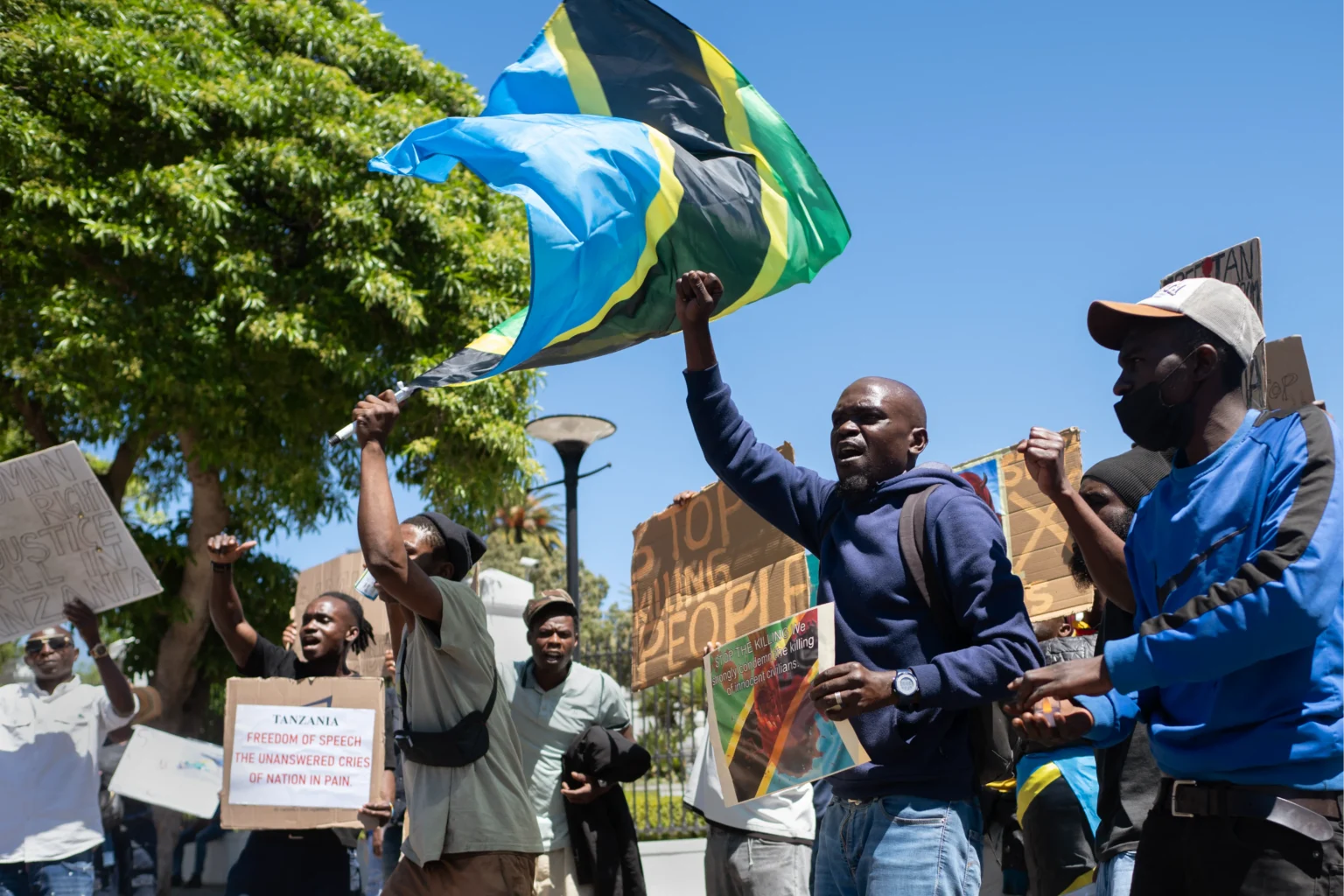
DAR ES SALAAM, Tanzania — Heavy police deployments across Tanzania’s commercial capital Dar es Salaam have heightened tensions ahead of planned Saba Saba Day demonstrations, with opposition leaders and rights activists accusing the government of suppressing dissent and creating a climate of fear following deadly unrest linked to last year’s elections.
The demonstrations were expected to coincide with Saba Saba Day, a date that holds political significance across East Africa and, in Tanzania, also recalls the legacy of the former African National Union of Tanganyika (TANU), the party that led the country to independence.
However, analysts and opposition figures say widespread fear of reprisals, coupled with memories of violence during and after Tanzania’s October 2025 elections, may limit public participation.
Heavy security presence in Dar es Salaam
In recent days, riot police, armoured vehicles and heavily armed security personnel have been deployed across parts of Dar es Salaam, particularly in strategic commercial and transport hubs.
Authorities have described the deployments as routine security operations.
But critics argue the show of force is intended to discourage planned protests and public gatherings.
Dar es Salaam Regional Commissioner Albert Chalamila recently warned that authorities would take firm action against anyone attempting to disrupt public order.
The government has also maintained a ban on political rallies and public political gatherings, citing security concerns.
Opposition alleges shrinking civic space
Opposition parties say the restrictions reflect a broader deterioration in political freedoms under President Samia Suluhu Hassan.
When Hassan assumed office in 2021 following the death of President John Magufuli, many observers viewed her as a reform-minded leader who appeared willing to ease restrictions on the media, opposition politics and civil society.
Her administration initially lifted bans on political rallies and allowed greater engagement between government and opposition groups.
However, human rights organisations, opposition leaders and international observers have increasingly expressed concern about what they describe as renewed repression.
Several opposition politicians have reported surveillance, arrests and restrictions on political activity.
Among the most high-profile cases is that of opposition leader Tundu Lissu, who has remained in detention since 2025 after being charged with treason. His supporters argue the prosecution is politically motivated, while authorities insist the legal process is being conducted in accordance with Tanzanian law.
Lingering trauma from election violence
The planned protests are unfolding against the backdrop of lingering controversy surrounding the October 2025 elections.
Opposition groups and human rights organisations have accused security forces of using excessive force against demonstrators and political activists during and after the polls.
Rights advocates have called for an independent investigation into reported killings, disappearances and arbitrary arrests linked to the unrest.
The Tanzanian government has acknowledged fatalities occurred during the election period but disputes some of the figures reported by opposition groups and activists.
While official investigations were promised, critics argue that little information has been released publicly regarding accountability for the violence.
Families affected by the unrest continue to demand answers.
Many Tanzanians interviewed by local and international media have described a climate of uncertainty and fear, particularly in urban areas where clashes were reported.
Protest organisers face uphill battle
Despite calls for demonstrations demanding constitutional reforms, political accountability and greater protection of civil liberties, observers say turnout may be limited.
Political analysts note that fear of arrest, police action and possible violence remains a significant deterrent.
Also Read: Activists notify police ahead of peaceful Saba Saba march to Parliament
Several opposition leaders have publicly stated that citizens are reluctant to participate in large public gatherings due to concerns for their safety.
At the same time, activists argue that continued restrictions on political activity risk further undermining confidence in democratic institutions.
Calls for dialogue and reforms
Opposition parties, including ACT-Wazalendo and Chadema, have renewed calls for political dialogue, constitutional reforms and guarantees for freedom of assembly and expression.
Critics also want the government to release findings from investigations into election-related violence and establish mechanisms to ensure accountability where abuses occurred.
The government, however, maintains that its priority remains preserving national stability, security and public order.
As July 7 approaches, attention will focus on whether demonstrations proceed, how security agencies respond and whether Tanzania can avoid a repeat of the tensions that have marked its recent political history.