

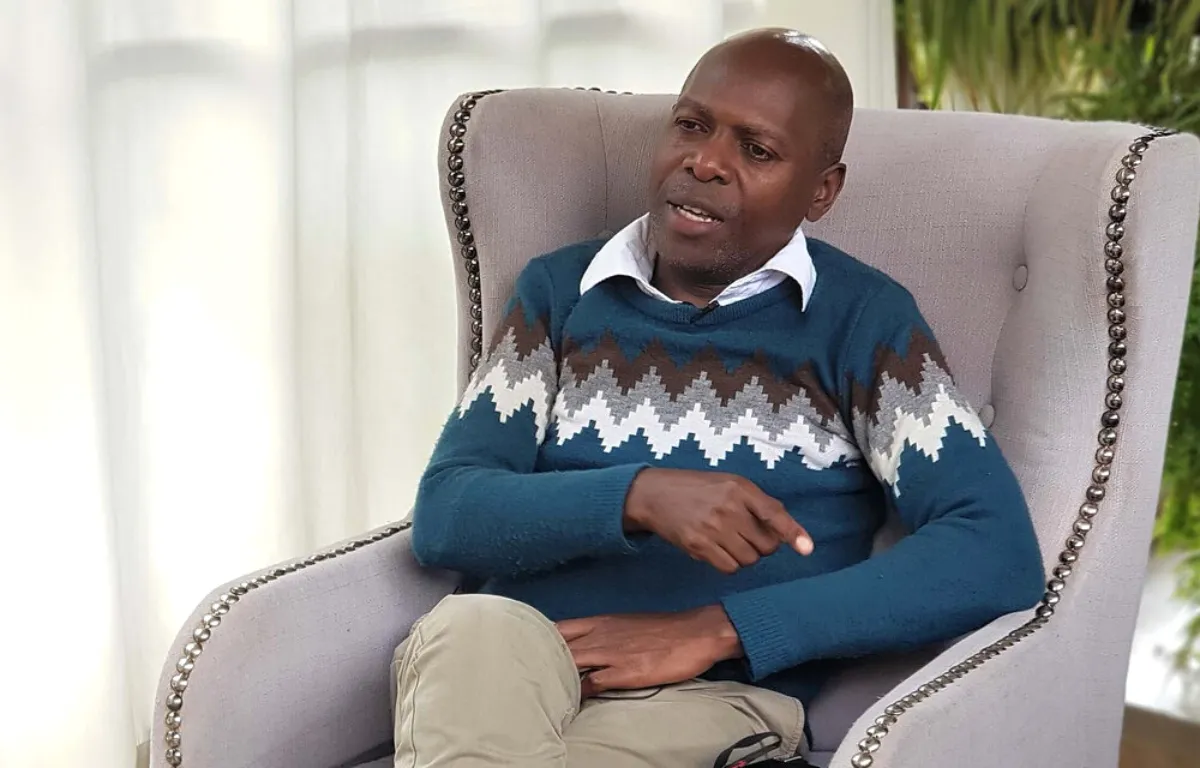
KAMPALA, Uganda — Veteran Ugandan journalist and political commentator Timothy Kalyegira has once again found himself at the centre of a legal and political storm, more than a decade after he was first prosecuted over commentary that challenged the official narrative surrounding one of Uganda’s darkest security incidents.
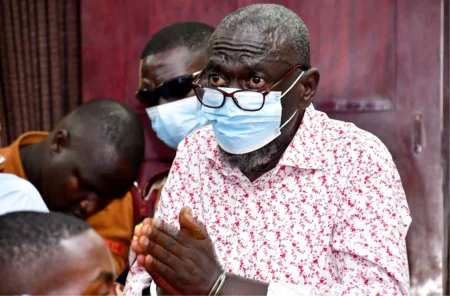
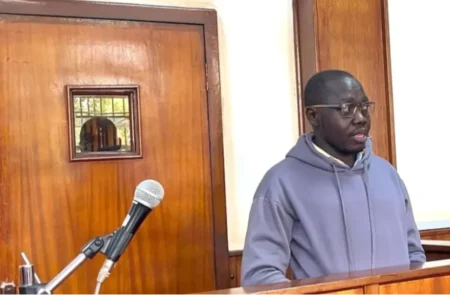
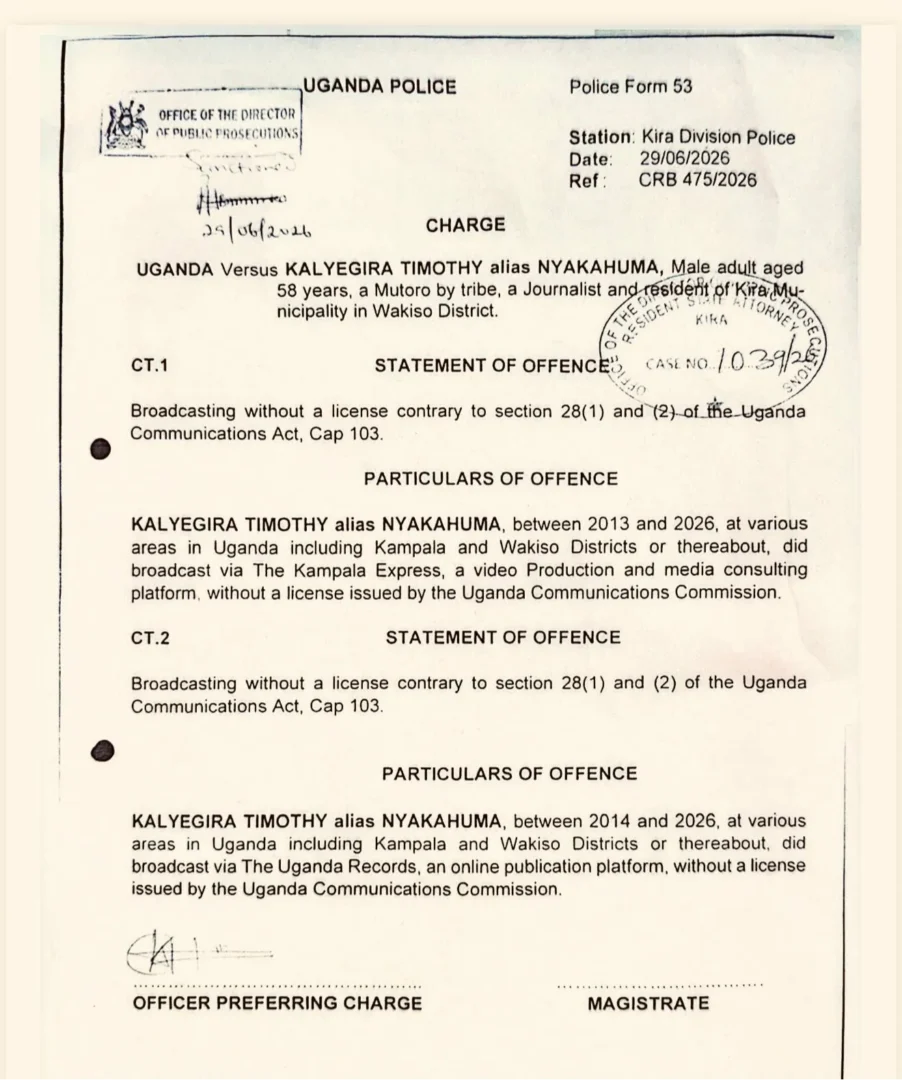
Mr. Kalyegira, 58, appeared before the Kira Chief Magistrate’s Court on June 29, 2026, following investigations registered by the Kira Division Police under Criminal Reference Book (CRB) 475/2026. He denied two counts of operating online media platforms without licences issued by the Uganda Communications Commission (UCC).
The charges relate to The Kampala Express, a video production and media consulting platform, and The Uganda Records, an online publication platform. Mr. Kalyegira has used these channels to publish independent political commentary, analysis, and opinion pieces for over a decade.
The court remanded him to Luzira Prison until July 16, when the case will return for further proceedings.
Yet for many observers, the prosecution is about far more than licensing requirements.
It has reopened long-standing questions about press freedom, digital regulation, and the relationship between Uganda’s political establishment and journalists who challenge official narratives.
A journalist long familiar with controversy
Timothy Kalyegira is widely regarded as one of Uganda’s most influential political analysts.
Known for his detailed historical research, incisive political commentary, and often provocative assessments of governance and security matters, he has built a substantial audience through newspapers, digital publications, and social media platforms.
His writings have frequently touched on highly sensitive subjects that many journalists approach with caution, including military affairs, succession politics, and the actions of powerful state institutions.
His latest legal troubles are not his first encounter with the Ugandan justice system.
In 2010 and 2011, he was arrested and charged with criminal libel and sedition after publishing a series of op-eds on his website, The Uganda Records. The state’s case centered on commentary suggesting that the state bore responsibility for the circumstances surrounding the July 2010 Kampala twin bombings.
The terrorist attacks, which targeted a restaurant and a sports club during a World Cup final screening, killed over 70 people and were claimed by the Somalia-based militant group Al-Shabaab.
At the time, Mr. Kalyegira’s comments attracted the attention of security agencies.
He was detained, charged and later released on bail while criminal proceedings continued.
His lawyer at the time told the Kampala Dispatch, Uganda’s News Monthly Magazine that authorities alleged he had defamed the President through articles published on his website.
Those cases, alongside sedition-related charges, were eventually dismissed in 2015.
A changing political environment
Mr. Kalyegira’s latest prosecution comes at a particularly sensitive moment in Uganda’s political landscape.
The case emerges just days after security forces shut down operations of Nation Media Group (NMG) Uganda, including NTV Uganda, Spark TV, Daily Monitor, KFM and Dembe FM, following directives publicly announced by Chief of Defence Forces (CDF), Gen Muhoozi Kainerugaba.
The closures triggered regional concern from media organisations, press freedom advocates and civil society groups.
Against that backdrop, Mr. Kalyegira’s prosecution has inevitably attracted scrutiny.
In recent months, the journalist has written extensively about Uganda’s security sector, military leadership and politically sensitive developments involving Gen Muhoozi and other senior officials.
Although prosecutors have not publicly linked those writings to the current case, the timing has fuelled debate among media observers.
What exactly are the charges?
According to the charge sheet, prosecutors allege that Mr. Kalyegira operated broadcasting services without obtaining licences from the Uganda Communications Commission (UCC).
The State claims that between 2013 and 2026 he broadcast content through The Kampala Express, while also operating The Uganda Records between 2014 and 2026 without the necessary regulatory approval.
Human rights lawyer Tumusiime Kato, who attended the court session, also stated that Mr. Kalyegira was facing charges connected to the Computer Misuse Act.
“Colleagues, @TimKalyegira is now at Kira Magistrates Court on charges related to Computer Misuse. We should all stand in solidarity with him,” Kato posted on X.
However, details of the specific social media posts or online content forming the basis of those allegations had not been publicly disclosed by the time of publication.
A legal grey area in the digital age
The prosecution has revived an increasingly important question in Uganda and across Africa: should online publishers, websites and digital news platforms be regulated in the same way as traditional broadcasters?
Uganda’s communications laws were largely developed during an era dominated by radio and television.
The rapid growth of digital media has complicated efforts to define where journalism ends and broadcasting begins.
Supporters of strict licensing requirements argue that online publishers should comply with the same regulatory standards as conventional media houses.
Critics, however, contend that extending broadcast licensing requirements to websites and digital commentary platforms risks creating barriers to free expression.
The issue has become even more significant as independent journalists increasingly rely on online platforms to reach audiences outside traditional media structures.
Computer Misuse Act controversy
Timothy Kalyegira’s case also intersects with ongoing debates surrounding Uganda’s Computer Misuse legislation.
In March 2026, Uganda’s Constitutional Court struck down key provisions of the Computer Misuse (Amendment) Act, 2022, finding that Parliament had passed the amendments without meeting constitutional quorum requirements.
The now-nullified provisions had been widely criticised by journalists, activists and digital rights organisations, who argued that they were frequently used to criminalise online speech.
The court’s decision left only the original 2011 Computer Misuse Act in force, covering offences such as hacking, electronic fraud and unauthorised access to computer systems.
As a result, legal observers are closely watching how prosecutors intend to apply the remaining provisions of the law in cases involving political commentary and journalism.
Press freedom concerns
Media freedom advocates have already expressed concern about the broader implications of the case.
For them, Mr. Kalyegira’s prosecution forms part of a wider pattern involving increasing regulation of online speech and growing pressure on independent media voices.
Uganda has faced repeated criticism from international press freedom organisations over arrests of journalists, restrictions on media coverage, internet shutdowns during elections and the use of regulatory agencies against media organisations.
Also Read: Ugandan opposition, activists would lose foreign funding if rights abuses ended, says Kalyegira
Supporters of government regulation argue that licensing and oversight are necessary to combat misinformation and ensure accountability.
Critics counter that enforcement often appears selective and disproportionately affects government critics.
What comes next?
Journalist Timothy Kalyegira now joins a growing list of high-profile political figures and activists detained at Luzira Prison, including prominent opposition figures; Dr Kizza Besigye, former Kampala Lord Mayor Erias Lukwago, and among other leaders and opposition supporters who have recently faced legal challenges.
Whether his prosecution ultimately becomes a straightforward licensing case or evolves into a broader test of media freedom remains to be seen.
What is clear is that his arrest has once again placed Uganda’s approach to journalism, digital regulation and freedom of expression under the spotlight.
For a journalist whose career has often been defined by challenging authority, the latest chapter may prove to be one of the most consequential yet.