





NAIROBI, Kenya — The June 25, 2026 demonstrations marking the second anniversary of Kenya’s historic Gen Z protests offered a stark reminder that the grievances which drove thousands of young people onto the streets in 2024 have not disappeared.
What was intended as a memorial for those killed during last year’s anti-Finance Bill protests instead evolved into another defining test of the relationship between citizens and the state.
Security agencies mounted one of the most extensive operations seen in Nairobi in recent years, deploying roadblocks, anti-riot units, mounted police, intelligence officers and, for the first time in a highly visible manner, Long Range Acoustic Devices (LRADs), commonly known as sound cannons.
The events of June 25 have reignited debate about police accountability, civil liberties, public trust in government institutions, and the direction Kenya is taking as the country moves toward the 2027 General Election.
Nairobi under security lockdown
Long before demonstrators reached Nairobi’s Central Business District (CBD), security agencies had effectively sealed off much of the capital.
Major roads leading into the city were blocked using razor wire barricades, police trucks and heavily armed officers. Public transport was disrupted, businesses remained closed and movement into key government installations, including Parliament, was heavily restricted.
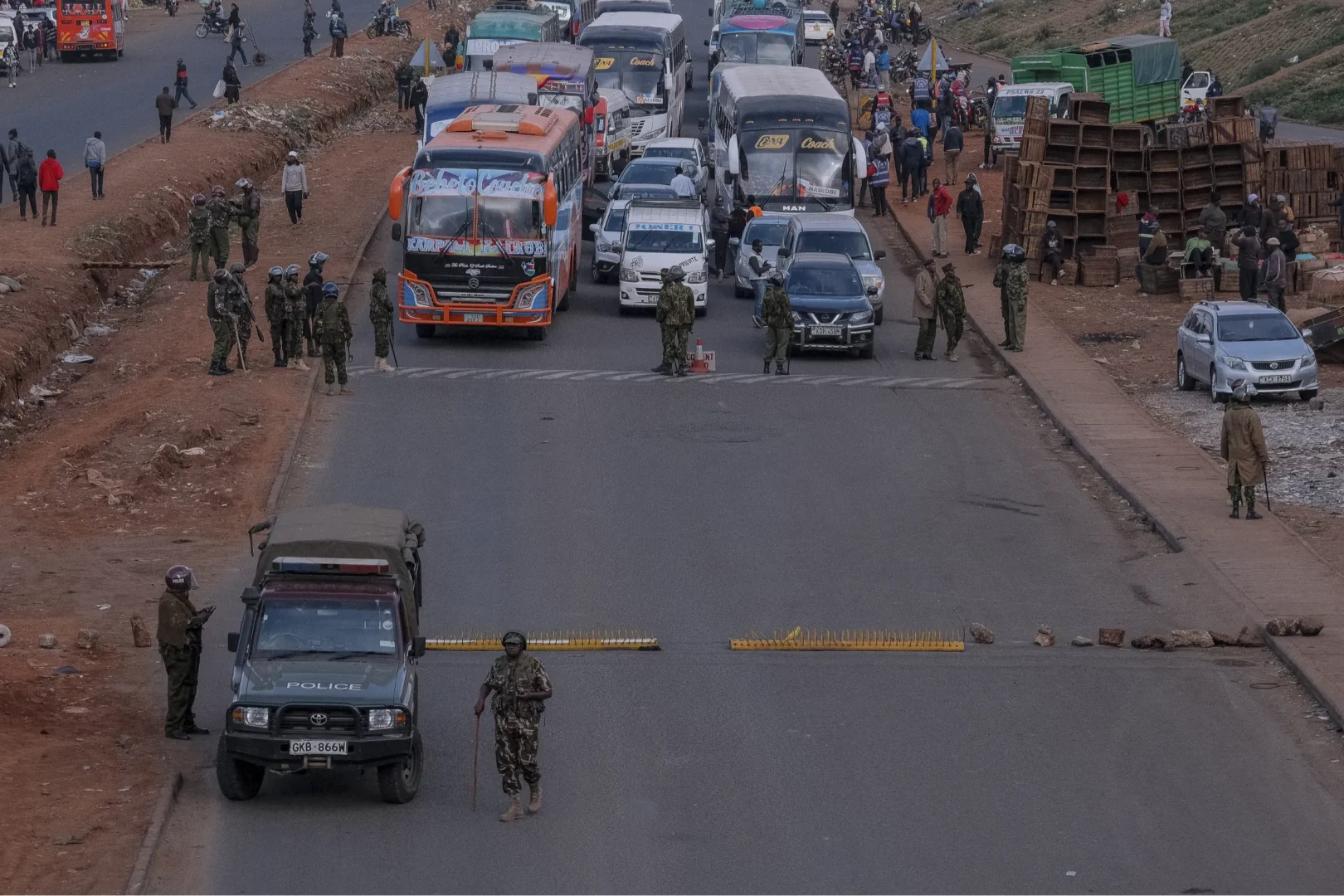
The government’s position was that the measures were necessary to prevent violence, looting and infiltration by criminal elements.
Police leadership argued that intelligence reports had indicated potential security threats.
Critics, however, viewed the operation as a deliberate effort to discourage participation in what had largely been advertised as a memorial procession rather than a violent protest.
The emergence of sound cannons
One of the most striking features of the security operation was the deployment of Long Range Acoustic Devices (LRADs), or “sound cannon,” considered non-lethal weapons.
Mounted on armoured security vehicles, the devices emitted powerful warning messages and high-intensity alert tones that could be heard across large sections of the city.
What are LRADs?
LRADs are acoustic communication systems originally developed for military and maritime security purposes.
Instead of bullets, they fire sound waves, emitting extremely loud noises. Regular sound waves get weaker the farther you stand from the emission point.
They can be used in two primary ways:
- Long-distance voice communication.
- High-intensity deterrent tones designed to disperse crowds.
Unlike conventional loudspeakers, LRADs focus sound into a narrow directional beam capable of travelling over long distances.
But the acoustic signals from sound cannon can be heard loudly up to a kilometer (0.62 miles) away. That’s because the sound waves are fired at a high-pressure rate.
The closer you are to a sonic weapon when it is fired, the stronger the pain you will experience.
LRAD are said to reach a maximum volume of 150 or 160 decibels. A fighter jet engine at take-off reaches around 130 decibels. A normal conversation takes place at roughly 60 decibels, while a crying baby can crack 80 or even 100 decibels.
What’s considered too loud varies from person to person and also depends on the frequency of the sound. But on average, sounds higher than 90 or 100 decibels are uncomfortable to hearing people. And anything above 120 decibels causes pain.
The devices have been used by police and military agencies in countries including the United States, Australia, Israel and several European states.
Loud noises have been used in warfare for centuries.
For example, Native Americans in what is now the United States used war drums to communicate with each other over long distances and to intimidate or confuse the enemy.
In World War II, sounds were also used in psychological warfare: The Nazi Luftwaffe (air force) equipped its dive bombers with ram-air sirens that produced a loud wailing noise when the planes took a dive. This caused an increased sense of panic among those under attack on the ground.
More recently, LRAD have been used on freighters off the coast of Somalia to ward off pirates. Police in Greece used acoustic weapons in summer 2021 to prevent migrants from entering the country irregularly, and thus the EU, from Turkey. US police used LRAD to disperse crowds protesting the G20 summit in Pittsburgh in 2009.
Why are LRADs controversial?
Human rights organisations have long questioned the use of LRADs for crowd control.
With extremely loud noises, such as those from sonic weapons, the sound waves hit the eardrum at high pressure and can cause significant damage as a result.
Medical experts warn that exposure to high-intensity acoustic waves can cause:
- Severe ear pain.
- Temporary hearing loss.
- Permanent hearing damage in extreme cases.
- Headaches.
- Dizziness.
- Disorientation.
- Anxiety and panic reactions.
The reflex reaction when exposed to this is to cover your ears. That’s why sonic weapons are also known as “acoustic handcuffs” — your hands can no longer be used for anything else while you are covering your ears.
Critics argue that the technology occupies a grey area between communication equipment and non-lethal weaponry.
While governments describe LRADs as crowd management tools, civil liberties groups often classify them as force multipliers capable of causing physical harm.
Their deployment in Nairobi signals a significant evolution in Kenya’s protest policing tactics.
Arrests and detentions
Interior Cabinet Secretary Kipchumba Murkomen later announced that at least 355 individuals had been arrested nationwide.
Authorities cited offences including:
- Obstruction of roads.
- Public disorder.
- Robbery.
- Vandalism.
- Attempted theft.
Nairobi recorded the highest number of arrests, followed by Kajiado, Kiambu, Murang’a, Bungoma, Meru, Laikipia and Machakos.
Dozens of those arrested were transported to police stations across Nairobi before being presented before courts.
Human rights observers raised concerns over reports that some individuals were seized by plain-clothed officers and bundled into unmarked vehicles, a tactic that has become increasingly controversial following previous allegations of enforced disappearances.
Although police maintain that arrests were lawful, concerns persist regarding transparency in detention procedures and access to legal representation.
Court battles and the legal response
The legal community responded rapidly.
Former Law Society of Kenya (LSK) President Faith Odhiambo coordinated teams of advocates to monitor arrests and represent detainees.
More than 200 suspects were subsequently arraigned at the Milimani Law Courts and charged with offences linked to road obstruction and disruption of traffic flow.
Among lawyers who publicly participated in legal efforts surrounding protest-related arrests were: Babu Owino, James Orengo, Faith Odhiambo and among other several advocates attached to the Law Society of Kenya’s legal aid teams.
Many accused persons denied the charges.
The courts granted bail to numerous suspects, allowing their release pending trial.
Former Nairobi Governor Mike Sonko also publicly announced that he had assisted in securing the release of several arrested protesters by facilitating payment of court-imposed bail.
The rapid mobilisation of lawyers highlighted the increasingly central role legal institutions are playing in disputes between protesters and the state.
The return of the abduction debate
Perhaps the most politically sensitive issue surrounding the protests remains allegations of enforced disappearances.
Throughout 2024 and 2025, civil society groups documented numerous cases involving activists, bloggers and government critics who were allegedly abducted before later resurfacing or remaining unaccounted for.
The June 25 demonstrations revived public fears that security agencies continue to rely on covert detention methods.
Government officials have consistently denied involvement in unlawful abductions and insist all arrests are conducted within the law.
Nevertheless, continued reports of individuals being taken away by unidentified officers have deepened public suspicion.
A government facing growing scrutiny
President William Ruto’s administration argues that maintaining public order is a constitutional obligation.
Government officials point to incidents of looting and property destruction during previous demonstrations as justification for strong security measures.
However, critics contend that the government’s response increasingly prioritises control over dialogue.
The perception that dissent is being securitised has become a recurring theme in public discourse.
Opposition leaders, civil society organisations and some religious groups have accused authorities of responding to criticism with:
- Heavy police deployments.
- Arrests.
- Intimidation.
- Restrictions on assembly.
Whether these concerns reflect reality or political perception, they are shaping public debate ahead of 2027.
The political significance of June 25
The June 25 demonstrations were never solely about the Finance Bill.
They have evolved into a symbol of a broader political awakening among young Kenyans.
The Gen Z movement emerged as a largely leaderless mobilisation demanding:
- Accountability.
- Fiscal transparency.
- Anti-corruption measures.
- Respect for constitutional rights.
Two years later, the movement continues to influence national politics.
Unlike traditional opposition movements organised around political parties, the Gen Z protests represent a decentralised form of civic engagement driven largely through digital platforms.
That presents a unique challenge for political leaders because such movements are difficult to negotiate with, co-opt or suppress through conventional political means.
Looking ahead to 2027
With the next General Election approaching, the government’s handling of protests will remain under intense scrutiny.
History suggests that perceptions of state repression often become powerful political issues during election cycles.
Also Read: Why Kenya’s Gen Z could become the decisive voting bloc in 2027
For President Ruto, the challenge will be balancing security concerns with constitutional freedoms.
For protesters and opposition figures, the challenge will be ensuring demonstrations remain peaceful and avoid giving authorities justification for stronger crackdowns.
The events of June 25 demonstrated that Kenya’s struggle is no longer merely about taxes or economic policy.
It is increasingly about trust.
Trust between citizens and police.
Trust between young people and political institutions.
And trust between a government seeking stability and a population demanding accountability.
How that trust deficit is managed may ultimately become one of the defining questions of Kenya’s 2027 election cycle.