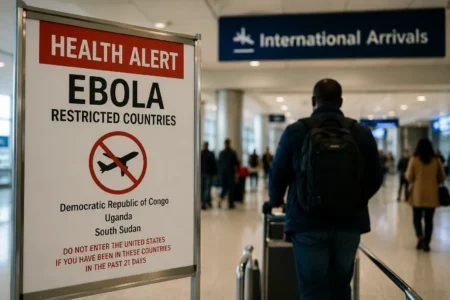





NAIROBI, Kenya — Israel has reversed an earlier decision to bar travellers from Kenya from entering the country over Ebola-related concerns, following diplomatic protests from the Kenyan government.
The move comes days after Israel’s Population and Immigration Authority (PIBA) issued a directive instructing airlines to deny boarding to travellers from Kenya, Uganda, Rwanda, South Sudan and the Democratic Republic of the Congo (DRC), citing concerns over the regional Ebola outbreak.
Kenyan officials strongly objected to the decision, arguing that the country had not recorded any Ebola cases and that the restrictions were not supported by scientific evidence or an appropriate risk assessment.
Foreign Affairs Principal Secretary Dr Korir Sing’oei said Kenya had formally raised concerns with Israeli authorities, describing the restrictions as unjustified.
“This is especially unfortunate given Kenya’s support to regional surveillance and response to Ebola. With over 80,000 tests, no case of Ebola has been reported in Kenya,” Sing’oei said.
Following consultations between the two governments, Israel removed Kenya and Rwanda from the list of affected countries, effectively restoring travel access for citizens and residents of the two nations.
In a notice issued on June 10, 2026, the Israeli Population and Immigration Authority directed airlines to prevent foreign nationals and residents from Kenya, Uganda, Rwanda, South Sudan and the DRC from boarding flights to Israel.
The restrictions also applied to travellers of any nationality who had visited any of the listed countries within 21 days before their planned travel date.
Airlines were instructed to screen passengers before departure and deny boarding to anyone who had recently stayed in or travelled through the affected countries.
The directive exempted Israeli citizens and permanent residents.
The Kenyan government maintained that the country remains free of Ebola and argued that its public health preparedness measures are among the strongest in the region.
Health Cabinet Secretary Aden Duale criticised the restrictions, describing them as unfair and inconsistent with the epidemiological situation in Kenya.
“What they have done is very unfair. Kenya is not in the Ebola epicentre. We have no case,” Duale said.
He added that Kenya had engaged diplomatic channels through the Ministry of Foreign and Diaspora Affairs, including discussions with Israeli Ambassador Michael Lotem, to seek a review of the decision.
“This matter is very serious. We are among the countries that have prepared extensively for any eventuality,” Duale said.
Duale has previously stated that Kenya remains on high alert despite recording no Ebola cases, citing the country’s role as a regional transport and trade hub with significant cross-border movement of people and goods.
Kenya’s response comes amid heightened monitoring of Ebola outbreaks in parts of Central and East Africa.
Also Read: WHO criticises travel restrictions imposed on Uganda over Ebola
The Ministry of Health has continued to strengthen surveillance systems, screening procedures and emergency response measures at border points, airports and healthcare facilities to guard against any potential importation of the disease.
Health authorities have reiterated that no Ebola cases have been confirmed in Kenya and that public health systems remain on alert to detect and respond to any suspected infections.
The latest developments underscore the growing diplomatic and public health challenges governments face as they balance disease prevention measures with international travel and trade.
Israel has not publicly indicated whether it will review restrictions affecting the remaining countries on the original watch list.