




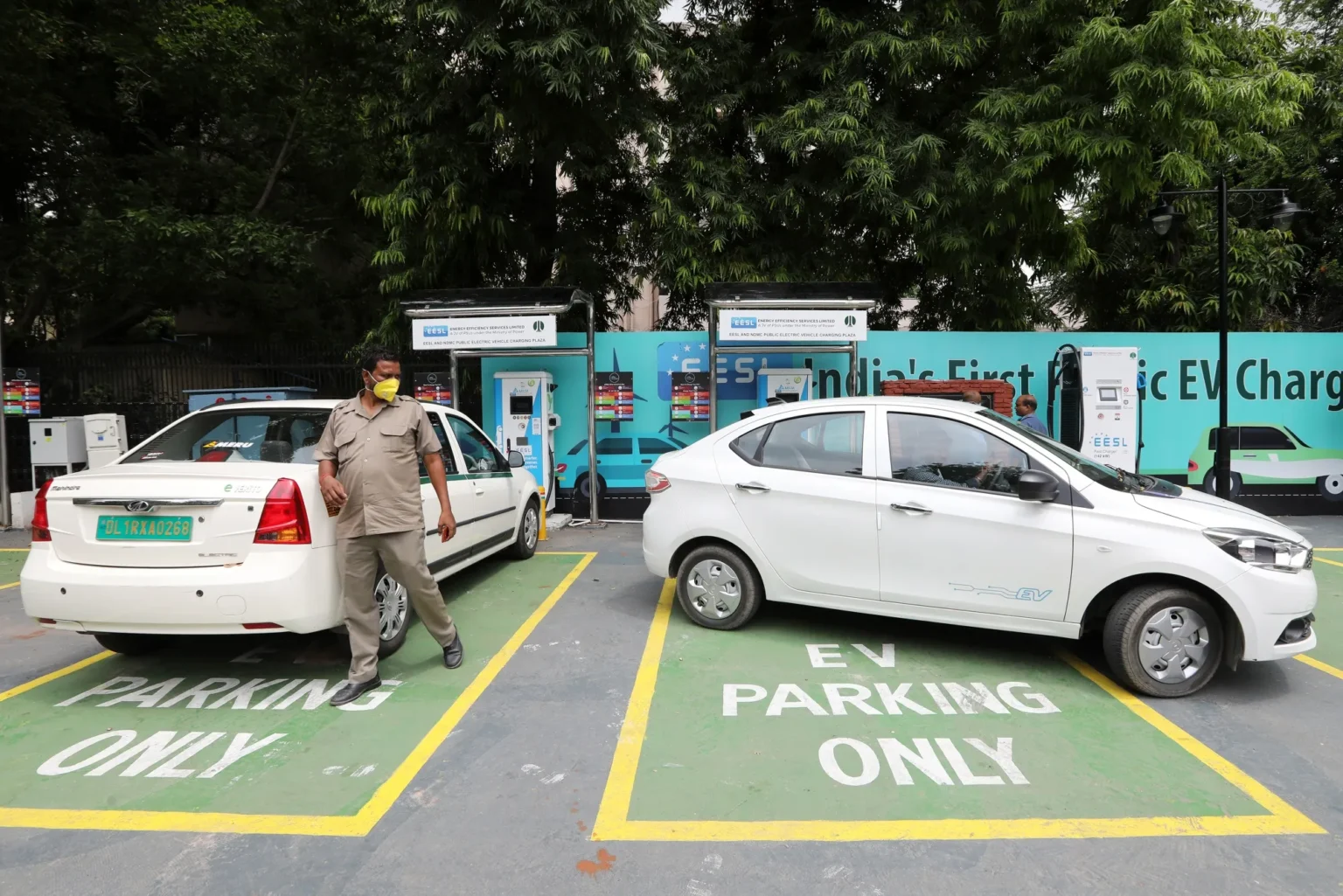
NEW DELHI, India — India’s electric vehicle (EV) market appears to be entering a decisive growth phase, with new data suggesting adoption is accelerating across multiple vehicle categories amid rising fuel costs, tighter emissions rules, and shifting consumer preferences.
In the year ending March 2026, electric car sales in India rose by about 25%, while EVs crossed the 5% share threshold in the passenger vehicle market, a level widely regarded by analysts as a potential “tipping point” for mass-market adoption.
“The transition is no longer directional but substantive,” India’s automobile dealers association said in a recent statement, reflecting growing confidence within the industry that EV demand is moving beyond early adopters.
While overall penetration remains modest compared to traditional internal combustion engine (ICE) vehicles, adoption is accelerating sharply in higher-value segments.
In passenger cars priced above one million rupees (about $10,481), roughly one in every 10 new vehicles sold is now electric.
Electric three-wheelers, widely used for last-mile transport in Indian cities, already account for more than 30% of sales in their category. Electric two-wheelers have also gained traction, now representing more than 15% of motorcycle and scooter sales.
Industry analysts say this pattern reflects a classic adoption curve, where commercial and high-utilisation vehicles transition first due to clearer cost savings.
Recent global instability, particularly tensions in the Middle East, has added further momentum to India’s EV push.
India imports nearly 90% of its crude oil, making it highly exposed to global price fluctuations. After several years of relative stability, state-run fuel retailers have recently raised pump prices as global oil prices surged by about 50%.
Prime Minister Narendra Modi has also urged citizens to conserve fuel through carpooling, public transport use, and remote work where possible.
“This rising uncertainty, alongside elevated fuel prices, acts as an incremental driver strengthening the case for EVs,” said Nomura, the Japanese brokerage.
Beyond short-term price pressures, structural policy changes are expected to significantly reshape India’s automotive market.
New Corporate Average Fuel Efficiency standards — known as CAFE-3 — are scheduled to take effect from April next year through to March 2032. The regulations will tighten emissions targets and increase compliance pressure on automakers.
Analysts at Bernstein said the rules “meaningfully tighten regulation and are likely to drive more visible acceleration in EV adoption”.
The draft framework proposes reducing average car emissions from 113g/km to 76g/km by 2032, a decline of roughly 33%.
Unlike current rules, which have seen limited enforcement of penalties, CAFE-3 is expected to introduce more binding compliance mechanisms, including financial sanctions for non-compliance.
“Penalties of about a billion dollars in fines across eight OEMs were never collected under previous frameworks, but CAFE-3 penalties might be enforced,” Bernstein noted, highlighting a potential shift in regulatory discipline.
Local governments are also stepping up their ambitions.
Also Read: Kenya exempts first 100,000 electric vehicles from import duty
Delhi, one of the world’s most polluted urban centres, has proposed draft policies aimed at phasing out internal combustion engine vehicles, including stopping new registrations of ICE two- and three-wheelers by 2027.
If implemented, such measures could make India’s capital one of the most aggressive EV transition zones globally.
Despite rapid growth, EVs still represent a small share of India’s overall vehicle fleet. However, analysts say the convergence of economic pressure, regulation, and infrastructure expansion is now creating conditions for sustained acceleration.
While challenges remain, including charging infrastructure gaps, affordability constraints, and supply chain dependence, the market signals suggest India may be entering the early mainstream phase of its electric mobility transition.
