


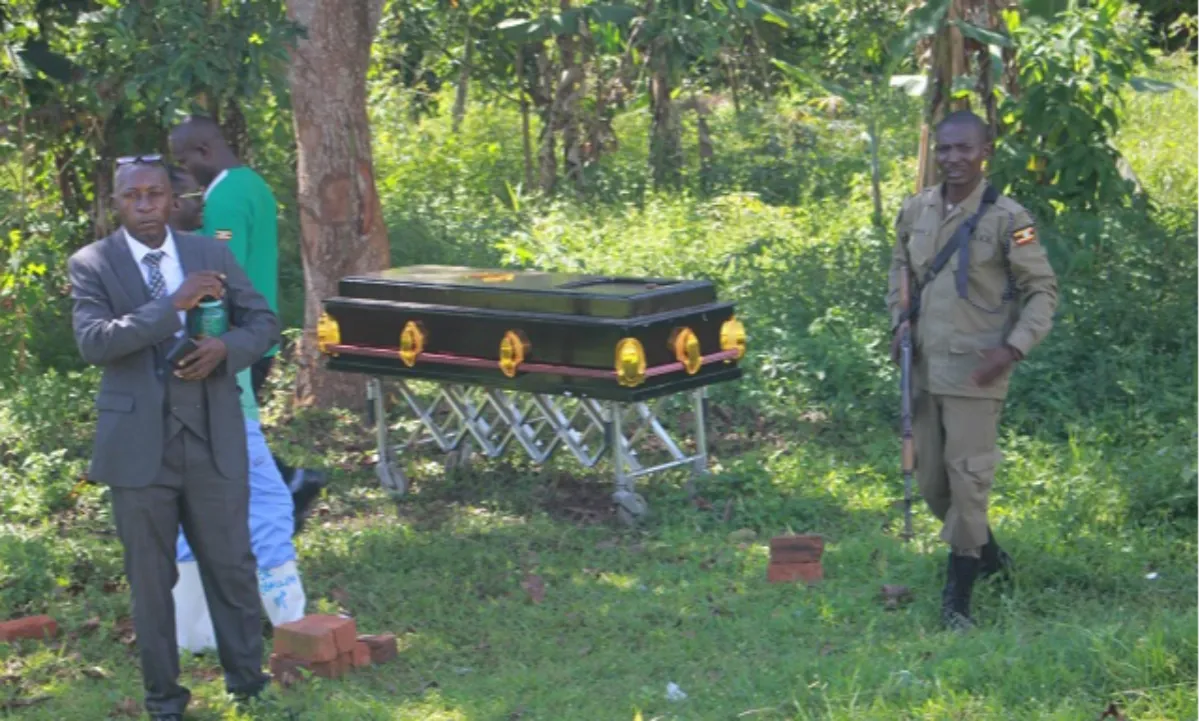
BUIKWE, Uganda — The remains of legendary Ugandan musician Paulo Kafeero were exhumed on Monday under heavy police security as authorities moved to facilitate DNA testing aimed at resolving a long-running dispute over the paternity of some of his children.
The exercise took place at Kafeero’s burial site in Busansula village and follows a court-backed process initiated by a section of the late singer’s children, who are seeking scientific verification of their biological relationship to one of Uganda’s most celebrated musicians.
Security personnel were deployed throughout the area as police restricted access to the burial grounds, allowing only authorised individuals and officials involved in the exhumation process to enter.
The heightened security reflected the sensitivity of a family dispute that has persisted for years and is closely linked to inheritance claims and ownership of the musician’s estate.
Police oversee exhumation
Witnesses at the scene reported a tense atmosphere as officials supervised the exhumation process.
A coffin containing Kafeero’s remains was opened, and specialists contracted to conduct the exercise carefully retrieved bone samples that will be subjected to DNA analysis.
Authorities said the operation was conducted under official supervision and in accordance with legal procedures agreed upon by the parties involved in the dispute.
According to police officials, the samples will be examined by both police and government laboratories to establish conclusive results.
Dr. Moses Byaruhanga said the decision to exhume the remains was reached after consultations and agreement among the concerned parties.
“There was no other reliable and quicker way to resolve this matter except by exhuming the father,” he said.
“DNA testing remains the most scientific and conclusive method to establish the truth.”
Family seeks closure after years of disputes
The dispute centres on questions of parentage among some of Kafeero’s children, an issue that has fuelled prolonged disagreements over inheritance and management of the late musician’s property.
Joseph Luzige, who leads a group representing some of Kafeero’s children, said the family viewed the exhumation as a necessary step toward ending years of conflict.
“No one wanted to exhume Paulo Kafeero,” Luzige said.
“But we have no choice if we are to end these endless conflicts once and for all.”
He added that the family hopes the DNA results will provide clarity and pave the way for resolving longstanding disagreements over land and other assets linked to the musician’s estate.
Another family member, Abubaker Nende, said relatives had pursued official channels to secure approval for the process and were prepared to accept the outcome of the tests.
“We are ready to accept the results of the DNA test, whatever they may be,” he said. “We just want justice.”
Residents divided over exhumation
The decision to exhume Kafeero’s remains sparked mixed reactions among residents of Nkokonjeru and surrounding communities.
While some residents supported the move as a necessary step toward settling family disputes, others criticised the decision, arguing that disturbing the grave of a deceased person was inappropriate and disrespectful.
Several residents expressed concern over the prolonged wrangles that have overshadowed the musician’s legacy, with some accusing family members of deepening divisions through disputes over land and inheritance.
Others argued that obtaining definitive DNA results could finally bring closure to a conflict that has persisted for years.
When access to the burial site was briefly granted after the exercise, some residents reportedly sang Kafeero’s popular songs in an emotional tribute to the musician whose work continues to resonate across Uganda decades after his rise to fame.
Legacy overshadowed by inheritance wrangles
Kafeero remains one of Uganda’s most influential Kadongo Kamu artists, celebrated for songs that addressed social issues and reflected the everyday experiences of ordinary Ugandans.
His music earned him widespread admiration and secured his place among the country’s most respected cultural figures.
However, years after his death in 2007, disputes among family members over parentage, inheritance and land ownership have increasingly drawn public attention, at times overshadowing his artistic legacy.
Also Read: 33 bodies, mostly children, exhumed from suspected mass grave in Kericho
Local leaders have expressed hope that the DNA process will help restore harmony within the family.
Alozious Kasimagwa said the exercise, though painful, could provide a lasting solution.
“This will bring peace to the family and the entire village,” he said.
DNA results expected
Authorities indicated that the DNA analysis would be conducted on an expedited basis, with results expected to guide the next phase of resolving inheritance and family disputes.
The findings could have significant implications for ownership claims involving Kafeero’s estate and may ultimately determine the legal status of individuals claiming to be his biological children.
For the family, the exhumation represents a difficult but potentially decisive step toward settling a dispute that has lingered for years after the musician’s death.
As the family awaits the results, many supporters of Kafeero hope the process will finally allow attention to return to his enduring contribution to Uganda’s music industry rather than the conflicts that have surrounded his estate.