



KAMPALA, Uganda — An earthquake that struck Uganda on Sunday night caused no reported damage or loss of life, according to the Ministry of Energy and Mineral Development.
The tremor, recorded at 9:19:21 p.m., was felt across multiple regions of the country, including Kampala, Lira, Apac, Gulu, Nakasongola, Masindi, Luwero, Wakiso, Mbale, Jinja, as well as parts of the Lake Victoria and Lake Kyoga basins and northern Uganda.
Preliminary data from the National Seismological Network indicated that the earthquake measured 4.4 on the Richter scale.
Its epicentre was located in the Lake Kyoga region, approximately 25 kilometres north of Nakasongola Town and about 53 kilometres east of Masindi Port, at a shallow depth of around 10 kilometres.
Geologists note that shallow earthquakes are often felt over wider areas, even when they are of moderate magnitude.
In a statement issued on Monday night, the Ministry said the earthquake was classified as light to moderate and posed minimal risk of destruction in well-constructed buildings.
Dr Patricia Litho, Assistant Commissioner for Communications and Information Management at the Ministry, said no significant structural damage or casualties had been reported.
The Ministry attributed the tremor to movements along the Aswa Shear Zone (Aswa Lineament), a major geological fault system that runs through parts of Uganda.
Officials further noted that Uganda lies within the western branch of the East African Rift System, a tectonically active zone where earthquakes occur periodically due to underground geological movements.
“The relatively shallow depth contributed to the wide area over which the tremor was felt,” the statement said.
The Ministry urged residents to remain calm while reiterating standard earthquake safety guidance.
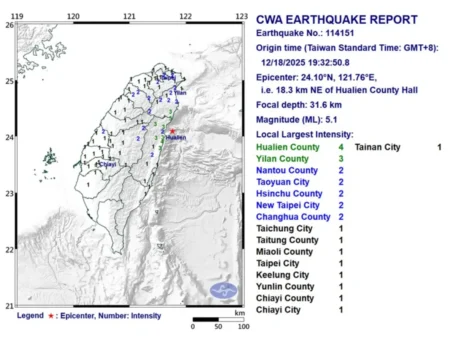
Also Read: 5.1-magnitude earthquake strikes eastern Taiwan, epicentre near Hualien city
People indoors were advised to take cover under sturdy furniture, avoid windows and falling objects, and refrain from using elevators during tremors.
Those outdoors were advised to move to open spaces away from buildings, trees and power lines, while motorists were encouraged to stop safely and remain alert to hazards.
The Ministry said its Seismological Monitoring Network will continue tracking seismic activity and issue updates where necessary.
The latest tremor comes months after a magnitude 4.3 earthquake was recorded in parts of Central Uganda on March 9, underscoring the country’s continued exposure to periodic seismic activity within the Rift Valley system.