

KAMPALA, Uganda — Uganda’s Speaker race has gripped the political class with all the intensity of a high-stakes contest—endorsements withdrawn, loyalties shifting, and factions scrambling for advantage. But strip away the noise, and a harder truth begins to surface: this is less a contest for power than a performance of it.
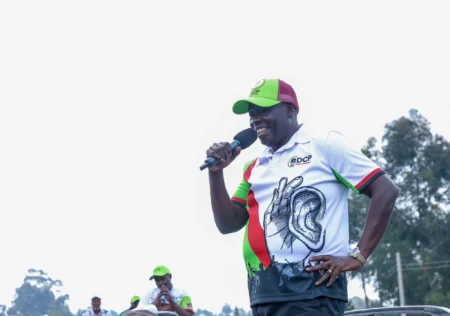
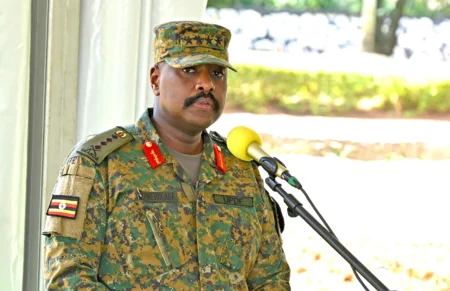
At the centre of the unfolding drama is the sudden reversal by the Patriotic League of Uganda (PLU), aligned with Gen Muhoozi Kainerugaba, withdrawing its backing for Anita Annet Among and Thomas Tayebwa. The move has been widely interpreted as a political earthquake, one that resets the race and reopens the field.
But does it?
The likely outcome remains structurally unchanged. The next Speaker will come from the ruling National Resistance Movement (NRM). And whoever takes the chair will inherit not just the authority of the office, but the constraints that have long defined it.
A contest without consequence
There is an uncomfortable reality that many within Uganda’s political circles acknowledge privately: the Speakership, while symbolically powerful, has increasingly functioned within the orbit of executive influence.
This is not a critique of individuals as much as it is of the system they operate in.
The office demands neutrality, procedural integrity and independence. Yet in practice, it has often reflected the priorities of the Executive—whether through legislative alignment, management of dissent, or the broader direction of parliamentary business.
The current contest, for all its drama, does little to challenge that structure.
It does not matter whether the next Speaker is calm or combative, eloquent or understated, reformist in tone or conservative in instinct. Those qualities may shape style, but they are unlikely to redefine substance.
In the end, Uganda will still get a Speaker from the NRM. And in the architecture of power as it stands, that Speaker will remain tethered—politically, if not formally—to the Executive.
Signals from the centre of power
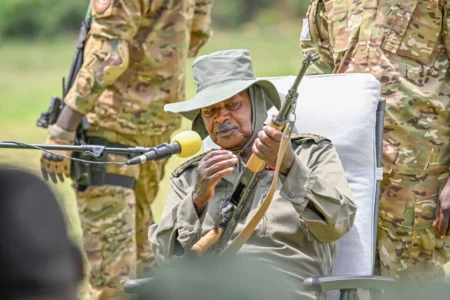
The language emerging from key actors reinforces this reality. Calls for MPs to align behind candidates endorsed by President Yoweri Kaguta Museveni are not merely suggestions; they are signals of where decisive authority lies.
Even more telling is the broader political choreography.
Endorsements are issued and withdrawn. Candidates rise and fall. Public narratives shift. Yet the centre holds firm.
This is not the unpredictability of open democratic competition. It is the managed uncertainty of a system in which outcomes are shaped as much by internal power calculations as by institutional process.
Historical pattern: Speakers and their political alignment
A review of Uganda’s parliamentary leadership over the past three decades reveals a striking consistency—not just in personnel, but in political alignment.
Speakers of Parliament (Since 1996 Constitution)
- Anita Annet Among (2022–present)
Party: National Resistance Movement (NRM)
Rose from Deputy Speaker following the death of Jacob Oulanyah. Her tenure has faced scrutiny over governance, spending controversies, and perceived proximity to executive power. - Jacob Oulanyah (2021–2022)
Party: National Resistance Movement (NRM)
A seasoned legislator and lawyer whose short tenure was cut by his death in office. - Rebecca Kadaga (2011–2021)
Party: National Resistance Movement (NRM)
One of Uganda’s longest-serving Speakers. Occasionally projected institutional independence but ultimately remained within ruling party structures. - Edward Ssekandi (2001–2011)
Party: National Resistance Movement (NRM)
Later became Vice President, reinforcing the close link between parliamentary leadership and executive hierarchy. - Francis Ayume (1998–2001)
Affiliation: Movement system (precursor to NRM dominance under no-party framework)
Served during Uganda’s transition from no-party to multiparty politics. - James Wapakhabulo (1996–1998)
Affiliation: Movement system
Oversaw early implementation of the 1995 Constitution.
Deputy Speakers of Parliament (Key Figures)
- Thomas Tayebwa (2022–present)
Party: National Resistance Movement (NRM) - Anita Annet Among (2021–2022)
Party: National Resistance Movement (NRM) - Jacob Oulanyah (2011–2021)
Party: National Resistance Movement (NRM) - Rebecca Kadaga (2001–2011)
Party: National Resistance Movement (NRM) - Edward Ssekandi (1998–2001)
Affiliation: Movement system
What the pattern reveals
Across nearly three decades, every Speaker has either belonged to the NRM or operated within its political framework.
That continuity is not incidental—it is structural.
It reflects a system in which parliamentary leadership is not an independent counterweight, but an extension of the broader ruling architecture.
The illusion of institutional autonomy
The deeper issue at stake is not who becomes Speaker, but whether the institution itself can act independently.
Parliament, in theory, is the cornerstone of representative governance. It is where laws are debated, executive actions scrutinised, and national priorities contested.
But when its leadership is perceived as aligned—structurally or politically—with the Executive, that role becomes harder to sustain convincingly.
Public confidence shifts. Debate narrows. Oversight weakens.
The Speakership, instead of acting as a buffer between competing powers, risks becoming a bridge that reinforces a single centre of authority.
Continuity disguised as change
Uganda’s current Speaker race, therefore, is unlikely to produce a rupture. It will produce continuity, albeit wrapped in the language of competition and renewal.
A new Speaker may bring a different tone, a different style of leadership, perhaps even a different public image. But the fundamental equation of power will remain intact.
Also Read: Anita Among’s Speakership re-election bid shaken after Gen Muhoozi’s explosive remarks
For many Ugandans watching from a distance, that reality tempers any sense of anticipation.
There is little to celebrate in a process where outcomes feel predetermined, and where institutional roles appear constrained long before any vote is cast.
Beyond the spectacle
Uganda’s political system has demonstrated remarkable stability over decades. But stability, when it comes at the expense of institutional independence, raises its own set of questions.
Uganda’s Speaker race offers a moment to reflect on those questions—not just for political actors, but for the broader public:
- What should Parliament represent?
- Who does it ultimately serve?
- And can it, in its current form, act as a genuine counterweight to executive power?
Until those questions are meaningfully addressed, leadership contests such as this will continue to generate heat without necessarily producing light.