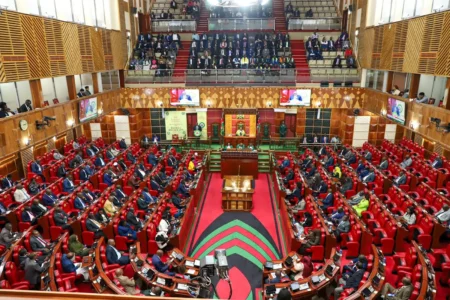





NAIROBI, Kenya — President William Ruto’s administration is facing mounting scrutiny after the National Assembly of Kenya invited members of the public and stakeholders to submit views on the proposed Finance Bill 2026, a legislation that has already triggered widespread criticism over several proposed tax measures.
In a public notice issued by the Office of the Clerk, Parliament said the exercise is being conducted in compliance with Article 118(1)(b) of the Constitution, which requires public participation in legislative processes.
The public consultation phase now sets the stage for debate on the Finance Bill 2026, which seeks to amend multiple tax and revenue laws that could significantly affect consumers, businesses, investors and Kenya’s growing digital economy.
“In compliance with Article 118(1)(b) of the Constitution and Standing Order 127(3), the Clerk of the National Assembly hereby invites the public and stakeholders to submit memoranda on the Finance Bill (National Assembly Bill No. 26 of 2026) to the Departmental Committee on Finance and National Planning,” the notice read in part.
The proposed legislation is sponsored by Kuria Kimani, who also chairs the Departmental Committee on Finance and National Planning.
Tax proposals triggering public backlash
The bill proposes amendments to several laws, including the Income Tax Act, the Excise Duty Act and the Road Maintenance Levy Act, proposals that have already sparked criticism from sections of the public, civil society groups and business stakeholders.
Among the most controversial proposals is the introduction of a 25 percent excise duty on mobile phones used for cellular and wireless networks, a move critics warn could raise smartphone prices and deepen the digital divide at a time when Kenya is aggressively promoting digital access and online government services.
The proposed law also introduces a deemed profit taxation model targeting imported second-hand clothes, commonly known as mitumba. Under the proposal, five percent of the customs value of imported mitumba goods would be treated as taxable income payable at the point of importation.
The proposal has alarmed traders who argue the measure could increase the cost of second-hand clothing, an industry that supports thousands of livelihoods across Kenya.
The bill further seeks to shorten tax filing timelines by two months, moving the annual filing deadline from June 30 to April 30.
Additional provisions target Kenya’s expanding digital economy through proposed taxation measures on proprietary digital platforms, software distribution systems and electronic payment services.
The legislation also introduces new regulatory provisions governing virtual assets and virtual asset service providers, signaling the government’s intention to tighten oversight of Kenya’s rapidly growing cryptocurrency and digital asset market.
Other proposed reforms include reducing the corporate tax rate for non-resident entities from 37.5 percent to 30 percent, broadening capital gains taxation involving foreign ownership structures linked to Kenyan assets, and granting the Kenya Revenue Authority expanded powers to generate pre-populated tax returns using electronically available taxpayer information.
Parliament invites public memoranda
The National Assembly said written submissions must be delivered physically to Parliament Buildings in Nairobi or submitted electronically before May 25 at 5pm.
“Any written Memoranda on the Bill should indicate the name of the person/organisation submitting it and their contact details and should be hand-delivered to the Office of the Clerk, First Floor, Main Parliament Buildings, Nairobi or emailed to cna@parliament.go.ke and financecommittee@parliament.go.ke to be received on or before Monday, May 25 2026 at 5pm,” the notice added.
The bill was officially published on May 6 and has since generated intense debate online and within policy circles.
Growing Fears of Public Resistance
Several groups, including the Law Society of Kenya, human rights activists and digital economy advocates, have criticized sections of the bill, particularly proposals touching on mitumba imports, digital assets, smartphone taxation and revised tax filing timelines.
Analysts warn that the government faces heightened public sensitivity around taxation following the unrest witnessed during previous finance bill debates.
Also Read: Kenya’s Cabinet approves Finance Bill 2025 amid economic reforms
Kenya’s 2024 Finance Bill protests remain one of the most politically consequential demonstrations in recent years after thousands of mostly young protesters stormed Parliament on June 25, 2024 amid anger over proposed tax increases.
The demonstrations led to deaths, injuries and widespread political pressure on the government to reconsider parts of the legislation.
With the Finance Bill 2026 now entering the public participation stage, political observers say lawmakers will face growing pressure to balance revenue generation targets with mounting concerns over the cost of living, youth unemployment and digital accessibility.
The debate is also expected to test the government’s commitment to inclusive policymaking as Kenya continues navigating fiscal pressures, debt obligations and economic recovery efforts.