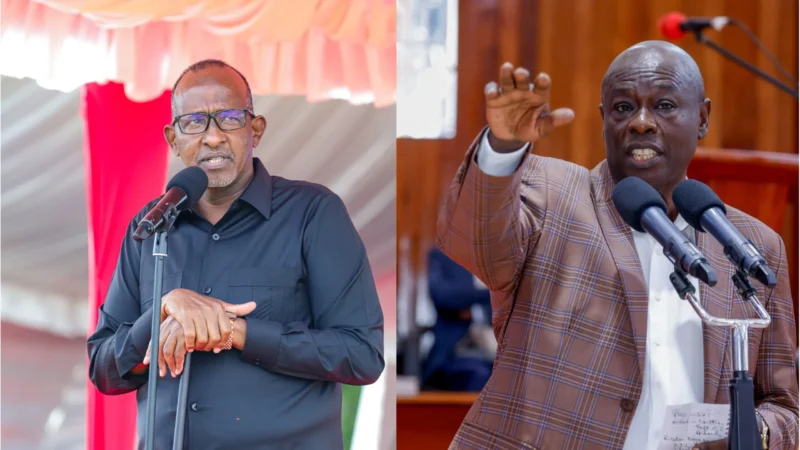



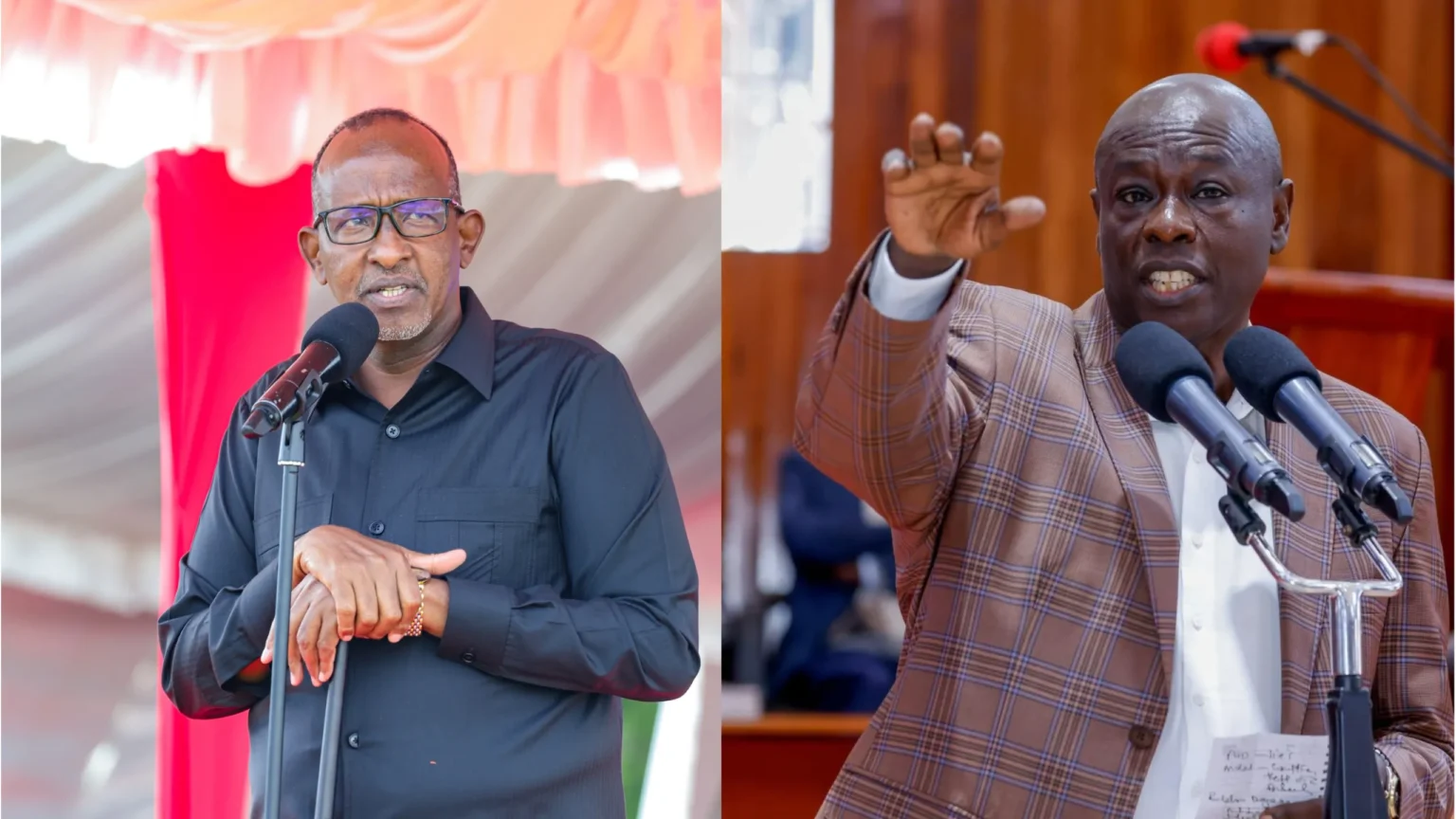
NAIROBI, Kenya — A political storm is intensifying over Kenya’s health reforms after former Deputy President Rigathi Gachagua unveiled what he described as a dossier alleging large-scale financial irregularities in the rollout of the Social Health Authority (SHA).
Speaking in Wote, Makueni County, Gachagua claimed that up to KSh103 billion had been misappropriated during the transition from the now-defunct National Health Insurance Fund (NHIF) to the new health financing system.
Flanked by opposition figures including Kalonzo Musyoka, Eugene Wamalwa and Justin Muturi, he accused Health Cabinet Secretary Aden Duale of links to firms within a consortium contracted to implement the programme.
“Aden Duale did challenge me to give information and facts…” Gachagua said.
“Duale asked me to provide proof that his name is there… he thinks Kenyans are fools… his name cannot be there…”
He further alleged systemic looting in the establishment of the SHA, warning that the scheme risks collapse if the issues are not addressed.
“Duale, you cannot ask us to provide a CR12 that bears your name… we know you… You are behind the rot in the health sector,” said Gachagua.
The former deputy president also questioned the financial structure of the transition from NHIF to SHA.
“NHIF proposed Ksh.800 million, instead, William Ruto, with a scheme to loot, removed NHIF and brought SHA with an aim of looting. Only one billion was used to set up SHA, the rest Ksh.103 billion shillings was stolen…,” he added.
In a swift response, Aden Duale dismissed the allegations, maintaining that no evidence had been provided to support the claims.
“I have publicly dared Gachagua, repeatedly, to produce a CR12 document from the Business Registration Service. This single sheet of paper would instantly reveal the shareholders and directors of Convergence Network Limited, the company he claims I own 17 per cent of,” stated Duale.
“Yet Gachagua has refused. Why? Because the CR12 would expose his lies and reveal that his entire campaign is built on something far uglier than corruption allegations — tribal hatred.”
Duale also rejected claims that individuals linked to the company were acting as proxies on his behalf.
“Gachagua alleges that Mr Abdullahi Abdi Sheikh, director of Konvergenz Network Solutions, is my proxy. His evidence? We are both Somali. That is it. That is the entire ‘proof.’ In Gachagua’s narrow worldview, any Somali businessperson succeeding in Kenya must automatically be a front for another Somali politician. A very unfortunate racial bookkeeping,” Duale noted.
“And that these are verifiable, registered, traceable evidence. There are no ghosts. No proxies. Just Kenyan entrepreneurs who happen to share an ethnicity that Gachagua finds politically convenient to demonise.”
Deputy President Kithure Kindiki also defended the government’s health reforms, dismissing Gachagua’s claims and highlighting the expansion of healthcare coverage under the new system.
He said the SHA has significantly increased the number of Kenyans covered compared to the NHIF era.
Also Read: Gachagua, Duale clash over alleged SHA irregularities
“But I underestimate their frustration. They cannot see anything good being done by the government because when they were in office, they did nothing to improve the lives of Kenyans. They wasted their time doing useless things, quarrelling, and sabotaging the President and eventually had to be kicked out. They cannot believe that we are delivering tangible development for all Kenyans,” Kindiki said.
The dispute marks the latest escalation in a widening political rift between Gachagua and President Ruto’s administration, with the former deputy president emerging as a key opposition voice.
At the centre of the controversy is the SHA, a flagship reform under the government’s universal health coverage agenda, which replaced NHIF in a bid to expand access to healthcare.
While the government maintains the programme is delivering results, including millions of new registrations, critics have raised concerns about transparency, procurement processes, and long-term sustainability.
Analysts say the absence of publicly verified documentation to support the allegations leaves the claims contested, but the political fallout is likely to intensify pressure on the government to provide greater transparency around the programme’s finances.