


NAIROBI, Kenya — Across Kenya’s cities and towns, a growing political awakening is taking shape, one driven not by established parties or traditional power brokers but by a generation coming of age in an era of connectivity, inequality, and unmet expectations.
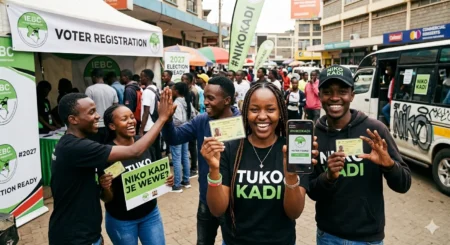
From the viral Niko Kadi, Tuko Kadi campaigns to spirited debates on social media, Kenya’s youth, particularly members of Generation Z, are increasingly frustrated with a political culture many see as trapped in outdated, colonial‑era governance models.
At the heart of this generational discontent is a simple message: young Kenyans want relevance, agency, and leadership that reflects their aspirations, not the same old rhetoric recycled by political elites.
Gen Z and the politics of identity
The Niko Kadi, Tuko Kadi movement, a youth-led drive pushing for civic registration and identity empowerment, has transcended its administrative roots to become an emblem of political engagement. To many young Kenyans, the slogan Niko Kadi (“I have a card”) is shorthand for a deeper assertion of voice, visibility, and participation.
Social media has amplified this dynamic. Platforms like TikTok, Instagram and X (formerly Twitter) have become digital agoras where young people express frustration with rising unemployment, high cost of living, and leadership they see as perpetuating patronage politics. The lighthearted uses of memes and slang often mask a sharper critique of governance and inequality.
It is within this context that the rhetoric of President William Ruto and the opposition has increasingly mirrored older, reactionary styles of political engagement, often marked by personal attacks, dismissive body‑shaming, and tribalised language, affording young people even more reason to distance themselves from elite politics.
Ruto’s response and the opposition’s mistakes
President Ruto’s recent public engagements reveal a growing mismatch between Kenya’s leadership and its evolving electorate.
On multiple occasions, Ruto has taken to the campaign trail with barbed criticism of his opponents, accusing them of opportunism and hypocrisy.
His choice of language, dismissive phrases like “scavengers riding on misfortune,” reflect a combative tone that resonates with little beyond his base.
Ruto has also, uncomfortably, been drawn into the momentum of youth‑driven movements without fully appreciating their organic energy.
Rather than positioning himself as a facilitator of youth empowerment, he has often responded with predictable political slogans or attempts to co‑opt the messaging for partisan advantage. In doing so he has risked validating critics who see his administration as reactionary rather than responsive.
Opposition figures are no better. In public debates and on social platforms, mudslinging, name-calling, body-shaming, raw insults and generally indecent language have often overshadowed substantive policy discussions.
Recently in Kiambu, the former Deputy President Rigathi Gachagua had some descriptions to make.
“…We will make sure William Ruto you are not going to sleep for the next six months.. tutakuanika na hawa vijana wangu hawa si umeona vile amekonda mpaka masikio inafanya nini…”Gachagua stated.
President Ruto, the target of an apparent body shaming by Gachagua, picked the mantle and took the low road race to the next phase.
“…Mtu mwenye ako na pepo ya ukabila na chuki na kisirani anatuambia nini kama Wakenya,” Ruto indicated.
Rage was apparent in the President William Ruto’s voice, tone and manner.
“You cold-blooded thief stealing from your own brother, stealing from orphans, stealing from widows and you want to give us a lecture. Unazunguka kwa barabara kwa mazishi eti unatuongelesha kitu gani mtu ambaye ameenda akatia mimba watoto wadogo kama rika ya mtoto wake halafu anaua hao watoto halafu anatuambia mambo yake. You cold-blooded murderer, you cold-blooded thief,” the head of state vehemently retorted.
“Na nikwambie Kasongo hapana ita watu wezi, mambo ya wizi ikiongelewa Kenya hakuna mtu hajui nani mwizi mkuu Kenya ni nani. Wewe unasema watu wameua watu tukianzia Kiambaa church 2007, Gen-Z kupiga watu risasi, mambo ya mauaji Wakenya wanajua mambo ya mauaji,” Gachagua alleged.
After Gachagua, President Ruto cast his muddy net wider.
“Watu waende gym wanakula chakula nyingi kichwa karibu inapasuka mnalala kwa mkutano mnaharibu hewa,” Ruto claimed.
Though he mentioned no name, Ruto’s remarks invited a response.
“First of all sijui kwanini unasumbuka vile mimi nakula kwa sababu mimi sikuli kwa bibi yako, hujaniona nikienda kutafuta chakula bibi yako ama bibi yako. Mimi nakula Kisii sasa hiyo kama ndio inanisumbua,” stated Jubilee’s Fred Matiang’i.
Let’s take you back to Ruto, who was clearly on a roll. His next target was someone in Kitale, though he did not mention names.
“Iko mwingine wa kutoka hapa Kitale aliwachiwa mali na ndugu yake watoto wanateseka ajue bei ya diaper kwanza,” Ruto noted.
Then back to where it all started, Rigathi Gachagua.
“Hatutakubali uibe Nairobi Hospital. Tukiachia utaiba pia Lee Funeral Home,” the DCP leader stated.
In such an atmosphere, young Kenyans, many of whom are well educated and tech‑savvy, see little difference between the ruling party and its adversaries: both appear beholden to old political styles that prioritise rhetoric over results.
Colonial legacies and modern frustrations
The grievances of Kenyan Gen Z are not merely generational. They are rooted in historical continuities that trace back to colonial governance models that emphasised control, hierarchies, and exclusion.
Decades after independence, many young Kenyans feel that political structures remain unresponsive, opaque, and resistant to change.
The lack of meaningful youth representation in decision‑making circles further deepens this sentiment.
Despite constituting a significant portion of the population, young people are underrepresented in Parliament, senior civil service roles, and corporate leadership.
This structural exclusion feeds the perception that the political system is designed to maintain the influence of entrenched elites rather than empower new voices.
The new civic consciousness
Yet, rather than retreating into cynicism, Kenya’s youth are building new forms of civic engagement.
Niko Kadi, Tuko Kadi is only the most visible strand of a broader movement that includes digital advocacy, community organising, and public interest journalism.
Young activists are demanding accountability on issues such as corruption, unemployment, climate change, and access to education.
Also Read: Kenya waives Ksh 1,000 ID replacement fee for six months to boost voter registration
Their engagement is not merely oppositional; it is constructive. Many youth‑led groups are mapping community needs, tracking government spending, and educating their peers on civic rights and responsibilities.
In doing so, they are redefining what political participation looks like in the 21st century.
A turning point for Kenyan democracy
The rise of Gen Z activism presents both a challenge and an opportunity for Kenya’s political class. It challenges leaders to move beyond tribalised slogans and personal attacks, and instead address structural injustices and deliver tangible progress on critical issues.
At the same time, it offers an opportunity to rebuild political discourse around real problems rather than personality clashes.
For a nation where nearly half the population is under 35, the stakes could not be higher. If established political actors fail to adapt, they risk alienating a generation whose loyalty will not be won with nostalgia or rhetoric, but through meaningful inclusion and respect.
The question now is not simply whether Kenya’s leaders will evolve, but whether they can listen to a generation that refuses to be ignored.