


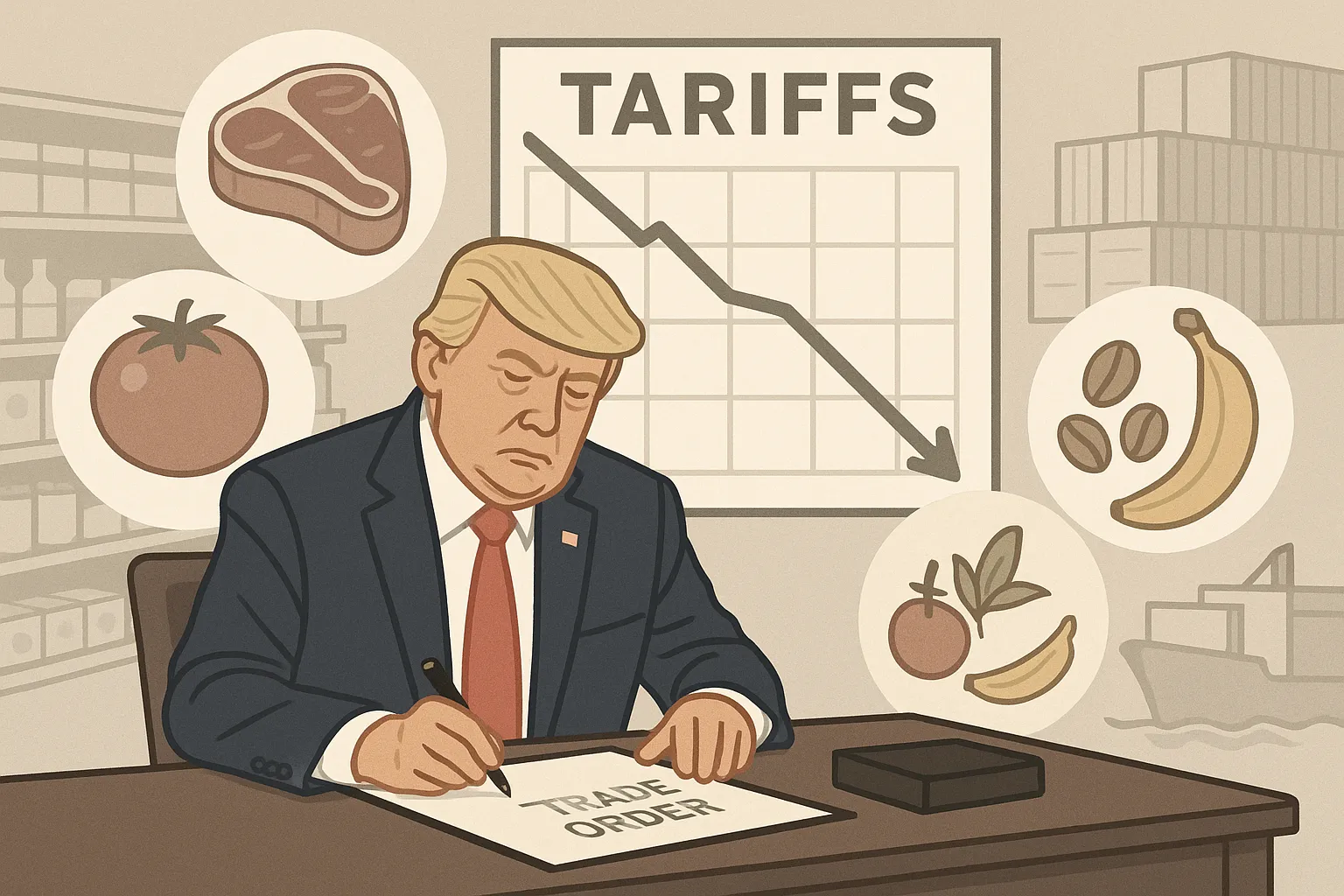
WASHINGTON D.C., United States — In a significant shift of his administration’s trade policy, U.S. President Donald Trump signed an executive order on Friday exempting a broad range of food imports, including coffee, bananas, and beef, from his sweeping global tariffs.
The move, which marks a reversal of his long-held insistence that tariffs do not raise consumer prices, comes amid mounting pressure over rising costs of living following recent Republican electoral setbacks.
The exemption, which took effect retroactively from midnight on Thursday, November 13, applies to dozens of products such as avocados, tomatoes, coconuts, and mangoes.
The administration justified the rollback by arguing that these goods cannot be produced in sufficient quantities domestically, thereby nullifying the tariffs’ intended protective effect on U.S. industry.
Focus on affordability
President Trump has consistently maintained that his tariff, a baseline of 10% on imports from all countries, with additional levies on many trading partners, are necessary to reduce the U.S. trade deficit and punish “cheaters.”
He has previously dismissed concerns about affordability as a “new word” and a “con job” by Democrats.
However, the rising cost of groceries, particularly soaring beef prices, has become a key political issue.
Last week, the President called for an investigation into the meat-packing industry, accusing companies of “Illicit Collusion, Price Fixing, and Price Manipulation.”
The latest exemptions signal a White House effort to lower consumer prices by walking back levies on food staples.
Speaking to reporters on Friday, President Trump addressed the decision:
The decision will affect products that are not produced in the US, “so there’s no protection of our industries, or our food products.”
He also suggested this policy shift would be sufficient:
He added that he doesn’t think more policy rollbacks will be required in the future, saying “I don’t think it’ll be necessary.”
He cited a specific example where the rollback is expected to have an immediate effect:
“We just did a little bit of a rollback on some foods, like coffee as an example, where the prices of coffee were a little bit high. Now they’ll be on the low side in a very short period of time,” Trump said.
Economists’ warnings confirmed
The move effectively confirms warnings from many economists that companies often pass the cost of tariffs onto consumers in the form of higher prices.
While inflation was milder than analysts projected in September, the Department of Labor reported that groceries were still up 2.7% from the previous year.
Also Read: The hunger crisis: Why Nairobi residents can’t afford to put food on the table
The tariff modifications were also linked to broader trade strategy, with the administration stating that import taxes on coffee and bananas will be lowered as part of trade deals with four Latin American countries.
Earlier this week, Treasury Secretary Scott Bessent vowed to decrease U.S. coffee prices by 20% this year.
Exempted products list
The White House released a list that includes more than 100 products no longer subject to the tariffs, including:
- Beverages/Ingredients: Coffee, cocoa, black tea, green tea, and vanilla beans.
- Beef products: High-quality cuts, bone-in and boneless cuts, corned beef, some frozen items, and salted, brined, dried, or smoked meat.
- Fruits and vegetables: Acai, avocadoes, bananas, coconuts, guavas, limes, oranges, mangoes, plantains, pineapples, various peppers, and tomatoes.
- Spices: Allspice, bay leaves, cardamom, cinnamon, cloves, coriander seeds, cumin seeds, curry, dill, fennel seeds, ginger, mace, nutmeg, oregano, paprika, saffron, and turmeric.
- Nuts, grains, and seeds: Barley, Brazil nuts, capers, cashews, chestnuts, macadamia nuts, miso, palm hearts, pine nuts, poppy seeds, tapioca, taro, and water chestnuts.
