


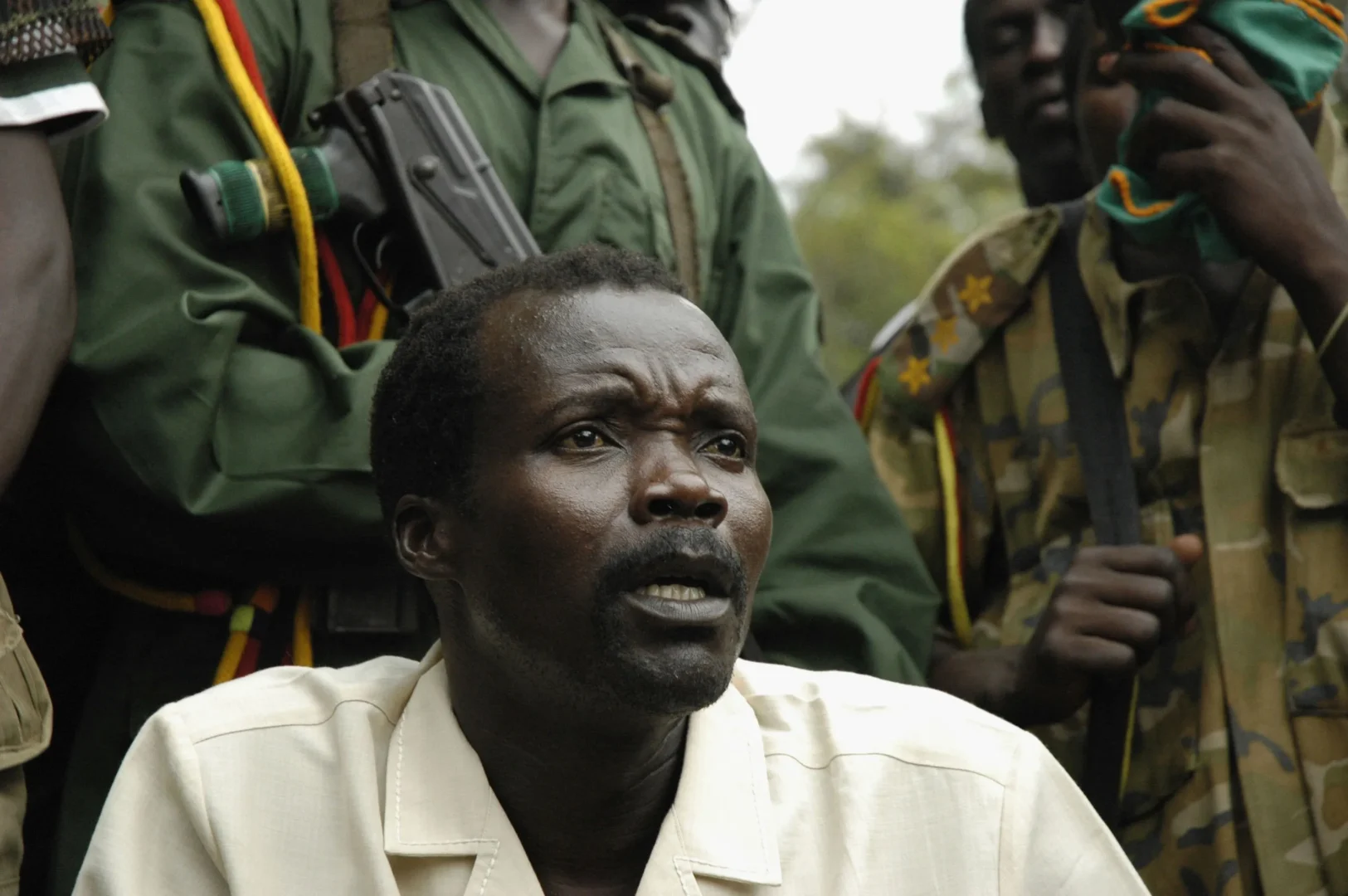
KAMPALA, Uganda — Survivors of the brutal Lord’s Resistance Army (LRA) insurgency in Uganda have expressed profound relief and support for the decision by the International Criminal Court (ICC) to formally confirm charges against the group’s notorious leader, Joseph Kony.
While an arrest warrant for Kony has been active since 2005, he remains a fugitive, believed to be hiding in the Central African Republic (CAR).
On Thursday, the ICC officially announced that Kony is being charged with 39 counts of war crimes and crimes against humanity, including murder, rape, using child soldiers, sexual slavery, and forced pregnancy.
Victims seek justice and accountability
The ICC’s move has renewed hope among victims that efforts to capture the LRA leader will intensify. Evelyn Amon, 42, was abducted by the LRA at age 11 and forced to become one of Kony’s wives, spending 11 years in the bush. She told the BBC that she now seeks justice and compensation for women who endured similar suffering.
“I cannot be happy like other women who went to school. I need justice for women who went through abduction like me,” Evelyn Amon, 42, said.
Ms. Amon described the severity of her ordeal, noting that she even forgot her own name during her captivity as the rebels referred to her as Betty Achol. She confirmed that victims like her want Kony to be tried so they can receive compensation from the court.
Similar hopes were voiced by Patrick Ochieng, 28, who was born into LRA captivity after his mother was abducted and sexually assaulted. He stressed the urgency of Kony’s capture.
“He should first be arrested. The victims who suffered can’t wait – some of these victims are already dying,” Mr Ochieng said.
Mr. Ochieng, whose mother was killed by the rebels when he was just five years old, is among the thousands of children forced into roles as child soldiers. He shared a harrowing account of his mother’s death:
“She tried to escape with us – me and my twin sister – but the policy was clear: if you try to escape and you’re caught, they [must] finish you. They’ll kill you,” the visibly emotional young man said.
A legacy of terror
The LRA was formed by Kony in the late 1980s in northern Uganda, claiming its goal was to install a government based on the biblical Ten Commandments. The group became internationally notorious for its brutal tactics, which included hacking off victims’ limbs or parts of their faces and systematic sexual violence.
During the nearly two-decade insurgency in northern Uganda, more than 100,000 people were killed, between 60,000 and 100,000 children were abducted, and 2.5 million people were displaced into internal camps, which themselves frequently came under LRA attack.
Muhammad Olanya, 17 at the time of the 2004 attack on the Lukodi camp near Gulu, recalled the terror:
“We heard strange sounds like drumbeats followed by whistles – those were bullets,” he told our reporter. “I ran, but by the time I reached the market, I was exhausted. I sat down by the roadside.”
Olanya was rescued by a Ugandan army officer but says the conflict devastated his life, costing him relatives and a formal education.
Fugitive status and search efforts
The LRA was eventually driven out of Uganda in 2005 and subsequently moved through the Democratic Republic of Congo and South Sudan, settling in the CAR, where remnants are understood to be involved in illegal mining and poaching.
Also Read: Kony’s daughters held captive by Russian mercenaries for four months
Kony’s notoriety peaked in 2012 following a massive social media campaign to highlight the LRA’s atrocities. The following year, the US offered a $5 million (£3.8 million) reward for information leading to his arrest.
Despite years of international manhunts, including US and Ugandan army operations that formally ended in 2017, Kony remains a fugitive. His ICC trial cannot commence unless he is arrested and physically present in court in The Hague.
Victims remain hopeful that the ICC’s decision to formally press forward with the confirmation of charges—even in Kony’s absence—signals a renewed commitment to achieving the justice and accountability that eluded a peace deal in 2008, when Kony demanded assurances that he and his allies would not be prosecuted.
