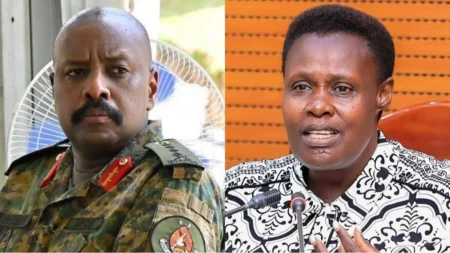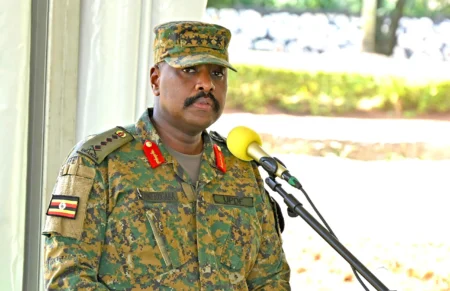
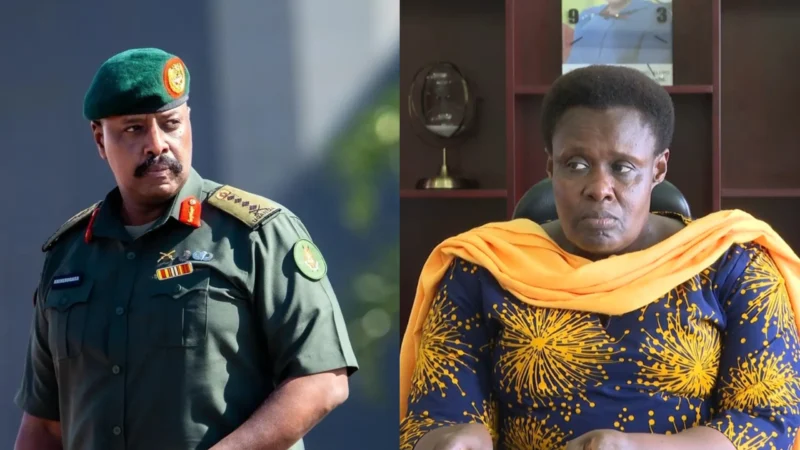



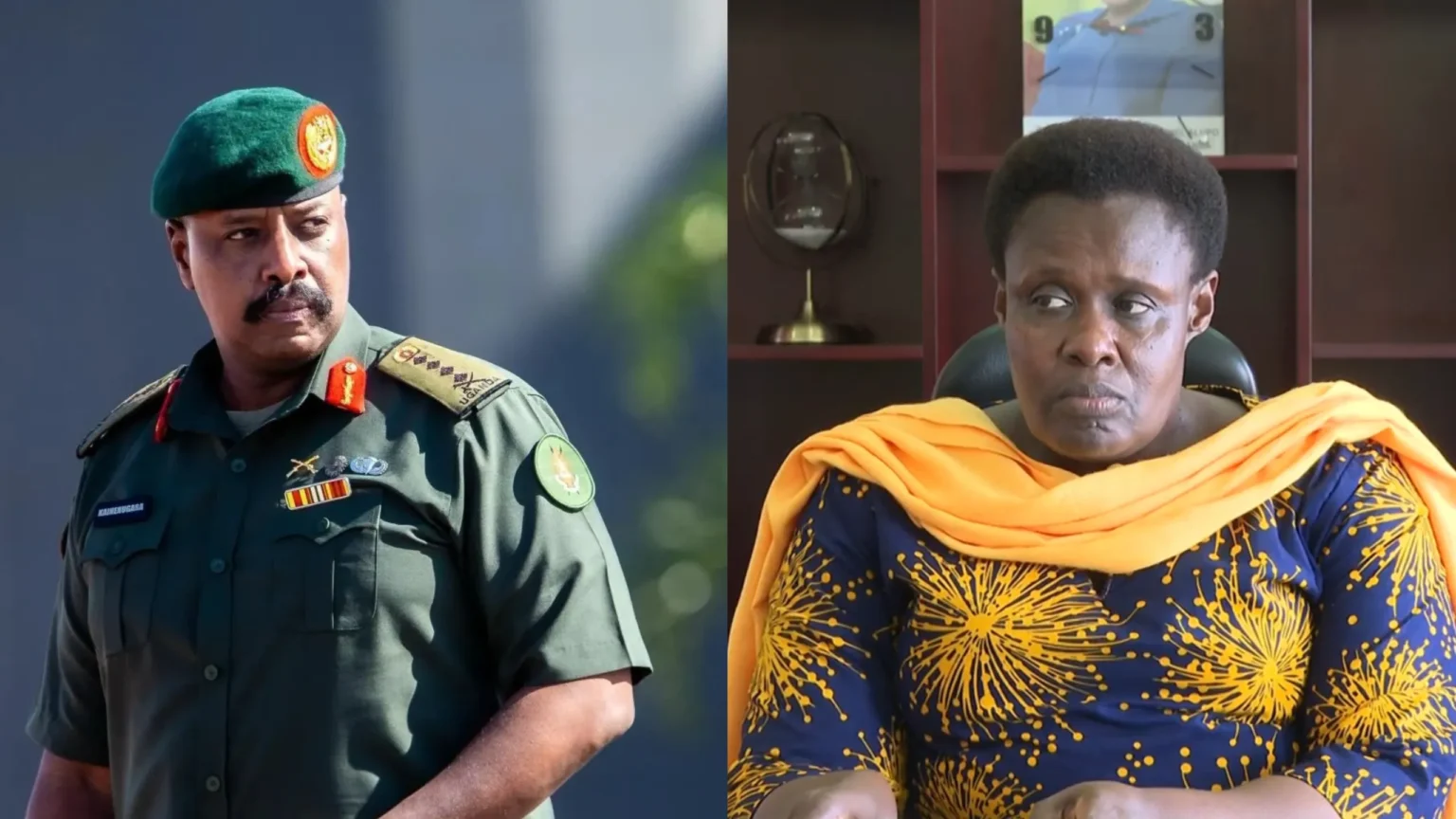
KAMPALA, Uganda — Uganda’s Chief of Defence Forces (CDF), Gen Muhoozi Kainerugaba, has once again found himself at the centre of a political controversy after launching a series of extraordinary public attacks against Vice President Jessica Alupo before his official X account became inaccessible on Tuesday, November 10, 2026.
The military chief’s remarks, published on Monday evening, November 9, went beyond ordinary political criticism. He questioned Alupo’s loyalty to President Yoweri Museveni, demanded that she prepare to leave the vice presidency and suggested that he could take over the position.
In one of his posts, Gen Muhoozi declared that whoever occupied the Vice Presidency should prepare to hand over the office. He subsequently suggested that government would operate on military terms if he assumed the position, promising to address what he described as inefficiency.
He also accused Alupo of supporting former Prime Minister Amama Mbabazi during the 2015–2016 presidential contest against Museveni, describing her alleged political conduct as disloyalty.
In another particularly contentious statement, he invoked his claimed support in the Teso region, where Alupo comes from, suggesting that he did not need to depend on people he considered traitors.
The statements attracted attention because they came from an individual who is not simply a political commentator but the serving head of Uganda’s armed forces and the son of the country’s president.
Hours later, his X account, @mkainerugaba, was no longer accessible.
Neither Gen. Muhoozi nor the government had provided an official explanation for the disappearance of the account at the time of reporting.
However, the timing has generated several political interpretations. Although none can be established as his actual motivation without further evidence, five possible explanations deserve examination.
1. Constitutional authority: Could Alupo influence Gen Muhoozi’s position as CDF?
One interpretation is that Gen Muhoozi may have recognised the constitutional implications of publicly challenging the Vice President, particularly given the relationship between the presidency and the military command structure.
However, the suggestion that Jessica Alupo could constitutionally dismiss him from his position as CDF requires an important correction.
Under Article 98(1) of Uganda’s Constitution, President Yoweri Museveni is the Commander-in-Chief of the Uganda People’s Defence Forces (UPDF).
The Vice President, under Article 108, deputises for the President when necessary and performs other responsibilities assigned by the President or the Constitution.
The Constitution does not independently give the Vice President the power to appoint or dismiss the CDF.
Furthermore, Section 7 of the Uganda People’s Defence Forces Act places the appointment of the CDF within the authority of the Commander-in-Chief.
Consequently, Alupo cannot independently remove Gen Muhoozi from military command simply by exercising her office as Vice President.
Nevertheless, the political relationship between the two offices is more complicated than their constitutional responsibilities suggest.
The Vice President occupies the second-highest position in Uganda’s executive hierarchy. Her relationship with the President, influence within the ruling National Resistance Movement (NRM) and access to the country’s political leadership could potentially matter in any discussions concerning military leadership.
Gen Muhoozi’s public confrontation with Alupo therefore risks turning what could have remained a personal or political disagreement into a broader question of institutional discipline.
The ultimate authority over his military appointment, however, rests with the President, not the Vice President.
2. The risk of confronting a former military officer
Another possible explanation concerns Alupo’s military background.
It would be inaccurate to describe her as a retired General. She is a former military officer, reported to have retired with the rank of Major, and has previously served in military intelligence and instructional roles.
Her background distinguishes her from civilian politicians who have never served in the armed forces.
Having served in military structures, Alupo understands the importance of hierarchy, discipline, command responsibilities and the political sensitivity surrounding the armed forces.
This makes a public confrontation between the country’s serving military chief and a former military officer occupying the vice presidency particularly significant.
It also creates an uncomfortable political situation for the presidency.
The question is not necessarily whether Alupo commands a personal military following capable of challenging Muhoozi. There is no established evidence of such an organised force.
Rather, the concern is that publicly humiliating a senior constitutional officeholder with military experience could generate resentment among political and military figures who consider institutional respect important.
Uganda’s military history also makes any suggestion of a confrontation involving influential military figures particularly sensitive.
The country has experienced several political transitions in which military institutions played decisive roles, including the 1971 coup that brought Idi Amin to power and the 1986 military victory that established Museveni’s government.
These historical experiences make responsible management of relations between civilian political institutions and military leadership essential.
There is, however, no verified evidence that Alupo is preparing to mobilise military personnel against Muhoozi.
3. The Teso factor: A politically sensitive confrontation
Muhoozi’s reference to Teso could be among the most politically consequential aspects of his statements.
Jessica Alupo comes from Katakwi District in the Teso sub-region of eastern Uganda.
By invoking his alleged support in Teso while questioning Alupo’s loyalty, Muhoozi introduced a regional dimension into what had initially appeared to be a personal political confrontation.
His suggestion that he had sufficient support in the region to disregard people he considered disloyal raises questions about the political calculations behind his remarks.
Teso is not simply a geographical reference in this dispute. It is Alupo’s political and social home region, where her position as Vice President carries symbolic and political significance.
An attack on a senior leader from a particular region can potentially be interpreted more broadly than an ordinary disagreement between two politicians.
It could generate questions about regional representation, political respect and the treatment of leaders from communities that support the ruling establishment.
For Muhoozi, publicly suggesting that he enjoys sufficient support in Teso may have been intended to demonstrate political confidence.
However, it could also create the opposite effect by alienating people who regard the Vice President as an important representative of their region.
The possibility of regional backlash therefore deserves consideration.
Nevertheless, there is no verified evidence that Teso residents had organised a political or security response against Muhoozi by the time his account disappeared.
His reference to regional support should also not be confused with evidence of an organised political or military movement.
The more important question is whether the confrontation could damage the NRM’s political relationships in a region where Alupo has considerable political significance.
4. Pressure from within the NRM
Perhaps one of the more compelling political explanations concerns the possibility of pressure from within the ruling National Resistance Movement.
Muhoozi’s increasingly prominent public role has occasionally generated discomfort within the ruling establishment, particularly among senior politicians and members of the military generation that participated in the struggle that brought Museveni to power.
This tension is not entirely new.
In October 2022, Muhoozi triggered a diplomatic crisis after threatening on X that he and the Ugandan army could capture Nairobi within two weeks.
The remarks attracted widespread condemnation in Kenya and forced Museveni to publicly apologise.
The President subsequently removed Muhoozi from his position as Commander of Land Forces, although he simultaneously promoted him to the rank of full General.
The incident demonstrated that Muhoozi’s social media statements could generate consequences extending beyond his personal political reputation.
They could affect Uganda’s diplomatic relations and create difficulties for the government.
In September 2024, Uganda’s Parliament also became involved in a controversy surrounding his public political statements.
According to the Uganda Broadcasting Corporation, Parliament declined to treat the General’s remarks as an official government position and directed that concerns raised by legislators be handled by the relevant ministries.
The controversy intensified in December 2024 when government spokesperson Ofwono Opondo publicly questioned the appropriateness of the CDF making provocative statements on social media.
He argued that a serving military chief occupied an exceptionally sensitive position and should not engage in casual public commentary.
These incidents demonstrate that concerns about Muhoozi’s public conduct have previously extended beyond opposition politicians.
There is therefore a reasonable basis for considering whether his latest confrontation with Alupo could have generated discomfort among senior NRM figures.
The Vice President is part of the country’s established political leadership, and publicly demanding her removal could be interpreted as challenging the existing political arrangement.
For a ruling party that has maintained power since 1986, internal cohesion and the management of succession politics are particularly important.
However, there is no confirmed evidence that the NRM leadership instructed Muhoozi to deactivate his account or issued him a specific warning following the November 9 posts.
The possibility of internal pressure remains an interpretation rather than an established explanation.
5. Fear of being called to order
Another possible explanation is that Muhoozi may have decided to withdraw from the platform after recognising the political consequences of his statements.
His position as CDF places him in a different category from ordinary political activists.
Military commanders are expected to maintain discipline, respect institutional boundaries and avoid statements that could be interpreted as official military policy without authorisation.
When a serving military chief publicly threatens the removal of a Vice President, the distinction between personal political opinion and institutional authority becomes particularly important.
The question becomes even more sensitive when the individual making the statements also happens to be the President’s son.
This creates a potential conflict between family influence, political ambitions and the formal responsibilities of military office.
Muhoozi’s previous experiences provide useful context.
In January 2025, he deactivated his X account after publishing controversial statements threatening opposition leader Robert Kyagulanyi, popularly known as Bobi Wine.
He cited the need to concentrate on his military responsibilities.
He returned to the platform six days later.
He had also withdrawn from X in 2022 following controversy surrounding his statements about Kenya.
The repeated pattern suggests that temporarily leaving the platform has become one of the ways Muhoozi has responded to periods of intense public controversy.
His latest disappearance could therefore represent another attempt to reduce public scrutiny, prevent further escalation or create room for political consultations.
But it would be premature to conclude that he was ordered to withdraw.
Without a statement from Muhoozi, the military or the presidency, the reason remains unknown.
Lessons from previous incidents involving military commanders
The controversy also raises a wider question about the relationship between military command and civilian political authority.
There are documented international examples of military commanders facing consequences after publicly challenging civilian leadership.
One notable case occurred in the United States in June 2010.
General Stanley McChrystal, then commander of US and NATO forces in Afghanistan, was forced to leave his position after comments published in Rolling Stone magazine exposed disparaging remarks about senior civilian officials in President Barack Obama’s administration.
The comments were considered incompatible with the relationship between military command and civilian leadership.
President Obama accepted McChrystal’s resignation and appointed General David Petraeus to replace him.
Although the American political and constitutional system is different from Uganda’s, the incident illustrates an important principle: senior military commanders are not politically independent of the civilian authority under which they serve.
A military officer’s rank does not provide unlimited freedom to publicly undermine the political leadership.
Uganda has also experienced similar tensions involving Muhoozi himself.
The 2022 Kenya controversy remains particularly instructive.
Following his threats to capture Nairobi, Museveni publicly apologised to Kenya and emphasised that public officers, whether civilian or military, should not interfere in the affairs of neighbouring countries.
Muhoozi was removed as Commander of Land Forces, although he was simultaneously promoted.
In January 2025, his threats against Bobi Wine generated further concern, with Reuters reporting that the opposition leader took the statements seriously.
The episode was followed by another departure from X.
These incidents establish a documented pattern of controversy surrounding Muhoozi’s public statements. They do not, however, establish why he deactivated his account on November 10, 2026.
The bigger question: Is Uganda entering a new phase of succession politics?
Perhaps the most important context surrounding the latest confrontation is Uganda’s continuing succession debate.
Museveni has governed Uganda since 1986, making the question of who will eventually succeed him an increasingly important political issue.
Muhoozi has repeatedly attracted attention over his political ambitions, with supporters associated with the MK Movement publicly promoting his potential leadership.
His military position, family connection to the President and growing political visibility have made him a central figure in discussions about the country’s future leadership.
Also Read: Museveni proposes son Muhoozi as successor at NRM NEC meeting
His November 9 remarks are particularly significant because he did not merely criticise Alupo’s performance.
He openly discussed taking over the vice presidency and suggested that the government would operate under military-style management.
That language raises questions about how Muhoozi views the relationship between military authority and political office.
The vice presidency is a constitutional position, not a military appointment. Under Article 108, the President appoints the Vice President subject to parliamentary approval.
The office can become vacant if the President revokes the appointment, the incumbent resigns or dies.
Muhoozi, therefore, cannot constitutionally install himself as Vice President through a public declaration.
His remarks instead expose the tension between the formal constitutional process and the influence that powerful political and military figures may exercise within Uganda’s political system.
They also raise questions about whether the NRM has a clear and broadly accepted framework for managing succession beyond Museveni.
The controversy could become more consequential if senior members of the ruling party begin taking sides or if disagreements over political succession spill into military institutions.
For now, there is insufficient evidence to conclude that a major internal confrontation is underway.
What Muhoozi’s X deactivation could mean
The disappearance of Muhoozi’s X account should not automatically be interpreted as evidence of a political defeat, an internal rebellion or an official disciplinary intervention.
However, its timing is politically significant.
The General had made unusually direct statements against a serving Vice President, invoked regional political support and suggested that he could assume her constitutional office.
His subsequent withdrawal from the platform came against a background of previous controversies involving foreign governments, opposition leaders and Uganda’s own political establishment.
The most plausible explanations include an attempt to contain the political damage, possible concerns about institutional discipline, pressure from influential political figures or a personal decision to avoid further escalation.
These explanations are not mutually exclusive.
Ultimately, the decisive question is not simply why Muhoozi deactivated his X account.
It is whether the latest confrontation will prompt President Museveni and the NRM leadership to draw clearer boundaries between military command, political ambition and constitutional authority.
For a country whose political history has been deeply shaped by the military, how this dispute is handled could have implications extending well beyond one social media account.