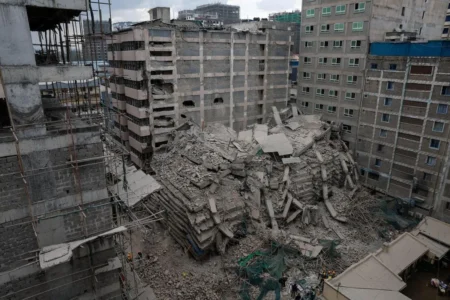






NAIROBI, Kenya — Nairobi Governor Johnson Sakaja has called for tougher penalties against developers who violate construction regulations, renewing his push for county governments to regain prosecutorial powers following the collapse of an incomplete multi-storey building in Eastleigh.
Sakaja said existing penalties were insufficient to deter construction violations, warning that developers who disregard approved building plans and safety standards put lives at risk.
Speaking at the collapse site along 1st Avenue, 9th Street, on Friday, October 23, the governor said Nairobi County had formally petitioned the Office of the Director of Public Prosecutions (ODPP) to consider restoring prosecutorial powers to county governments.
“We have formally written to the Office of the Director of Public Prosecutions, and we hope our request will be considered. Counties must be empowered to take firm action against rogue developers who disregard building regulations and put lives at risk,” Sakaja said.
He questioned the deterrent effect of existing penalties, arguing that some developers convicted of construction-related offences could face fines as low as KSh5,000.
“Even when such offenders are arrested and taken to court, the penalties can be as low as Sh5,000, which is not a sufficient deterrent,” he said.
The governor argued that stronger enforcement and more substantial penalties were necessary to ensure developers comply with construction requirements and prevent avoidable loss of life.
Sakaja raises concerns over professional oversight
The governor also urged professional associations representing architects, engineers and quantity surveyors to investigate cases in which qualified professionals are removed from construction projects after securing county approvals.
He alleged that some developers engage qualified professionals to obtain building permits but later dismiss them and continue construction without the required technical oversight.
Sakaja called on the professional bodies to work with county authorities to identify projects where the withdrawal of architects, engineers or quantity surveyors may have compromised compliance with approved designs and safety standards.
He said professionals found to have breached their obligations should face appropriate disciplinary action.
The concerns place renewed focus on the responsibilities of developers and construction professionals throughout a project, including ensuring that work follows approved plans and applicable safety requirements.
However, the specific circumstances surrounding the Eastleigh building’s collapse, including whether professional oversight was withdrawn, had not been established in the information provided by the county.
Occupation certificates under scrutiny
Sakaja stressed that developers must obtain the necessary county approvals, engage qualified professionals and adhere to approved construction plans.
He also emphasised that buildings should not be occupied before the required inspections have been completed and an occupation certificate issued.
The issue has particular significance in Eastleigh, where the building was still under construction when it collapsed, with the ground floor reportedly occupied at the time.
The circumstances have raised questions about how the premises were being used while construction continued and whether the relevant safety and occupancy requirements had been met.
The collapse has intensified scrutiny of Nairobi’s building approval and inspection processes, although the cause of the incident remained undetermined in the information provided.
Multi-agency teams continue response
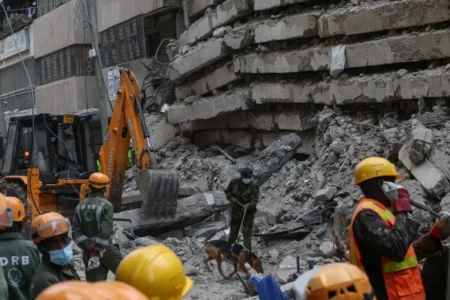
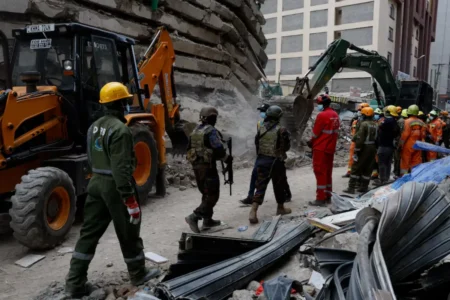
The collapse triggered a multi-agency search and rescue operation amid fears that people could be trapped beneath the rubble.
Nairobi City County emergency response teams were working alongside the National Disaster Operations Centre, the Kenya Red Cross, the Kenya Defence Forces and other agencies.
Heavy machinery was deployed to remove debris and open access to areas where victims might be trapped, while additional resources were mobilised to support rescue efforts.
Also Read: Eastleigh building collapse: Workers recount desperate escape as structure came down
Sakaja said county health teams were on standby to provide medical assistance to anyone rescued from the site.
He also urged families and members of the public with information about missing people to report to designated centres established by the response teams.
The public was advised to share information through the county emergency hotlines, 1508 and 1199.
Push to strengthen enforcement
Sakaja said restoring prosecutorial powers to county governments, strengthening collaboration with professional bodies and imposing more effective penalties would improve compliance with building regulations.
His proposal comes amid renewed questions about whether existing enforcement mechanisms are sufficient to hold developers and other responsible parties accountable when construction requirements are breached.
Any restoration of prosecutorial powers would, however, need to operate within Kenya’s constitutional and statutory framework governing criminal prosecutions.
As rescue teams continue responding to the Eastleigh collapse, investigations into the circumstances of the incident will be central to determining whether construction or occupancy rules were breached and whether any individuals or institutions should be held accountable.