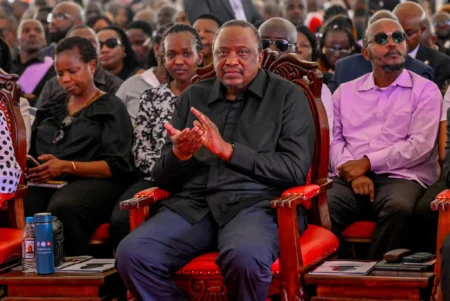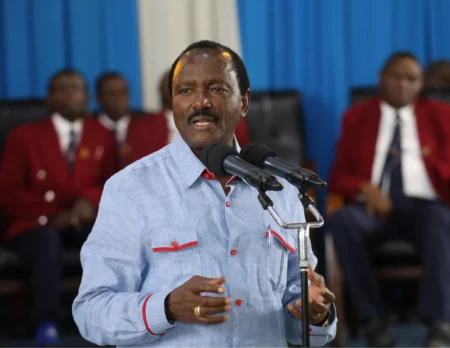





NAIROBI, Kenya — Former President Uhuru Kenyatta has resigned as chairperson of the Azimio la Umoja One Kenya Coalition, weeks after handing over the leadership of the Jubilee Party to former Interior Cabinet Secretary Fred Matiang’i.
Kenyatta announced the decision in a letter dated October 5, saying his resignation took effect immediately following the formal handover of Jubilee Party leadership.
He, however, made clear that leaving the coalition’s formal leadership structure did not amount to abandoning the political organisation.
“Following the official handover of the Jubilee Party Leadership, I am writing to formally resign from my leadership position within the Azimio La Umoja Coalition, effective immediately,” Kenyatta said.
He described the move as part of the wider renewal of democratic institutions rather than a break with the coalition.
“This decision is not a departure from our shared political journey, but a necessary step in the continuous renewal of our democratic institutions,” he said.
Kenyatta’s resignation comes at a significant moment for the opposition coalition, which changed its name from Azimio la Umoja One Kenya Coalition to The Ukombozi Alliance (TUA) in September.
Wiper leader Kalonzo Musyoka announced the rebranding on September 21, saying the decision had been unanimously agreed upon by the coalition’s leadership. At the time, Kenyatta was initially presented as chairman of the rebranded alliance.
Jubilee handover sets transition in motion
Kenyatta’s departure from the Azimio leadership followed his September 22 handover of the Jubilee Party leadership to Matiang’i.
At the time, Kenyatta said he would remain a member of Jubilee and serve in a senior advisory capacity, while Matiang’i took over the party leadership pending formalisation through the National Delegates Convention.
“I will not leave Jubilee. I have decided that I will remain as a senior adviser and a senior member of Jubilee,” Kenyatta said during the handover.
Matiang’i, who had been Jubilee’s deputy party leader, accepted the transition and subsequently began public engagements under his new role.
By early October, he was touring the Coast, meeting party aspirants and outlining his plans for the party as it prepares for the 2027 General Election.
The transition marked the end of Kenyatta’s formal leadership of Jubilee after years of internal disputes over control of the party.
Jubilee had endorsed Matiang’i as its presidential candidate in October 2025, when he was appointed deputy party leader.
Two High Court rulings complicate the legal picture
Kenyatta’s Jubilee exit also came against the backdrop of conflicting High Court decisions over the political rights of retired presidents.
On September 14, Justice Lawrence Mugambi upheld Section 6 of the Presidential Retirement Benefits Act, which states that a retired president cannot hold office in a political party for more than six months after leaving the presidency.
The ruling did not bar retired presidents from remaining party members or participating in political activities.
A week later, however, Justice Bahati Mwamuye reached a different conclusion.
In a September 21 judgment, Mwamuye declared Section 6 unconstitutional and void, ruling that retirement from the presidency does not remove a former head of state’s constitutional political rights.
The conflicting decisions mean the legal position has been contested within the High Court itself, rather than settled by one judgment overruling the other.
Kenyatta had already proceeded with the Jubilee leadership transition before the second ruling was delivered.
His subsequent resignation from the Azimio leadership therefore comes despite the later judgment that struck down the restriction on retired presidents holding party office.
No leadership vacuum, Kalonzo says
Kalonzo has sought to draw a distinction between Kenyatta’s former position and his own role within the rebranded coalition.
In a statement responding to the resignation, Kalonzo said there was no leadership vacuum within TUA and that the coalition’s political direction and operations remained unchanged.
“There is no vacuum at the helm of Ukombozi, and no change in the party’s leadership, direction or programme,” Kalonzo said.
He said the chairperson of the coalition council and the party leader are separate offices.
According to Kalonzo, the chair operates at council level, providing convening, guidance and counsel, while the party leader is responsible for the organisation’s political and executive affairs.
Kalonzo therefore remains the political and executive head of the coalition despite Kenyatta’s resignation from the council leadership.
Kalonzo also said Kenyatta would remain a member of the coalition and would continue to be available to offer counsel.
He said TUA would invite the former president for an official visit at which a formal handover ceremony would be held.
Rebrand reshapes opposition coalition
The resignation also comes less than three weeks after Azimio formally adopted the Ukombozi Alliance name.
The rebranding was presented by Kalonzo as part of efforts to reorganise the opposition ahead of the 2027 election.
The new structure has since generated discussions over its leadership, membership and relationship with other opposition formations.
Reports following the September rebrand indicated that Siaya Governor James Orengo had replaced Kenyatta as chairman of the coalition council. Other reports subsequently focused on possible approaches to leaders including former Deputy President Rigathi Gachagua and Orengo.
The leadership picture was further clarified by Kalonzo after Kenyatta’s resignation, with the Wiper leader insisting that his own position as party leader remained unaffected.
Uhuru says he remains part of the political journey
Despite relinquishing his formal position, Kenyatta said he remained committed to the coalition.
He described Azimio as an organisation founded around bringing together Kenya’s political diversity while advancing democracy and national development.
He also argued that political parties could retain their individual identities while pursuing common objectives through a coalition.
“A coalition is not merely a temporary alliance of convenience; it is a permanent covenant of conviction,” he said.
Kenyatta said he would continue supporting the organisation from outside its formal leadership structure.
Also Read: Uhuru signals willingness to hand over Jubilee Party leadership after court ruling
“I remain, as always, a committed member of the Azimio family, ready to support the institution from the ranks, and always available to offer counsel when called upon,” he said.
The wording leaves his future political involvement open while clearly separating membership and political participation from formal coalition leadership.
For TUA, the immediate task is now to consolidate its new organisational structure after the Azimio rebrand, while managing relations among constituent parties and other opposition formations.
For Jubilee, Matiang’i has taken over day-to-day political leadership as the party prepares for its National Delegates Convention and the next phase of its 2027 preparations.
Kenyatta, meanwhile, has moved from holding formal leadership positions in both institutions to a less defined role as a party member, adviser and political figure.
His resignation therefore marks another stage in the restructuring of the opposition landscape — but not necessarily an end to his association with it.